
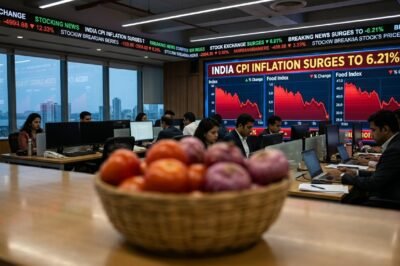
The Indian economy has hit a turbulent patch as retail inflation, measured by the Consumer Price Index (CPI), surged to a 14-month high of 6.21 percent in October. This significant jump represents a departure from the relatively stable price environment observed earlier in the year and, more critically, it marks a breach of the Reserve Bank of India’s (RBI) upper tolerance limit of 6 percent. For policymakers and the common citizen alike, this development serves as a stark reminder of the volatile nature of the domestic market, particularly when it comes to essential commodities. The surge from September’s 5.49 percent to the current 6.21 percent has been sharper than most economists anticipated, effectively slamming the door on any immediate hopes for a domestic interest rate cut. As the festive season concludes, the reality of high costs is setting in, casting a shadow over consumption patterns and the broader macroeconomic outlook. This inflationary spike is not merely a number on a spreadsheet; it represents a tangible pressure on the purchasing power of millions, necessitating a deep dive into the underlying factors that have propelled prices to these heights.
The Statistical Breakdown: Beyond the Headline Numbers
When analyzing the latest data from the Ministry of Statistics and Programme Implementation (MoSPI), it becomes clear that the rise in inflation is not uniform across all sectors. However, the sheer weight of food prices has dragged the entire index upward. The Consumer Food Price Index (CFPI) recorded an inflation rate of 10.87 percent in October, compared to 9.24 percent in September. This double-digit growth in food inflation is the highest seen in over a year and is the primary driver behind the overall CPI breach. In rural areas, the inflation rate stood at 6.68 percent, while urban inflation was slightly lower at 5.62 percent, highlighting the disproportionate impact on the agrarian and rural economy where food expenditure forms a larger share of the household budget.
Core inflation, which excludes the volatile food and fuel categories, has also shown signs of a gradual uptick. While it remains relatively contained compared to the headline figure, the upward trend in services and manufactured goods suggests that inflationary pressures are beginning to seep into the broader economy. This ‘stickiness’ in core inflation is particularly concerning for the Reserve Bank, as it indicates that the price rise is not entirely temporary or restricted to seasonal vegetable spikes. The year-on-year increase in the ‘clothing and footwear’ and ‘housing’ sectors further complicates the narrative, suggesting a multi-faceted inflationary environment.
The Vegetable Crisis: A Primary Driver of the Surge
The most dramatic contributor to the October inflation spike has been the astronomical rise in vegetable prices. On a year-on-year basis, vegetable inflation soared by a staggering 42.18 percent. Essential staples such as tomatoes, onions, and potatoes, often referred to as the TOP trinity in Indian kitchens, have seen prices double or even triple in various retail markets across the country. Unseasonal rains in key producing states like Maharashtra, Karnataka, and Andhra Pradesh disrupted the harvest cycle and damaged standing crops, leading to a severe supply-side crunch. The delay in the arrival of the fresh kharif crop exacerbated the situation, creating a vacuum in the market that wholesalers were quick to exploit.
Beyond vegetables, other items in the food basket have also maintained a high trajectory. Oils and fats saw an inflation rate of 9.51 percent, a significant jump from previous months, partly driven by the government’s decision to increase import duties on edible oils to support domestic farmers. Pulses and products continued to remain in the high single digits, while the prices of fruits and milk showed moderate but persistent increases. The cumulative effect of these rising costs has made the ‘thali’ significantly more expensive for the average Indian family, forcing a reallocation of disposable income away from discretionary spending and toward essential sustenance.
Impact on the Reserve Bank of India’s Monetary Policy
The breach of the 6 percent ceiling carries heavy implications for the RBI’s upcoming Monetary Policy Committee (MPC) meeting in December. For several months, the central bank has maintained a ‘withdrawal of accommodation’ stance, eventually shifting to a ‘neutral’ stance in the last meeting. However, Governor Shaktikanta Das has repeatedly cautioned that the ‘inflation elephant’ is yet to return to the forest permanently. With the latest reading exceeding the mandate’s upper bound, the prospect of a repo rate cut in the near term has effectively vanished. Markets that were pricing in a 25-basis point cut in December must now reconcile with a ‘higher-for-longer’ interest rate regime.
The RBI is mandated to keep inflation at 4 percent, with a tolerance band of 2 percent on either side. A breach above 6 percent for three consecutive quarters would require a formal explanation to the government; while this is currently just a single-month breach, the trajectory is worrying. The central bank must now balance the need to support economic growth with the imperative to anchor inflation expectations. If inflation remains above the target for prolonged periods, it risks becoming entrenched, leading to wage-price spirals that are far harder to control. Consequently, the MPC is likely to maintain a hawkish tone, emphasizing price stability over immediate growth stimuli.
Household Budgets and Consumer Sentiment
The real-world impact of a 6.21 percent inflation rate is most visible in the cooling of consumer sentiment. While the festive season typically sees a surge in spending, the high cost of living has tempered the enthusiasm of the middle and lower-income strata. When a significant portion of the monthly budget is consumed by skyrocketing prices for onions and tomatoes, there is little left for high-value purchases like electronics, automobiles, or apparel. FMCG companies have already begun flagging a slowdown in urban demand, noting that consumers are opting for smaller pack sizes or shifting to cheaper unbranded alternatives to manage their expenses.
Furthermore, the persistent nature of high food inflation acts as a ‘regressive tax’ on the poor. For a family earning a subsistence wage, a 40 percent increase in vegetable prices is not a statistical fluctuation but a nutritional crisis. The psychological impact of breaching the 6 percent mark cannot be understated, as it erodes confidence in future financial stability. If consumers expect prices to continue rising, they may further pull back on spending, creating a feedback loop that could potentially slow down the GDP growth rate in the coming quarters. This makes the government’s supply-side interventions, such as the subsidized sale of Bharat Atta and Bharat Dal, more critical than ever.
Comparative Global Context and Macroeconomic Pressures
India is not alone in its struggle with inflation, but the drivers here are uniquely domestic. While many Western economies are seeing inflation cool down toward their 2 percent targets, India’s surge is heavily tied to its agricultural supply chain and monsoon patterns. However, external factors cannot be ignored. The strengthening of the US Dollar and the volatility in global crude oil prices due to geopolitical tensions in the Middle East add another layer of complexity. Since India imports a vast majority of its energy requirements, any spike in international oil prices quickly translates into higher transportation and logistics costs, adding to the inflationary pressure on all goods.
The divergence between India’s inflation path and the global trend of easing interest rates puts the RBI in a difficult position. If the US Federal Reserve continues to cut rates while the RBI remains on hold, the interest rate differential could lead to increased capital inflows, potentially appreciating the Rupee but also complicating liquidity management. Conversely, if the RBI is forced to hike rates to combat runaway inflation, it could stifle the nascent recovery in private investment. The global macroeconomic environment remains fragile, and India must navigate this period of high domestic inflation with a combination of prudent fiscal management and agile monetary policy.
Conclusion: Navigating the Path Ahead
The October inflation report serves as a wake-up call for the Indian economy. While the surge is largely driven by seasonal and weather-related factors in the food category, the breach of the RBI’s upper limit demands immediate attention. In the short term, the arrival of the fresh winter harvest should provide some relief, particularly in the prices of vegetables and fruits. However, structural issues in the agricultural supply chain, including inadequate cold storage and fragmented marketing, continue to make the economy vulnerable to such shocks. The government must double down on supply-side measures to ensure that essential commodities reach the markets efficiently and that hoarding is kept in check.
Looking forward, the medium-term outlook for inflation will depend on the persistence of core inflation and the stability of global energy prices. For the Reserve Bank, the path to the 4 percent target remains arduous and full of pitfalls. Investors and consumers must brace for a period where high interest rates remain the norm, as the central bank prioritizes price stability to ensure sustainable long-term growth. As we move into the final quarter of the fiscal year, the focus will remain squarely on how quickly the ‘inflation elephant’ can be coaxed back into the forest, and whether the Indian economy can maintain its growth momentum amidst these mounting cost pressures.






































Leave a Reply