
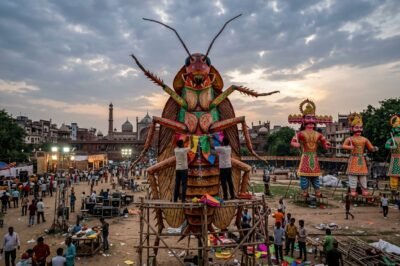
In the heart of India’s capital, where the dust of history mingles with the frantic pace of modern urbanization, the annual spectacle of Ramlila has long served as a cathartic medium for the triumph of good over evil. This year, however, the skyline of the Ramlila Maidan is set to feature a jarring and peculiar silhouette alongside the traditional multi-headed Ravan. A towering 30-foot effigy of a cockroach has been constructed, standing as a visceral metaphor for the persistent and resilient ‘social pests’ that plague contemporary society. As the festive fervor of Dussehra reaches its crescendo, this unconventional addition marks a significant shift in how cultural festivals are being utilized as platforms for civic discourse and socio-political commentary. Traditionally, the burning of Ravan, Kumbhkaran, and Meghnad symbolized the destruction of ego, greed, and lust. By introducing a giant insect into this mythological pantheon, organizers are tapping into a collective frustration with systemic issues that are often seen as ‘infestations’ rather than mere flaws. The move has sparked intense debate among traditionalists and modernists alike, highlighting the evolving nature of public performance in India’s most densely populated urban centers.
The Evolution of Effigy Burning: From Mythology to Modern Metaphor
The practice of Ravan Dahan is deeply rooted in the Ramayana, signifying the victory of Lord Rama over the demon king of Lanka. For decades, the effigies have remained relatively static in their symbolism. However, the socio-economic landscape of Delhi has undergone a metamorphosis, and with it, the expectations of the audience have shifted. The decision to include a 30-foot cockroach is not merely a creative whim but a calculated move to resonate with the modern urban dweller who faces daily battles with corruption, administrative neglect, and the literal and metaphorical filth of the city. Historically, Ramlila committees have occasionally experimented with topical effigies—burning figures representing terrorism, inflation, or specific diseases like COVID-19. The cockroach, however, represents a more nuanced form of evil: the kind that thrives in the dark, survives against all odds, and multiplies when ignored.
Artisans from various parts of the country, many of whom have spent generations perfecting the craft of effigy making, have had to adapt their techniques to create this massive insectoid structure. The use of bamboo frames, layered paper, and specialized pyrotechnics remains the same, but the anatomical challenge of a 30-foot cockroach requires a different structural integrity compared to the humanoid Ravan. This evolution in craftsmanship reflects a broader trend in Indian festivals where the medium remains traditional but the message becomes increasingly contemporary. It is a testament to the flexibility of Hindu festivals, which have historically absorbed local flavors and societal concerns to remain relevant across centuries.
Symbolism of the Cockroach: Why This Specific Pest?
In the lexicon of urban psychology, the cockroach is often associated with resilience, filth, and the uncanny ability to survive in the most inhospitable environments. By choosing this creature, the Ramlila organizers are targeting the ‘unseen’ evils of society. In a financial and political hub like Delhi, these evils often manifest as bureaucratic red tape, the ‘hidden’ costs of public services, and the persistence of unhygienic conditions despite numerous government campaigns. The cockroach symbolizes a lack of accountability; it is the pest that scatters when the light is turned on, much like corrupt practices that hide in the shadows of complex legalities. This symbolic choice has resonated with a public that is increasingly cynical about ‘quick fixes’ to long-standing systemic problems.
Furthermore, the cockroach represents a psychological ‘othering’ of negative traits. Just as the ten heads of Ravan represent ten negative attributes of the human psyche, the giant insect represents the externalized decay of the civic environment. It serves as a visual manifestation of the ‘nuisances’ that the average citizen deals with—from the literal lack of sanitation to the metaphorical pestilence of misinformation and social disharmony. By burning this effigy, the public partakes in a collective ritual of cleansing, hoping that the flames will not just consume the paper and wood, but also provide a momentary sense of victory over the seemingly indestructible problems of modern life.
Logistics and Artistry: Building the 30-Foot Insect
The construction of a 30-foot cockroach is a feat of vernacular engineering. Unlike the vertical, symmetrical structure of a Ravan effigy, the cockroach requires a horizontal emphasis with articulated legs and antennae that can withstand the wind and weight. The Shri Dharmik Leela Committee, one of the oldest and most prestigious organizers in Delhi, has overseen the meticulous planning required for this project. They employed dozens of workers who worked around the clock to ensure that the effigy is not only visually striking but also safe for the massive crowds that gather at the venue. The materials used—primarily eco-friendly paper, crackers with low sulfur content, and sustainable bamboo—reflect a growing consciousness regarding the environmental impact of these celebrations.
The artistry involves more than just size; it involves the ‘performance’ of the burn. Specialized firework designers have been consulted to ensure that the cockroach burns in a specific sequence, perhaps starting from the antennae and moving down to the core, symbolizing the systematic dismantling of a problem. This attention to detail serves to heighten the theatricality of the event, making it a viral-ready spectacle in the age of social media. The logistics also extend to the positioning of the effigy; placed alongside Ravan, it creates a visual dialogue between ancient myth and modern reality, forcing the spectator to draw parallels between the historical demon and the modern pest.
The Intersection of Culture and Civic Awareness
The introduction of the cockroach effigy is a prime example of ‘edutainment’—the blending of education and entertainment. In recent years, the Indian government’s emphasis on initiatives like the Swachh Bharat Abhiyan (Clean India Mission) has permeated popular culture. This effigy can be seen as an extension of that narrative, albeit from a grassroots level. It serves as a reminder that the battle for a ‘clean’ India is not just about physical waste but also about moral and administrative purity. By making the ‘evil’ something as relatable and detestable as a cockroach, the organizers are simplifying complex social issues for a mass audience, ensuring that the message hits home across different demographic strata.
Market analysts and social scientists view this as a strategic use of ‘cultural capital.’ Festivals like Ramlila attract millions of viewers, both in-person and through digital broadcasts. Utilizing this space to highlight civic grievances is a powerful tool for social mobilization. It bridges the gap between the sacred and the profane, suggesting that religious duty is not just about personal piety but also about collective civic responsibility. This trend is likely to influence other major festivals across India, where traditional motifs may increasingly be replaced or augmented by contemporary symbols to reflect the zeitgeist of the nation.
Economic and Social Impact of Modernized Ramlilas
The economic footprint of the Ramlila festival in Delhi is massive, involving thousands of small-scale vendors, security personnel, and artists. The addition of ‘viral’ elements like the giant cockroach serves as a significant draw for tourists and locals alike, increasing footfall and, consequently, the economic activity around the festival grounds. For the sponsors and organizers, these unique additions offer a competitive edge in a city where multiple Ramlilas vie for public attention. The ‘Cockroach vs. Ravan’ narrative creates a unique selling point that generates media coverage, social media engagement, and higher sponsorship valuations. From a business perspective, the modernization of traditional icons is a savvy move to capture the attention of a younger, tech-savvy generation that may find traditional narratives less engaging.
Socially, the event acts as a pressure valve for public frustration. In a city where air pollution, traffic congestion, and infrastructure failures are frequent points of contention, the ritualistic burning of a symbol representing these ‘pests’ provides a psychological release. It fosters a sense of community as thousands of people cheer for the destruction of the effigy. However, some critics argue that such spectacles might trivialize deep-seated issues, turning serious social problems into mere entertainment. Regardless of the stance, the sheer scale of the 30-foot insect ensures that the conversation around these issues remains in the spotlight, long after the embers have cooled.
Conclusion: Future Implications of Topical Effigies
The burning of a 30-foot cockroach alongside Ravan in Delhi is more than just a quirky news headline; it is a significant indicator of how Indian traditions are adapting to reflect the complexities of 21st-century life. As we look forward, it is clear that the boundary between cultural celebration and social activism is becoming increasingly blurred. Future Ramlilas may see even more radical departures from tradition as organizers seek new ways to maintain relevance and provoke thought. While the core message of the victory of light over darkness remains constant, the ‘darkness’ being fought is being redefined in the image of modern anxieties. This evolution ensures that the Ramlila remains a living, breathing part of India’s social fabric, capable of articulating the hopes and frustrations of its people in the language of fire and myth.




































Leave a Reply