
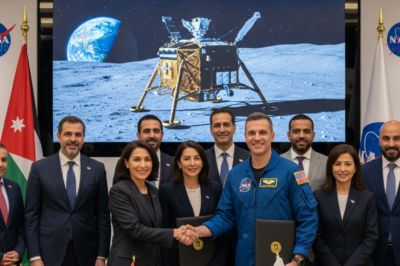
Jordan has officially entered a new era of diplomatic and scientific engagement by signing the NASA-led Artemis Accords, joining a global coalition dedicated to the peaceful, transparent, and sustainable exploration of space. This landmark move was finalized during a high-profile ceremony that saw the Hashemite Kingdom become the 37th nation to commit to these principles. By aligning with the Artemis program, Jordan is not only securing a seat at the table for future lunar discussions but is also positioning its domestic scientific sectors to benefit from unparalleled international cooperation. The signing ceremony, featuring NASA Administrator Bill Nelson and Jordanian representatives, highlights the deepening strategic partnership between the United States and Jordan, extending their terrestrial cooperation into the celestial realm. For Jordan, a country with a rich history of intellectual achievement and a growing interest in high-tech industries, the Accords provide a structured framework to transition from a consumer of satellite data to a participant in the missions that will eventually see the first woman and first person of color land on the Moon. This decision reflects a broader national strategy to diversify the economy, empower the youth through STEM (Science, Technology, Engineering, and Mathematics) education, and contribute to the collective knowledge of humanity as we venture further into the solar system.
The Genesis of the Artemis Accords: A Global Framework for the Lunar Frontier
The Artemis Accords were established by NASA in 2020, in coordination with the U.S. Department of State and several founding member nations. At their core, the Accords are built upon the foundation of the 1967 Outer Space Treaty, which has served as the bedrock of international space law for over half a century. However, as technology has advanced and the prospect of permanent lunar bases and resource extraction has moved from science fiction to reality, the need for more specific guidelines became apparent. The Accords represent a proactive effort to establish a common set of principles to govern civil space exploration, ensuring that as humanity returns to the Moon—this time to stay—we do so in a way that is safe, sustainable, and beneficial for all. These principles include the public release of scientific data, the establishment of safety zones to prevent harmful interference, and the commitment to mitigate orbital debris. For a nation like Jordan, these guidelines offer a clear roadmap for how to engage with more established space agencies without the need for an massive initial domestic launch infrastructure. By adhering to these norms, Jordan ensures that its future space activities are recognized as legitimate and peaceful by the international community. The framework covers essential aspects such as the registration of space objects and the deconfliction of activities, which are critical as the lunar surface becomes more crowded with robotic and human missions.
Jordan’s Strategic Entry: Why the Hashemite Kingdom is Looking to the Stars
Jordan’s decision to join the Artemis Accords is far from a spontaneous diplomatic gesture; it is a calculated component of the country’s long-term developmental goals. Under the leadership of His Majesty King Abdullah II, Jordan has consistently sought to modernize its economy by investing in human capital and technological innovation. The Royal Jordanian Geographic Centre (RJGC), which has long been the primary body for surveying and remote sensing in the country, will likely play a central role in this new chapter. By joining the Accords, Jordan aims to catalyze its domestic technology sector, encouraging startups and established firms to explore applications in satellite communications, remote sensing for agriculture, and even aerospace engineering. Furthermore, the psychological impact on the Jordanian youth cannot be overstated. In a region often characterized by terrestrial challenges, the prospect of participating in a lunar mission provides a powerful inspiration for students to pursue complex scientific fields. This “Artemis Generation” in Jordan will have access to data and collaborative opportunities that were previously out of reach, potentially leading to breakthroughs in water management, environmental monitoring, and urban planning using space-derived data. This shift towards a knowledge-based economy is vital for Jordan’s future stability and growth.
Technical and Scientific Opportunities: Bridging the Gap for Jordanian Engineers
One of the most tangible benefits of signing the Artemis Accords is the facilitation of scientific exchange. NASA and other signatory nations commit to sharing their scientific findings with the world, a practice that levels the playing field for smaller nations. For Jordanian researchers, this means access to high-resolution lunar mapping, data on the lunar regolith, and information regarding the presence of water ice at the Moon’s south pole. This data is invaluable for universities in Amman and beyond, allowing them to participate in international peer-reviewed research and contribute to the global understanding of the Moon’s geology. Moreover, the Accords emphasize interoperability—the development of common technical standards for everything from docking mechanisms to communication protocols. For Jordan’s emerging engineering sector, this presents an opportunity to design components or software that are compatible with international systems, opening up markets in the global space supply chain. Whether it is developing sensors for lunar rovers or creating AI algorithms for autonomous navigation, Jordanian engineers now have a framework that encourages their integration into the most ambitious missions of our time. This technical alignment also simplifies the process for Jordanian academic institutions to collaborate on payloads and experiments that could one day fly on NASA-led missions.
Regional Geopolitics: The Middle East’s Growing Influence in Space Exploration
Jordan’s signature on the Artemis Accords also highlights a significant shift in Middle Eastern geopolitics. The region is increasingly becoming a hub for space activity, with nations like the United Arab Emirates and Saudi Arabia making massive investments in their respective space agencies. The UAE’s Hope Probe mission to Mars and its own signature on the Accords demonstrated that Arab nations are ready to lead in high-science domains. Jordan’s entry into this group reinforces a regional consensus on the importance of peaceful space exploration. It also fosters a spirit of regional competition that is healthy and productive, driving improvements in educational standards and technological capabilities across the Middle East. By joining this international framework, Jordan also strengthens its ties with the West, particularly the United States, while maintaining its independent sovereign interests. The Accords provide a neutral platform for cooperation, where the focus is on scientific progress rather than political friction, potentially serving as a model for how nations in the region can collaborate on other complex issues like climate change and resource scarcity. This collective regional move toward space reflects a desire to move beyond oil-dependent or traditional economies toward high-value technical industries.
The Tenets of Peace: Upholding International Law in the New Space Race
A major concern for the international community as we move toward lunar settlement is the potential for conflict over territory or resources. The Artemis Accords address this by reinforcing the principle of peaceful purposes. All activities conducted under the Artemis umbrella must be non-military in nature and transparent to the global community. For Jordan, a nation that has consistently advocated for international law and stability, these tenets are a natural extension of its foreign policy. The Accords explicitly state that the extraction of space resources—such as mining lunar ice for rocket fuel—is not inherently national appropriation, which is prohibited by the Outer Space Treaty. Instead, it provides a legal framework for utilizing these resources to support long-term missions. By participating in this legal evolution, Jordan helps shape the norms that will govern the future of the solar system. The commitment to emergency assistance is another critical pillar; signatories agree to provide aid to astronauts in distress, regardless of their nationality. This humanitarian aspect of the Accords resonates with Jordan’s long-standing tradition of providing aid and refuge on Earth, extending that ethos into the final frontier. It ensures that the lunar surface remains a place of collaboration rather than a battleground for terrestrial rivalries.
Looking Ahead: The Road to the Moon and Beyond for Jordan
As Jordan moves forward as a signatory of the Artemis Accords, the next steps will involve deep integration into the international scientific community. We can expect to see increased bilateral agreements between NASA and Jordanian scientific institutions, possibly leading to the training of Jordanian personnel at NASA facilities. There is also the potential for Jordan to host regional space conferences, positioning itself as a diplomatic bridge between the established space powers and the emerging space nations of the Global South. The long-term vision of the Artemis program—establishing a sustainable presence on the Moon and using it as a stepping stone for Mars—now includes Jordanian aspirations. While the path to the stars is long and filled with challenges, Jordan’s commitment to the Accords ensures that it will not be left behind. The nation is now part of a collective journey to explore the unknown, answer fundamental questions about our place in the universe, and develop the technologies that will sustain life both on Earth and beyond. The signing of these Accords is not the end of a process, but the beginning of an era where the Jordanian flag may one day be associated with the greatest feats of human exploration. It is a signal to the world that Jordan is ready to contribute its unique perspective and talent to the ultimate frontier.
In conclusion, Jordan’s accession to the Artemis Accords is a multifaceted triumph. It is a win for diplomacy, a win for science, and a win for the future of the Jordanian economy. By choosing the path of international cooperation and adherence to the rule of law, Jordan has ensured that its voice will be heard in the most significant scientific endeavor of the century. As the world watches the Artemis rockets lift off from the Kennedy Space Center, the people of Jordan can take pride in knowing that they are an integral part of that mission. The stars have never been closer for the Hashemite Kingdom, and the peaceful exploration of the cosmos is now a shared Jordanian legacy. The ripples of this decision will be felt for decades, as today’s students become tomorrow’s lunar scientists, all under the umbrella of a peaceful and cooperative international framework.







































Leave a Reply