
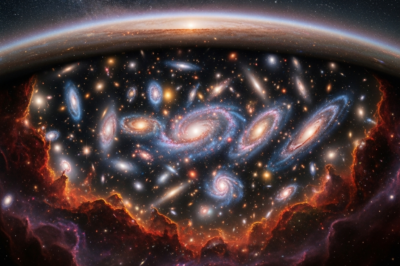
For decades, astronomers have been staring into the depths of the cosmos, mapping the intricate web of galaxies that define our universe. Yet, a significant portion of our cosmic neighborhood remained shrouded in mystery, hidden behind the very galaxy we call home. In a groundbreaking revelation that has sent ripples through the scientific community, researchers have identified a gargantuan structure known as the Vela Supercluster. This cosmic behemoth, lurking within the so-called ‘Zone of Avoidance’ (ZoA), is estimated to possess a staggering mass equivalent to 30,000 trillion times that of our Sun. The discovery not only fills a massive void in our celestial maps but also provides critical clues regarding the gravitational forces acting upon the Milky Way and its movement through space.
The ‘Zone of Avoidance’ is a region of the sky that is obscured by the Milky Way’s own interstellar dust and stars. For a long time, this ‘blind spot’ prevented astronomers from seeing what lay beyond our galactic plane. However, using advanced multi-wavelength observations and spectroscopic data, an international team of scientists has finally pierced through this veil. The implications are profound: the Vela Supercluster is one of the most massive structures ever detected in the local universe, and its proximity—approximately 800 million light-years away—suggests it plays a pivotal role in the cosmic flow that dictates how galaxies move in our corner of the universe. This discovery underscores the fact that even in an era of high-precision cosmology, the universe still holds secrets of unimaginable scale right in our backyard.
The Enigma of the Zone of Avoidance (ZoA)
To understand why such a massive structure remained hidden for so long, one must first grasp the concept of the Zone of Avoidance. Our galaxy, the Milky Way, is a flat, disk-like structure composed of hundreds of billions of stars, vast clouds of gas, and thick ribbons of interstellar dust. When we look out from Earth along the plane of this disk, this material acts as a cosmic curtain. It absorbs and scatters visible light, making it nearly impossible for traditional optical telescopes to see distant objects located behind it. This region covers roughly 10% to 20% of the night sky, leaving a massive gap in our extragalactic surveys.
Historically, this ‘avoidance’ was not a choice but a technical limitation. Astronomers focused their efforts on ‘clear’ parts of the sky where the view of the deep universe was unobstructed. However, the realization that the Milky Way is being ‘pulled’ toward a specific direction in space—a phenomenon known as the Great Attractor—suggested that something massive was hiding in the shadows. The identification of the Vela Supercluster is a direct result of the persistent effort to map these hidden regions using infrared and radio waves, which can pass through dust much more effectively than visible light.
Defining the Vela Supercluster: Scale and Mass
The Vela Supercluster (VSC) is not just another cluster of galaxies; it is a cosmic titan. A supercluster is a large group of smaller galaxy clusters or galaxy groups, and they are among the largest known structures in the universe. Preliminary data suggests that the VSC spans a vast volume of space and contains thousands of galaxies. The most mind-boggling aspect is its mass. By analyzing the redshift of the galaxies within the structure—a measure of how fast they are moving away from us—scientists have calculated that the VSC has a mass of approximately 30,000 trillion solar masses. To put this into perspective, our own Milky Way galaxy is estimated to have a mass of about 1.5 trillion solar masses. The Vela Supercluster is essentially the weight of 20,000 Milky Ways combined.
Located at a distance of roughly 250 megaparsecs (about 800 million light-years), the VSC is significantly further away than the Great Attractor or the Shapley Supercluster, yet its mass is so immense that it exerts a measurable gravitational pull on our local group of galaxies. It acts as a massive anchor in the cosmic web, influencing the trajectories of everything within hundreds of millions of light-years. The discovery of such a high-density region helps resolve long-standing discrepancies in our understanding of ‘peculiar velocities’—the motion of galaxies that deviates from the general expansion of the universe.
How Scientists Pierced the Galactic Veil
The discovery of the Vela Supercluster was not an accidental find but the culmination of rigorous spectroscopic surveys. Leading the charge was Professor Renée Kraan-Korteweg from the University of Cape Town, along with an international team of collaborators. The primary tool used for this discovery was the Southern African Large Telescope (SALT) and the Anglo-Australian Telescope (AAT). By utilizing these powerful instruments, the researchers were able to perform multi-object spectroscopy, which allowed them to measure the redshifts of thousands of partially obscured galaxies simultaneously.
While infrared surveys like 2MASS (Two Micron All-Sky Survey) had previously hinted at the existence of increased galaxy density in the Vela constellation, it was the spectroscopic data that confirmed the galaxies were physically grouped together at the same distance, forming a single coherent structure. This process involves breaking down the light from distant galaxies into its constituent colors and looking for specific chemical signatures that are shifted toward the red end of the spectrum. This ‘redshift’ tells scientists exactly how far away the galaxy is. When thousands of these points were plotted, the outline of the Vela Supercluster finally emerged from the cosmic haze, revealing its true dimensions and power.
Gravitational Implications: The Great Attractor and Beyond
For decades, astronomers have been puzzled by the motion of the Milky Way and our neighboring Andromeda galaxy. We are moving through space at approximately 2 million kilometers per hour relative to the Cosmic Microwave Background radiation. While the gravity of the nearby Virgo Cluster and the more distant Shapley Supercluster explains part of this motion, there was always an ‘excess’ velocity that couldn’t be fully accounted for. This led to the hypothesis of the ‘Great Attractor,’ a mysterious gravitational anomaly located in the direction of the Centaurus constellation.
The identification of the Vela Supercluster provides the missing piece of this gravitational puzzle. Although the VSC is further away than the Great Attractor, its sheer mass contributes significantly to the bulk flow of galaxies in our region of the universe. It serves as a secondary, yet equally important, gravitational engine. By factoring in the mass of the VSC, cosmologists can now more accurately model the ‘cosmic flow’—the river-like motion of galaxies through the voids of space. This discovery suggests that our local environment is part of a much larger and more complex gravitational network than previously thought, involving multiple superclusters acting in concert to shape the large-scale structure of the cosmos.
Mapping the Large-Scale Structure of the Universe
The universe is not a uniform soup of matter; it is a complex, web-like structure. Galaxies are strung along long filaments of dark matter, with massive superclusters like Vela sitting at the intersections of these filaments. Between these filaments lie vast, empty spaces known as cosmic voids. Mapping this ‘Cosmic Web’ is one of the primary goals of modern astrophysics, as it helps us understand the evolution of the universe since the Big Bang and the nature of dark matter and dark energy.
The Vela Supercluster occupies a unique position in this web. Its discovery helps scientists define the boundaries of the Laniakea Supercluster—the specific ‘watershed’ of galaxies that includes the Milky Way. Laniakea is 500 million light-years in diameter and contains 100,000 galaxies. However, structures like Vela exist just beyond the edge of what we previously considered our local supercluster, suggesting that Laniakea might be part of an even larger hierarchy of structures. Understanding where one supercluster ends and another begins is essential for testing the standard model of cosmology (Lambda-CDM), which predicts how matter should cluster together over billions of years.
Technological Advances and Future Research
The discovery of the Vela Supercluster is just the beginning. As technology advances, our ability to probe the Zone of Avoidance will only improve. New radio telescopes, such as the MeerKAT in South Africa and the Australian Square Kilometre Array Pathfinder (ASKAP), are already beginning to survey the hidden skies with unprecedented sensitivity. These telescopes use radio waves, which are completely unaffected by interstellar dust, to detect the neutral hydrogen gas within hidden galaxies. This allows for an even more comprehensive map of the ‘blind’ regions of our sky.
In the coming years, the Square Kilometre Array (SKA)—which will be the world’s largest radio telescope—is expected to reveal thousands of more galaxies within the Zone of Avoidance. Furthermore, the James Webb Space Telescope (JWST) offers infrared capabilities that can look deeper into the dust clouds of the Milky Way than ever before. These missions will help refine the mass estimates for the Vela Supercluster and perhaps discover even more massive structures that are currently hiding in the dark. The era of ‘blind spots’ in astronomy is rapidly coming to an end, as we develop the tools to see through our own galaxy and into the furthest reaches of the cosmic unknown.
Conclusion: A New Perspective on our Cosmic Home
The discovery of the Vela Supercluster serves as a humbling reminder of how much we still have to learn about the universe. For all our technological prowess, a structure with the mass of 30,000 trillion suns remained hidden from our view until very recently. This finding not only resolves long-standing questions about the motion of our galaxy but also opens new avenues for research into the large-scale structure of the universe and the distribution of matter within it. As we continue to map the ‘hidden’ parts of our sky, we gain a clearer picture of our place in the cosmos—not as an isolated island, but as a small part of a vast, interconnected, and dynamically moving cosmic tapestry. The Vela Supercluster is a testament to the power of human curiosity and the endless capacity of the universe to surprise us with its sheer scale and complexity.






































Leave a Reply