
Introduction: The Rare Spectacle Beyond the Corona
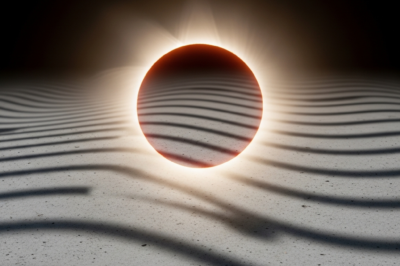
As the celestial clockwork brings our moon directly between the Earth and the Sun, the world prepares for the awe-inspiring sight of a total solar eclipse. While most observers focus their attention upward, awaiting the shimmering corona and the dramatic ‘diamond ring’ effect, a far more elusive and mysterious phenomenon occurs right at their feet. Shadow bands, often described as ‘snake-like’ or ‘wavy’ lines of alternating light and dark, appear racing across the ground just moments before and after totality. These ephemeral patterns have captivated astronomers and amateur stargazers for centuries, yet they remain one of the most difficult eclipse features to document and explain. In this comprehensive analysis, we delve into the science, history, and observational techniques surrounding shadow bands, providing you with everything you need to know before the next major eclipse event. Understanding these bands is not just about witnessing a quirk of light; it is about observing the very fluid dynamics of the Earth’s atmosphere as it reacts to the sudden withdrawal of solar energy.
What Exactly Are Shadow Bands?
Shadow bands are thin, faint, and rapidly moving patterns that manifest as undulating ribbons of light and shadow. They typically appear within the final 60 to 90 seconds before totality and reappear for a similar duration immediately after the moon begins to move away from the solar disk. Their appearance is often compared to the wavy patterns seen at the bottom of a swimming pool on a sunny day. However, unlike the patterns in a pool which are caused by the refraction of light through water, shadow bands are an atmospheric phenomenon. They are generally low-contrast, making them difficult to see against dark or textured surfaces like grass or gravel. To the naked eye, they look like thin, gray, shimmering ripples, often moving at speeds ranging from a slow crawl to a frantic sprint across any flat, light-colored surface. Their width can vary from a few centimeters to several inches, and the distance between the bands can fluctuate wildly depending on local atmospheric conditions. Because they are so faint and move so quickly, many first-time eclipse viewers miss them entirely, focusing instead on the darkening sky and the emerging stars.
The Science of Atmospheric Scintillation
The primary scientific explanation for shadow bands lies in the concept of atmospheric scintillation. Under normal circumstances, the Sun is an extended light source, meaning its light reaches Earth from a wide angular diameter. This broad light source washes out any small-scale shadows or refractions caused by the atmosphere. However, during the final moments leading up to a total solar eclipse, the Sun is reduced to a tiny, razor-thin crescent. This thin sliver of light effectively acts as a point source, much like a distant star. When light from a point source passes through the Earth’s atmosphere, it encounters different layers of air with varying temperatures, densities, and refractive indices. These ‘eddies’ or pockets of air act like tiny lenses, bending the light back and forth as it travels toward the ground. This process is exactly what causes stars to ‘twinkle’ at night. In the case of a solar eclipse, the ‘twinkling’ of the remaining solar crescent is projected onto the ground as moving bands of light and dark. Scientists refer to this as the collimation of light; the more the light is restricted to a single point or thin line, the more pronounced the atmospheric turbulence becomes visible to the human eye. This is why shadow bands are only visible when the Sun is at least 99% obscured.
Historical Perspectives and Early Observations
Shadow bands have been noted in historical records for centuries, though they were often dismissed as optical illusions or psychological effects caused by the excitement of the eclipse. One of the earliest scientific mentions dates back to the 18th century, but it wasn’t until the 19th century that they became a subject of serious inquiry. During the total solar eclipse of 1842, numerous observers across Europe reported seeing ‘faint moving ripples’ on the walls of buildings. Later, during the 1870 eclipse, Father Angelo Secchi, a pioneer in stellar spectroscopy, provided detailed accounts of these bands, noting their direction and speed. For many years, there was a debate in the scientific community: were these bands caused by diffraction at the moon’s edge, or were they purely atmospheric? It wasn’t until the mid-20th century, with the advent of high-speed photography and sophisticated light sensors, that the atmospheric theory gained dominance. Researchers like G.B. Taylor and later, NASA scientists, utilized photodiode arrays to measure the intensity and frequency of the bands, confirming that their characteristics matched the known turbulence patterns of the upper troposphere and stratosphere. Despite this, every eclipse offers a new opportunity to study them, as no two sets of shadow bands are ever exactly the same.
The Challenge of Capturing Shadow Bands on Camera
For photographers and videographers, shadow bands represent the ‘holy grail’ of eclipse documentation. They are notoriously difficult to capture for several reasons. First, the contrast between the light and dark bands is extremely low, often representing a change in brightness of only 1% to 2%. Second, they move at incredibly high speeds, sometimes exceeding several meters per second, which requires a high frame rate and a fast shutter speed to avoid motion blur. Most standard consumer cameras struggle with the low-light conditions immediately preceding totality while simultaneously trying to resolve these fast-moving, low-contrast patterns. To successfully record shadow bands, enthusiasts often use a ‘shadow band sheet’—a large, flat, white cloth stretched tightly over the ground. Professional setups might involve 4K or 8K cameras shooting at 60 or 120 frames per second, with the exposure locked to prevent the camera’s auto-gain from washing out the subtle patterns. Even with modern technology, many attempts result in nothing more than a blurry, gray video, which only adds to the mystique and allure of the phenomenon for the scientific community.
How to Best Observe Shadow Bands During the Next Eclipse
If you are planning to witness an upcoming total solar eclipse, observing shadow bands requires a bit of preparation. You cannot simply look at the sky; you must look at the ground. First, find a location with a large, flat, and light-colored area. A concrete sidewalk, a white-painted wall, or the side of a white van can work, but the gold standard is a large white bedsheet spread out on a flat patch of ground. Use stones or stakes to keep the sheet perfectly flat, as wrinkles can distort the appearance of the bands. As the light begins to take on a strange, silvery quality about five minutes before totality, start watching the sheet closely. Do not wear polarized sunglasses, as they may interfere with your ability to see the subtle contrast. About two minutes before totality, the bands may start to appear as very faint, shaky lines. In the final thirty seconds, they often become more distinct and move more rapidly. Pay attention to the direction they are moving; they usually align with the orientation of the solar crescent and move in a direction determined by the prevailing winds in the upper atmosphere. Repeat the process immediately after totality ends, as the bands often reappear with even greater clarity once the moon begins its retreat.
The Future of Shadow Band Research
While the basic cause of shadow bands is understood, they continue to be a subject of interest for meteorologists and atmospheric scientists. Because the bands are a direct visualization of atmospheric turbulence, they can be used to study the structure of the air layers high above the Earth. Some researchers have suggested that shadow bands could be used to measure wind speeds at different altitudes or to detect gravity waves in the atmosphere triggered by the cooling effect of the moon’s shadow. The cooling of the air within the eclipse path creates a ‘cold core’ that can disrupt normal atmospheric flow, and shadow bands may be a byproduct of this unique thermal event. As citizen science becomes more prevalent, NASA and other organizations often call upon the public to submit their videos and observations of shadow bands to create a massive, multi-point data map of the atmosphere’s behavior during the eclipse. This collaborative effort helps scientists refine their models of how our atmosphere reacts to rapid changes in solar radiation, which has implications for everything from weather forecasting to climate science. In the end, shadow bands remain a beautiful intersection of celestial mechanics and terrestrial physics, a fleeting reminder of the complex and invisible forces that surround our planet.
Conclusion: A Moment of Ephemeral Beauty
The total solar eclipse is a multifaceted event, offering a range of phenomena that vary from the grandly celestial to the subtly atmospheric. Shadow bands represent the latter, a delicate dance of light and air that serves as a terrestrial echo of the cosmic alignment occurring overhead. While they may not have the immediate visual impact of the sun’s corona, their rarity and the difficulty of seeing them make them a prized experience for any dedicated eclipse chaser. They remind us that our atmosphere is not just a transparent void, but a living, fluid medium that reacts in real-time to the energy of the Sun. As you stand in the path of the next totality, remember to take a few moments to look down. You might just catch a glimpse of the universe’s own ‘twinkling’ projected onto the Earth, a fleeting gift from the atmosphere that disappears as quickly as it arrives. The study of shadow bands is far from complete, and with every eclipse, we come one step closer to fully decoding the secrets written in these racing ribbons of light.






































Leave a Reply