
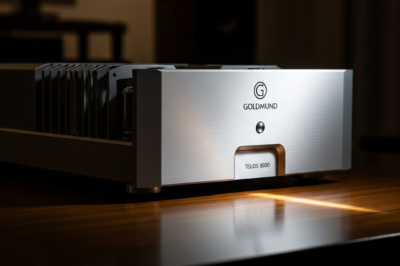
In the rarefied world of ultra-high-end audio, where the pursuit of sonic perfection often transcends the boundaries of reason and economics, Swiss manufacturer Goldmund has once again shattered expectations. The announcement of the Goldmund Telos 8800, described as the company’s ‘most advanced amplifier ever,’ has sent shockwaves through the audiophile community. This is not merely a piece of electronic equipment; it is a monumental statement of engineering prowess, a sculptural masterpiece, and a fiscal behemoth that carries a price tag higher than many top-tier Ferraris. For those who demand the absolute pinnacle of sound reproduction, the Telos 8800 represents the culmination of decades of research into psychoacoustics, materials science, and power management.
The Telos 8800 is a mono power amplifier, meaning a stereo setup requires two of these massive units. Each unit is built with the precision of a Swiss watch, but on a scale that is truly intimidating. As the high-fidelity market continues to polarize between mass-market convenience and bespoke luxury, Goldmund has firmly planted its flag at the summit of the latter. This article delves deep into the technical specifications, the design philosophy, and the broader implications of a device that costs more than many luxury homes, exploring why such a product exists and what it signifies for the future of audio technology.
The Engineering Zenith: Technical Specifications of the Telos 8800
At the heart of the Goldmund Telos 8800 lies a power delivery system that defies conventional logic. The amplifier is capable of delivering a staggering 1400 watts of power into an 8-ohm load. To put this in perspective, most high-end home amplifiers struggle to reach 200 or 300 watts. This immense headroom is not just about playing music at ear-splitting volumes; it is about absolute control. When an orchestral crescendo or a deep electronic bass hit occurs, the Telos 8800 ensures that the loudspeakers are driven with zero distortion and infinite ease. The damping factor is equally impressive, ensuring that the movement of the speaker cones is tracked with surgical precision, eliminating any unwanted resonance.
The internal architecture of the 8800 is a marvel of thermal management and signal purity. Goldmund has utilized a proprietary combination of silver-gold internal wiring and custom-made MKP (metallized polypropylene) capacitors. These components are chosen for their ability to maintain stability under extreme electrical stress. The amplifier also features a massive heat sink system that is integrated into the chassis design. Given the sheer amount of current flowing through the circuits, heat is the primary enemy of electronic longevity and sonic consistency. The Telos 8800 uses lateral MOSFETs in a configuration that mimics the characteristics of vacuum tubes while maintaining the reliability and power of solid-state technology.
The Ferrari Comparison: Understanding the $700,000+ Price Tag
When media outlets like What Hi-Fi? point out that the Telos 8800 costs more than a Ferrari, they are highlighting a fascinating intersection of luxury markets. A Ferrari SF90 Stradale might retail for around $500,000, yet a pair of Telos 8800 amplifiers will comfortably exceed that figure, often landing in the $700,000 to $800,000 range depending on the finish and regional taxes. Why does a box that sits in a living room cost more than a mid-engine Italian supercar? The answer lies in the economy of scale and the cost of uncompromising research.
Ferrari produces thousands of cars per year, allowing them to amortize R&D costs over a larger volume. Goldmund, by contrast, produces the Telos 8800 in extremely limited quantities for a global elite. Every component is hand-assembled in Geneva, Switzerland. The chassis is machined from aircraft-grade aluminum, providing a non-resonant environment that protects the delicate audio signals from external vibrations. Furthermore, the 8800 employs Goldmund’s patented ‘Mechanical Grounding’ technology, which uses physics to channel vibrations away from the internal electronics toward the floor. This level of mechanical engineering is akin to the suspension systems found in Formula 1 cars, designed to ensure that every micro-detail of the signal remains untouched by the physical environment.
Aesthetics and Design: Jewelry for the Ears
Goldmund has always been known for its ‘Swiss Made’ aesthetic—minimalist, silver-toned, and imposing. The Telos 8800 continues this tradition but adds a level of opulence that is unprecedented. Standing nearly a meter tall, the amplifier is a monolithic presence. It is available in a standard silver finish, but for the truly discerning (and wealthy) client, Goldmund offers custom finishes including gold-plated accents. The visual design is not just for show; the vertical orientation of the amplifier allows for better natural convection cooling, as heat rises through the internal chimney-like structure.
The front panel is remarkably clean, featuring only the iconic Goldmund gold plate and a discreet status indicator. This ‘less is more’ approach masks the complexity within. The rear of the unit is a different story, featuring heavy-duty WBT connectors and a proprietary Goldmund ‘Link’ system for digital synchronization between components. The tactile feel of the device—the way the metal plates join with microscopic tolerances—communicates a sense of permanence. This is a product designed to last for generations, much like a Patek Philippe watch, intended to be passed down as a functional heirloom.
The Science of Sound: Why Power Matters
Many skeptics ask: ‘Does anyone really need 1400 watts?’ In the world of high-fidelity, the answer is often related to ‘dynamic range.’ Most modern recordings, especially in the classical and jazz genres, feature massive swings between the quietest whispers and the loudest peaks. If an amplifier lacks sufficient power, it will ‘clip’ during these peaks, leading to harsh distortion that fatigues the ears. The Telos 8800 provides a ‘black’ background—a floor of silence so deep that the smallest details, such as the sound of a performer’s breath or the wood of a violin vibrating, become audible.
Furthermore, the 8800 is designed to handle difficult speaker loads. Some of the world’s best speakers have impedance curves that dip dangerously low, which can cause lesser amplifiers to overheat or shut down. The Telos 8800 treats these difficult loads with contemptuous ease. By maintaining a constant voltage regardless of the speaker’s behavior, Goldmund ensures a frequency response that is perfectly flat from DC to well beyond the range of human hearing. This ultrasonic capability, while not directly audible, is said to improve the phase coherence of the sounds we *can* hear, leading to a more realistic 3D soundstage.
The Global Market for Ultra-Luxe Audio
The release of the Telos 8800 comes at a time when the luxury goods market is seeing unprecedented growth in the ‘home experience’ sector. Following the global shifts of the early 2020s, high-net-worth individuals have increasingly invested in their private residences. Dedicated listening rooms and home theaters have become as standard as home gyms and wine cellars. Goldmund is catering to a demographic that views music not just as background noise, but as a spiritual and intellectual pursuit.
This segment of the market is immune to traditional economic downturns. For a billionaire in Dubai, Hong Kong, or New York, the price of the Telos 8800 is secondary to its exclusivity. Being one of the few people on the planet to own the ‘most advanced amplifier ever’ carries a social currency that is hard to quantify. However, the technology developed for the 8800 often trickles down into Goldmund’s more affordable (though still expensive) products, such as the Telos 590 or their active wireless speakers. In this sense, the 8800 is a ‘halo product,’ serving as a laboratory for innovations that will eventually benefit a wider range of audiophiles.
Conclusion: The Ultimate Pursuit of Silence
The Goldmund Telos 8800 is a polarizing masterpiece. To some, it represents the excesses of a world gone mad; to others, it is the ultimate expression of human ingenuity in the field of acoustics. By pushing the boundaries of what is possible with analog amplification, Goldmund has created a device that effectively disappears, leaving only the music behind. It is a testament to the idea that there is no upper limit to quality, only the limits of our own perception and our willingness to pursue the ideal.
Whether compared to a Ferrari, a piece of fine art, or a high-end timepiece, the Telos 8800 stands in a category of its own. It reminds us that at the highest levels of craftsmanship, the distinction between a ‘tool’ and ‘art’ becomes blurred. As we move further into a digital age characterized by compressed audio and convenience, the existence of a 1400-watt, $700,000 Swiss amplifier is a bold, defiant celebration of the analog soul of music. It is, quite simply, the loudest statement of silence ever made.





































Leave a Reply