
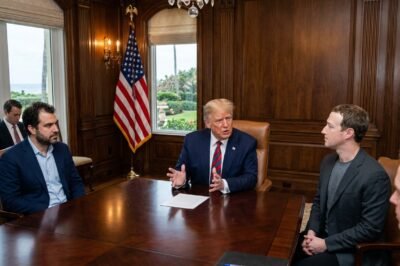
In a move that signals a profound reconfiguration of the relationship between the United States government and the world’s most powerful technology companies, Donald Trump is set to host a high-stakes summit this Tuesday with a roster of artificial intelligence luminaries, including Meta CEO Mark Zuckerberg and Anthropic’s Dario Amodei. This meeting, first reported by Reuters, represents a pivotal moment in the intersection of political power and silicon dominance. For years, the relationship between Trump and the leaders of Silicon Valley—particularly Zuckerberg—has been defined by public animosity, legal skirmishes, and fundamental disagreements over the role of digital platforms in public discourse. However, as the global arms race for artificial intelligence supremacy accelerates, a new pragmatism appears to be taking hold. This gathering is not merely a social engagement; it is a strategic council designed to align the ‘America First’ policy agenda with the technical capabilities of the country’s leading AI labs. As the world watches, the discussions held behind closed doors on Tuesday could very well dictate the regulatory, economic, and security landscape for the next decade, marking the end of the laissez-faire era and the beginning of a state-sponsored technological hegemony.
The Re-alignment of Silicon Valley and the White House
The upcoming summit represents a remarkable 180-degree turn in the political optics of Silicon Valley. For much of the last decade, the tech sector has been viewed as a bastion of liberal ideology, often at odds with the populist movement led by Donald Trump. The inclusion of Mark Zuckerberg is particularly noteworthy. Zuckerberg, who once faced threats of prosecution from Trump regarding election-related controversies, has recently adopted a more neutral, statesperson-like public persona. By engaging directly with the incoming administration, Zuckerberg is positioning Meta as a critical partner in the national infrastructure, rather than a mere social media entity. This shift suggests that tech titans have recognized that survival and growth in the age of AI require a seat at the table of executive power. The meeting serves as a clear signal that the adversarial relationship of the past is being replaced by a mutual understanding: the government needs the tech sector’s innovation to remain competitive against China, and the tech sector needs the government’s support to navigate the complex regulatory and resource requirements of building massive AI models.
Beyond the personal dynamics, the presence of various ‘AI titans’ suggests a broad-based coalition. While the specific attendee list continues to evolve, the inclusion of both legacy tech leaders and new-age AI pioneers like Dario Amodei illustrates the administration’s desire to understand the full spectrum of the AI ecosystem. From the social graphs of Meta to the constitutional AI frameworks of Anthropic, the administration is casting a wide net. This is a strategic move to ensure that no single company becomes the sole arbiter of AI policy, while also creating a unified front that can project American strength on the global stage. The meeting is expected to cover a wide range of topics, including the allocation of energy resources for data centers, the relaxation of antitrust pressures for companies pursuing national security objectives, and the streamlining of the H-1B visa process for specialized technical talent, all of which are critical for maintaining the momentum of American innovation.
Mark Zuckerberg’s Strategic Pivot to Diplomacy
Mark Zuckerberg’s attendance is perhaps the most scrutinized aspect of this gathering. In recent months, Zuckerberg has noticeably distanced himself from partisan politics, focusing instead on the development of ‘Llama,’ Meta’s open-source large language model. This move toward open source has been interpreted by many as a masterstroke of corporate diplomacy. By making Meta’s AI tools available to the public and the broader developer community, Zuckerberg has aligned his company’s interests with a decentralized, pro-competitive vision that resonates with certain factions of the Republican platform. During the Tuesday meeting, Zuckerberg is likely to emphasize how open-source AI can prevent a monopoly by any single entity, thereby fostering a more robust and innovative American economy. This narrative allows him to present Meta not as a gatekeeper, but as an enabler of American ingenuity, a framing that is far more palatable to an administration wary of ‘Big Tech’ overreach while simultaneously being supportive of ‘Big American’ success.
Furthermore, Zuckerberg’s engagement reflects a broader trend among tech CEOs who are increasingly adopting a ‘CEO-as-Diplomat’ role. In an era where technological capability is synonymous with national power, these leaders are no longer just managing companies; they are managing international relations. Zuckerberg’s willingness to meet with Trump suggests a realization that the regulatory hurdles facing Meta—ranging from data privacy laws to potential breaks-ups—can be mitigated through direct communication and strategic alignment with the executive branch. By showing up, Zuckerberg is demonstrating that Meta is ready to play its part in a national AI strategy that prioritizes American dominance over traditional European-style regulation. This meeting could mark the formal end of the ‘Tech Cold War’ between the GOP and Meta, replacing it with a pragmatic partnership focused on the existential challenge of the 21st century: AI supremacy.
Anthropic and the Critical Debate over AI Safety
The inclusion of Dario Amodei, the CEO of Anthropic, introduces a different but equally vital dimension to the summit. Anthropic has distinguished itself in the crowded AI field through its relentless focus on ‘Constitutional AI’ and safety. Unlike some of its competitors who have been criticized for a ‘move fast and break things’ approach, Anthropic has championed the idea that AI must be built with inherent safeguards to prevent misuse. Amodei’s presence at the table suggests that the Trump administration is not entirely ignoring the risks associated with AI, even as it pursues a deregulation-heavy agenda. The discussion will likely involve the tension between rapid development and the prevention of catastrophic risks, such as the use of AI in bio-terrorism or large-scale cyber warfare. Amodei’s task will be to convince the administration that safety and speed are not mutually exclusive, but that a secure AI framework is actually a prerequisite for long-term national security.
Statistics and industry reports suggest that the investment in AI safety is growing, but it still pales in comparison to the capital being poured into raw compute power. Amodei is expected to advocate for a balanced approach where the government provides the necessary infrastructure—specifically in terms of energy and high-end chips—while the companies provide the ethical and safety oversight. This ‘public-private partnership’ model for AI safety could become a hallmark of the new administration’s policy. By bringing in a safety-conscious leader like Amodei, the administration can insulate itself from criticisms that it is being reckless with the future of the technology. For Anthropic, the meeting is an opportunity to ensure that its vision of ‘safe’ AI becomes the standard for government contracts and national security applications, effectively turning safety into a competitive advantage in the federal marketplace.
AI as a National Security Imperative and the China Factor
At the heart of the Tuesday meeting is the inescapable reality of the geopolitical competition with China. The Trump administration has consistently framed technological advancement through the lens of national security. AI is no longer just a tool for business efficiency; it is the fundamental infrastructure for future military and economic operations. The ‘AI titans’ will likely be asked how their technologies can be integrated into the nation’s defense systems and how the U.S. can maintain its lead over Chinese state-sponsored firms like Baidu and Alibaba. Recent reports indicate that China is investing hundreds of billions of dollars into its ‘AI 2030’ plan, and the U.S. private sector is the only force capable of countering this state-led push. The meeting will likely touch on the need for ‘AI Nationalism,’ where American firms are given preferential treatment in exchange for their cooperation with national security objectives.
This national security focus also brings the ‘Manhattan Project’ for AI back into the conversation. There have been ongoing discussions in policy circles about a massive federal investment in compute clusters and specialized hardware. By hosting the leaders of Meta and Anthropic, Trump is signaling that the private sector will be the primary engine of this project, but with significant government backing. This could include the creation of ‘AI Enterprise Zones’ where regulations are waived to allow for the rapid construction of nuclear-powered data centers. The goal is clear: to ensure that the first General Artificial Intelligence (AGI) is developed on American soil, by American companies, and for American interests. The strategic alignment of these companies with the state’s security apparatus represents a return to the Cold War-era military-industrial complex, updated for the digital age.
The Potential Repeal of the Biden-Era AI Executive Order
One of the most consequential topics expected to be on the agenda is the future of Executive Order 14110, the comprehensive AI regulation signed by President Biden. This order established new standards for AI safety and security, required developers of powerful AI systems to share their safety test results with the government, and aimed to protect against the risks of AI-generated content. Many in the Republican camp, as well as some venture capitalists and tech founders, have criticized this order as an example of ‘regulatory overreach’ that stifles innovation. The Tuesday summit provides an opportunity for Trump to hear directly from the CEOs about which aspects of the order they find most burdensome. It is widely expected that the incoming administration will move to repeal or significantly weaken these regulations, replacing them with a more industry-friendly framework that emphasizes voluntary compliance and ‘permissionless innovation.’
For companies like Meta, which favors an open-source model, the Biden-era reporting requirements for large-scale training runs are seen as a particular hindrance. Zuckerberg is likely to argue that transparency should not be synonymous with government surveillance of technical progress. Similarly, the ‘titans’ of the industry will likely push for a move away from the ‘Precautionary Principle’—the idea that a technology must be proven safe before it can be deployed—and toward a ‘Pro-Innovation’ stance where the benefits of rapid AI deployment are weighed more heavily than the theoretical risks. This shift in regulatory philosophy would have global ramifications, as other countries often look to the U.S. to set the standard for tech governance. A move toward total deregulation could spark a global race to the bottom, or it could unleash a wave of productivity that secures the U.S. economy’s dominance for decades to come.
Economic Implications of an Unfettered AI Frontier
The economic stakes of the meeting cannot be overstated. Analysts suggest that AI could add between $15 trillion and $20 trillion to the global economy by 2030, and the U.S. is currently positioned to capture the largest share of that value. However, this growth is contingent on several factors that require government intervention: the modernization of the electrical grid to handle the massive power demands of AI, the expansion of domestic semiconductor manufacturing, and the creation of a legal framework that protects intellectual property while allowing for the training of large models. The CEOs at Tuesday’s meeting will likely present a ‘wish list’ of economic policies designed to accelerate this growth. This includes tax incentives for AI research and development, and a commitment to keeping the internet a ‘free-trade zone’ for AI services, preventing the balkanization of the digital economy.
Furthermore, the meeting will likely address the impact of AI on the American workforce. While the administration is focused on ‘America First,’ there is a growing concern that AI could lead to significant job displacement in sectors ranging from manufacturing to white-collar services. The ‘AI titans’ will need to provide the administration with a roadmap for how AI can be a tool for ‘human augmentation’ rather than just automation. This involves investment in retraining programs and education. By securing a commitment from these companies to prioritize the American worker, Trump can frame his pro-AI stance as a win for the middle class. The intersection of high-tech innovation and blue-collar job security will be a delicate balance to strike, but it is one that will be central to the political viability of the administration’s tech agenda.
Conclusion: A New Era for American Tech Hegemony
The Tuesday meeting between Donald Trump and the titans of the AI industry marks the beginning of a new chapter in the history of the digital age. It represents the formalization of a partnership that seeks to merge the raw power of the state with the innovative capacity of the private sector. By bringing together formerly disparate figures like Mark Zuckerberg and Dario Amodei, the administration is building a coalition that is unified by a singular goal: American supremacy in the field of artificial intelligence. This summit is a clear indication that the ‘tech-lash’ of the previous decade is over, replaced by a strategic imperative to win the most important technological race in human history.
As the administration moves forward, the success of this partnership will depend on its ability to balance the competing interests of innovation, safety, and national security. The repeal of restrictive regulations and the focus on national-interest technology projects suggest a return to a more aggressive, growth-oriented posture. However, the risks—both ethical and existential—remain. Whether this new era of ‘Techno-Nationalism’ will lead to a period of unprecedented prosperity or to a new set of global tensions remains to be seen. What is certain, however, is that the decisions made in the boardroom this Tuesday will resonate across the globe, shaping the future of how we live, work, and interact with the machines of our own making.






































Leave a Reply