
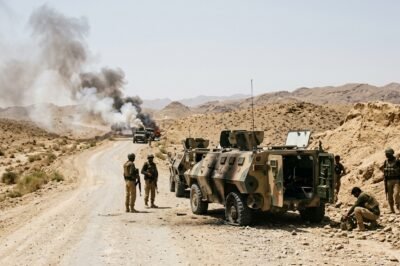
The recent attack in the restive province of Balochistan has sent ripples through the geopolitical landscape of South Asia, marking a significant and chilling escalation in a decades-long conflict. When news broke that nine Pakistani soldiers were killed in a calculated strike against a military convoy, the world’s attention was immediately drawn to the perpetrators: the first female unit of the Baloch Liberation Army (BLA). This development is not merely a tactical shift but a profound psychological and symbolic evolution in the insurgency that has plagued Pakistan’s largest and most resource-rich province. For years, the Baloch resistance was characterized by traditional guerrilla warfare, primarily led by men from tribal backgrounds. However, the introduction of a specialized female combat wing—the Majeed Brigade’s all-women unit—signals a desperate and determined phase in their struggle for autonomy. This analysis delves into the tactical nuances of the ambush, the socio-political motivations behind the mobilization of women, and the broader implications for Pakistan’s internal security and its international partnerships, particularly those involving the multi-billion dollar China-Pakistan Economic Corridor (CPEC). As the smoke clears from the latest battleground, the questions remaining for Islamabad are as much about cultural shifts as they are about border security.
The Tactical Sophistication of the Majeed Brigade
The Majeed Brigade, often cited as the elite and most lethal wing of the Baloch Liberation Army, has undergone a radical transformation over the last decade. Originally established to carry out high-profile suicide missions and targeted assassinations, the brigade has increasingly focused on precision strikes that maximize psychological impact. The deployment of a female unit in this specific convoy attack demonstrates a high level of organizational sophistication. Intelligence reports suggest that these units undergo rigorous training that rivals the traditional male cadres, focusing on reconnaissance, the handling of improvised explosive devices (IEDs), and urban warfare tactics. By utilizing women, the BLA exploits a significant blind spot in the Pakistani security apparatus, where cultural norms often prevent the intrusive searching or suspicion of female travelers, thereby allowing them to bypass checkpoints and approach high-security targets with greater ease.
Furthermore, the shift toward a formalized female wing indicates a long-term recruitment strategy aimed at diversifying the insurgency. The BLA has leveraged social media and underground networks to portray these women not as victims, but as vanguard fighters, a narrative that resonates deeply with a population that feels marginalized by the central government. This specific attack on the convoy was not an isolated act of desperation but a calculated military operation. Witnesses and early reports suggest the use of sophisticated weaponry and a multi-layered ambush strategy where the convoy was first disabled by explosives and then engaged with small arms fire. The coordination required for such an operation implies that the female unit is fully integrated into the BLA’s command-and-control structure, marking a departure from the auxiliary roles women previously held in the movement.
Anatomy of the Ambush: How the Convoy was Targeted
The geography of Balochistan, with its rugged terrain and vast, unpopulated expanses, provides a natural advantage to insurgent groups. The attack on the Pakistani military convoy took place in a strategically sensitive area, likely chosen for its limited exit routes and poor communication signals. According to security analysts, the rebels utilized a ‘kill zone’ tactic, a classic guerrilla maneuver where the target is funneled into a section of the road where they are vulnerable from multiple high-ground positions. The use of IEDs to stop the lead vehicle is a hallmark of the Majeed Brigade, ensuring that the entire convoy is brought to a standstill, leaving the remaining soldiers exposed to concentrated fire.
In this instance, the death toll of nine soldiers indicates that the rebels maintained fire superiority for a significant duration before security reinforcements could arrive. The involvement of the female unit suggests that these fighters were involved in the primary assault phase, rather than just logistical support. This level of frontline engagement is unprecedented in the Baloch context. Historically, female members were involved in intelligence gathering or transporting messages, but the transition to active combatants participating in a high-casualty ambush marks a threshold that the Pakistani military will find difficult to counter without significant changes to their operational procedures. The precision of the strike suggests months of surveillance on military movements, indicating a robust intelligence network within the local population that supports the BLA’s objectives.
The Symbolic Power of the Female Combatant
The inclusion of women in suicide missions and combat roles is a potent psychological weapon. For the BLA, it serves to shame the male population into joining the cause while simultaneously signaling to the state that the insurgency has reached a point of total mobilization. The narrative of the “sacrificing mother” or the “warrior sister” is a powerful tool in revolutionary propaganda. By highlighting the first female unit’s role in the death of nine soldiers, the BLA is attempting to rewrite the social contract within the Baloch resistance. This move mirrors other global insurgencies, such as the PKK in Turkey or the LTTE in Sri Lanka, where female combatants were used to represent the ultimate commitment to the nationalist cause.
However, the sociopolitical implications run deeper. The emergence of female rebels is often a response to perceived state-sponsored violence against women and families. In Balochistan, the issue of “enforced disappearances” has been a rallying cry for years. Many families claim that their male relatives have been abducted by security forces, leaving the women to lead protests and, now, take up arms. The transformation of a peaceful protestor into a Majeed Brigade combatant is a trajectory that the Pakistani government has largely failed to address through political means. As long as the grievances of the local population remain unaddressed, the BLA will find a steady stream of recruits among those who feel they have nothing left to lose, regardless of gender.
CPEC and the Economic Fallout
The timing and location of the attack are particularly damaging to Pakistan’s economic aspirations. Balochistan is the heart of the China-Pakistan Economic Corridor (CPEC), a flagship project of the Belt and Road Initiative. The security of Chinese investments and personnel is a top priority for Islamabad, yet the BLA has consistently targeted infrastructure and security forces associated with these projects. By demonstrating that even their female units can inflict heavy casualties on the military, the BLA is sending a clear message to Beijing: the province is not secure for foreign investment. This creates a diplomatic headache for Pakistan, which has had to reassure China repeatedly about the safety of the corridor.
The economic impact of such attacks extends beyond direct damage. The high cost of maintaining a massive military presence in the province to guard every convoy and construction site is a drain on Pakistan’s already fragile economy. Moreover, the persistent instability discourages other international investors from entering the Pakistani market. If the BLA continues to evolve its tactics—moving from sporadic bombings to organized unit-led ambushes—the military will be forced to divert even more resources to internal security, potentially weakening its posture on other fronts. The BLA’s strategy is clearly aimed at making the occupation of Balochistan too expensive for the Pakistani state to sustain in the long run.
State Response: Military Crackdowns and Political Stalemates
In the wake of the attack, the Pakistani military typically responds with large-scale search operations and increased surveillance. However, these kinetic responses often exacerbate the situation by further alienating the local populace. The cycle of violence—attack, crackdown, and subsequent recruitment—has become a hallmark of the Baloch conflict. Security experts argue that a purely military solution is impossible given the terrain and the deep-seated ethnic grievances involved. The introduction of female units complicates the military’s response even further, as aggressive actions against women can lead to massive social backlash and provide the BLA with even more propaganda material.
On the political front, there is a noticeable lack of dialogue between the central government and the genuine representatives of the Baloch people. The mainstream political process in the province is often viewed as being manipulated by the establishment, leading to a vacuum of leadership that the militants are more than happy to fill. Without a credible political roadmap that addresses the distribution of provincial resources and the human rights concerns of the Baloch people, the military will continue to face an evolving and increasingly sophisticated insurgency. The death of nine soldiers is a tragedy that underscores the failure of the current security-first approach to a problem that is fundamentally political and economic in nature.
Conclusion: Future Security Trajectories
The attack by the first female unit of the Baloch rebels is a watershed moment in the history of the insurgency. It indicates that the BLA is not only surviving despite years of military operations but is also innovating and expanding its capabilities. As the Majeed Brigade continues to integrate more women into its ranks, the tactical challenges for the Pakistani security forces will multiply. We can expect to see an increase in gender-specific training for border guards and a potential shift in how military convoys are protected, perhaps involving more aerial surveillance and armored transport. However, these are merely technical fixes for a structural problem.
Looking ahead, the international community will likely keep a close watch on how Pakistan balances its security needs with the protection of human rights. If the state continues to rely solely on force, the insurgency will likely continue to radicalize, drawing in younger and more diverse segments of the population. The 9-soldier casualty count is a grim reminder that the conflict in Balochistan is far from over. It is a clarion call for a shift in strategy—one that moves away from the battlefield and toward the negotiating table, addressing the root causes of the unrest before the Majeed Brigade’s new tactics become the norm rather than the exception. The road to peace in Balochistan is long, but it must start with acknowledging that the nature of the war has changed forever.
- Total Casualties: 9 Pakistani Soldiers confirmed.
- Perpetrators: First specialized female unit of the BLA’s Majeed Brigade.
- Tactics Used: IED blast followed by heavy small arms ambush.
- Strategic Focus: Undermining CPEC and demonstrating rebel evolution.
- Regional Impact: Increased tensions in Balochistan and security concerns for foreign investors.



































Leave a Reply