
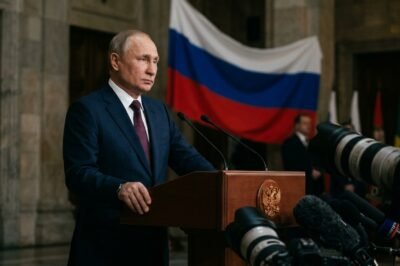
The geopolitical chessboard of Eurasia has been dramatically reshaped following a stern and calculated warning from Russian President Vladimir Putin directed at the Republic of Korea. During a high-profile state visit to Vietnam, which closely followed a landmark trip to Pyongyang, Putin articulated a clear and dangerous red line: should South Korea proceed with the supply of lethal weaponry to Ukraine, it would constitute a ‘big mistake’ with irreversible consequences for bilateral relations. This development marks a significant escalation in the diplomatic friction between Moscow and Seoul, transitioning from mutual economic cooperation to open strategic hostility. For decades, South Korea managed a delicate balancing act, maintaining a robust security alliance with the United States while fostering lucrative trade ties with Russia. However, the ongoing conflict in Ukraine and Russia’s burgeoning military partnership with North Korea have shattered this equilibrium, forcing Seoul to reconsider its long-standing policy of non-lethal assistance. Putin’s warning is not merely a rhetorical flourish; it is a calculated attempt to deter the world’s ninth-largest arms exporter from entering the European theater, a move that could fundamentally alter the kinetic dynamics of the war in Ukraine.
The Escalation of Rhetoric: Analyzing the Moscow-Seoul Divide
The tension between Russia and South Korea has reached its most volatile point since the end of the Cold War. Putin’s specific threat was triggered by Seoul’s suggestion that it might reconsider its policy of providing only humanitarian and non-lethal aid to Kyiv. This shift in Seoul’s stance came immediately after Putin and North Korean leader Kim Jong Un signed a comprehensive strategic partnership treaty, which includes a mutual defense clause. From Moscow’s perspective, any South Korean intervention in the form of lethal aid would be seen as an act of aggression facilitated by Western pressure. Vladimir Putin emphasized that South Korea has ‘nothing to worry about’ regarding the new Russia-North Korea pact unless it plans an act of aggression against Pyongyang, yet he simultaneously warned that Moscow reserves the right to supply weapons to North Korea if the West continues to arm Ukraine.
This diplomatic standoff is characterized by a high-stakes game of ‘mirroring’ actions. For every step Seoul takes toward the NATO-led coalition supporting Ukraine, Moscow takes a step toward rehabilitating North Korea’s military capabilities. The rhetoric coming out of the Kremlin suggests that Russia no longer views South Korea as a neutral economic partner but as a proxy for Western interests in East Asia. This breakdown in communication is particularly damaging because South Korea had previously been one of the few ‘unfriendly’ nations (as designated by Russia) with which Moscow hoped to eventually restore pragmatic economic ties. The current trajectory suggests that these bridges are being systematically dismantled.
The North Korean Connection: A Mutual Defense Pact as Leverage
Central to Putin’s warning is the newly minted defense treaty between Russia and North Korea. This pact, which echoes a 1961 Cold War-era agreement, stipulates that both nations will provide immediate military assistance in the event of an armed invasion of either party. By revitalizing this alliance, Putin has created a potent piece of leverage against South Korea. If Seoul provides K2 tanks or K9 howitzers to Ukraine, Moscow can retaliate by sharing sensitive military technology—such as satellite propulsion, submarine designs, or advanced missile guidance systems—with Kim Jong Un’s regime. This creates a direct security threat for South Korea on its own doorstep, effectively tethering the conflict in Eastern Europe to the stability of the Korean Peninsula.
Furthermore, the pact signifies a total abandonment of the international sanctions regime against North Korea by a permanent member of the UN Security Council. Putin’s willingness to openly flout these sanctions serves as a message to Seoul: Russia is no longer invested in the regional status quo. The strategic partnership with Pyongyang allows Russia to diversify its sources of artillery and ballistic missiles for use in Ukraine, while simultaneously forcing South Korea and its primary ally, the United States, to divert attention and resources back to the Indo-Pacific. This ‘two-front’ pressure is a hallmark of current Russian foreign policy aimed at stretching Western defense capabilities to their breaking point.
Economic and Industrial Stakes: South Korea’s Massive Arms Production Capacity
One of the primary reasons the Kremlin is so concerned about South Korea’s potential involvement is the sheer scale and efficiency of the South Korean defense industry. Unlike many European nations that have struggled to ramp up production to meet Ukraine’s needs, South Korea’s ‘K-Defense’ sector is currently in a state of hyper-productivity. South Korean firms like Hanwha Aerospace, Hyundai Rotem, and LIG Nex1 have secured multibillion-dollar contracts with Poland and other NATO members, providing a ready supply of high-quality, NATO-compatible hardware. If South Korea were to bypass the ‘indirect supply’ route (where it backfills US or Polish stocks) and ship directly to Kyiv, the volume of high-end weaponry reaching the front lines could be substantial.
The economic implications for South Korea are equally complex. Russia was once a significant market for South Korean conglomerates like Samsung, Hyundai, and LG. While many of these companies have suspended operations or exited the market due to sanctions, a total severance of ties would mean the permanent loss of billions in invested capital and future market share. Putin’s warning targets this economic anxiety, suggesting that once the ‘red line’ of lethal aid is crossed, there will be no returning to the status quo ante. South Korea must now weigh the long-term benefits of being a primary security partner for the West against the immediate risks of a hostile Russia and a nuclear-armed, Russia-backed North Korea.
Global Security Architecture and the Indo-Pacific Pivot
The friction between Moscow and Seoul is a microcosm of the broader shifts in the global security architecture. We are witnessing the fusion of Euro-Atlantic and Indo-Pacific security concerns. NATO has increasingly sought to engage with its ‘AP4’ partners—South Korea, Japan, Australia, and New Zealand—recognizing that the challenges posed by the Russia-China-North Korea-Iran axis are interconnected. Putin’s warning to South Korea is an attempt to disrupt this emerging global alignment. By threatening to destabilize the Korean Peninsula, Russia hopes to convince Seoul that the costs of supporting the liberal international order in Europe are too high to bear locally.
This situation also puts the United States in a difficult position. Washington must provide enough security guarantees to Seoul to prevent it from feeling intimidated by the Russia-North Korea pact, while also encouraging South Korea to continue its vital role in the global ammunition supply chain. If South Korea feels that its domestic security is being compromised by its support for Ukraine, it may scale back its cooperation with NATO, which would be a significant strategic victory for the Kremlin. The interplay between these major powers suggests that the war in Ukraine is no longer a regional European conflict but a catalyst for a global realignment of military and political loyalties.
The Market Implications: Defense Stocks and Strategic Alliances
From a financial perspective, Putin’s warnings and the subsequent regional tension have sent ripples through global markets. South Korean defense stocks, which had been performing exceptionally well due to European demand, are now facing a period of increased volatility. Investors are balancing the prospect of massive new orders from Ukraine or NATO against the risk of regional instability on the Korean Peninsula. If the situation escalates to a point where South Korea must prioritize its own domestic stockpiles, the ‘export boom’ could face logistical or political bottlenecks. Conversely, the increased threat level typically leads to higher defense spending across the board, which could benefit the sector in the long run.
Additionally, the energy sector and shipping industries remain sensitive to Russian-South Korean relations. South Korea is a major hub for LNG tanker construction and maritime logistics. Any Russian move to seize South Korean assets or block maritime cooperation could impact global supply chains. The ‘Business’ aspect of this geopolitical spat is not limited to arms; it involves the fundamental restructuring of how East Asian economies interact with the Russian landmass. As South Korea pivots more decisively toward the West, we can expect a total decoupling from Russian energy and resources, a process that is costly and fraught with economic risk.
Future Implications: A New Era of Cold War Dynamics in East Asia
Looking forward, the relationship between Russia and South Korea is unlikely to recover in the near term. Putin’s warning has set a precedent that links Seoul’s foreign policy in Europe directly to its security at home. This ‘linkage’ strategy will likely become a permanent fixture of Russian diplomacy. South Korea now faces a strategic crossroads: it can double down on its alliance with the United States and NATO, potentially becoming a key ‘arsenal of democracy’ for the West, or it can attempt to find a middle ground that pacifies Moscow but risks alienating its most important security partners. The most probable outcome is a continued, albeit cautious, increase in South Korean support for the Western coalition, met by incremental escalations from Moscow and Pyongyang.
Ultimately, the warning issued by Vladimir Putin serves as a stark reminder that the boundaries of modern warfare are no longer defined by geography. Decisions made in Seoul about artillery shells can influence the frontline in Donbas, just as treaties signed in Pyongyang can alter the security calculus in Washington and Brussels. The world has entered a new era of complex, interlocking alliances where local disputes are subsumed into a larger, global struggle for influence. For South Korea, the challenge will be navigating this ‘New Cold War’ without sparking a ‘Hot War’ in its own backyard, all while maintaining its status as a global economic and industrial powerhouse.



































Leave a Reply