
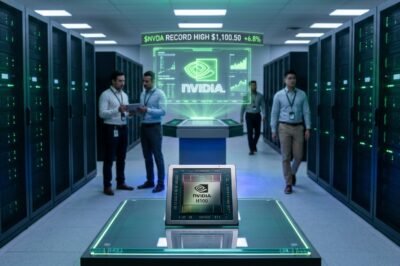
The global financial landscape witnessed a seismic shift this week as Nvidia, the Santa Clara-based chipmaker that has become the poster child for the artificial intelligence revolution, officially surpassed Microsoft to become the world’s most valuable public company. This historic milestone marks the first time in decades that a hardware-centric infrastructure provider has held the top spot, signaling a fundamental transition in how the market values technology and future growth. For years, the throne of market capitalization was a seesaw battle between the software prowess of Microsoft and the consumer ecosystem of Apple. However, the relentless demand for generative AI, powered almost exclusively by Nvidia’s advanced graphics processing units (GPUs), has propelled the company to a staggering market valuation exceeding $3.33 trillion. Investors are no longer just betting on the applications of tomorrow; they are pouring capital into the literal silicon and circuitry that makes those applications possible. This achievement is not merely a reflection of a stock market rally but a testament to a decades-long strategic pivot led by CEO Jensen Huang, who transformed a niche gaming hardware firm into the indispensable engine of the new industrial revolution.
The Meteoric Rise of a Semiconductor Powerhouse
Nvidia’s journey to the top of the S&P 500 is a narrative of foresight and calculated risk. Just a decade ago, the company was primarily known among PC enthusiasts and gamers for its GeForce line of graphics cards. However, the realization that the parallel processing capabilities of GPUs were uniquely suited for complex mathematical computations led to the development of CUDA, a proprietary software platform that allowed developers to use Nvidia hardware for general-purpose computing. This decision, often viewed as a gamble at the time, laid the groundwork for the modern AI era. As machine learning and neural networks moved from academic research into commercial reality, Nvidia was the only player with a mature, scalable solution ready to handle the immense workloads required by Large Language Models (LLMs) like GPT-4.
In the last eighteen months alone, Nvidia’s share price has surged by more than 200%, a performance that has left even the most bullish analysts breathless. The company’s revenue has seen triple-digit year-over-year growth, driven primarily by its Data Center division. Companies like Meta, Google, Amazon, and Tesla are engaged in an unprecedented arms race, spending tens of billions of dollars to secure thousands of Nvidia’s H100 and upcoming Blackwell chips. This insatiable appetite for compute power has turned Nvidia into a gatekeeper for the tech industry, where the ability to innovate is now directly proportional to the number of Nvidia chips a company can procure.
Disrupting the Hierarchy: Microsoft and Apple in the Rearview
For the better part of the last decade, Microsoft and Apple have dominated the top two spots of the global market cap rankings. Microsoft, under Satya Nadella, reinvented itself as a cloud and AI powerhouse through its partnership with OpenAI and its Azure platform. Apple, meanwhile, relied on the consistent cash flow and high margins of the iPhone ecosystem. Nvidia’s ascent to overtake both signifies a shift from the ‘Age of the Internet’ and ‘Age of the Smartphone’ to the ‘Age of AI Infrastructure.’ While Microsoft remains a critical partner and customer for Nvidia, the market is currently rewarding the provider of the ‘shovels’ in this digital gold rush more than the gold miners themselves.
Statistically, the gap closed rapidly. Nvidia’s market cap crossed the $1 trillion mark in mid-2023, hit $2 trillion earlier this year, and has now sprinted past the $3.3 trillion mark. This velocity of wealth creation is unprecedented in the history of the stock market. Analysts point out that unlike the dot-com bubble of the late 90s, Nvidia’s valuation is backed by actual earnings and massive profit margins. The company is currently operating with net margins exceeding 50%, a figure almost unheard of for a hardware manufacturer, further cementing its position as a high-growth, high-profit outlier in the tech sector.
The Anatomy of Success: Why H100 Chips Are the New Oil
The primary driver behind this valuation is the H100 Tensor Core GPU. These chips are not just components; they are the fundamental building blocks of modern intelligence. Each chip, costing upwards of $30,000 to $40,000, is capable of processing trillions of operations per second, making it possible to train models that can understand language, generate images, and drive autonomous vehicles. Nvidia’s competitive advantage lies not just in the hardware, but in its entire ecosystem. The company provides the networking hardware (via its acquisition of Mellanox), the cooling systems, and most importantly, the software stack that ensures these chips run at peak efficiency.
Competitors like AMD and Intel are racing to catch up, but Nvidia has a multi-year lead in both performance and developer adoption. The ‘CUDA Moat’ is a significant barrier to entry; most AI developers have built their software on Nvidia’s platform, making the cost of switching to a competitor extremely high. Furthermore, Nvidia has accelerated its release cycle, moving from a two-year to a one-year cadence for new chip architectures. With the ‘Blackwell’ platform already entering production, the company is widening the gap before its rivals can even bridge the previous generation’s performance delta.
Market Implications and the S&P 500 Concentration
Nvidia’s dominance has created a unique situation for the broader financial markets. The company now accounts for a significant portion of the S&P 500’s total returns. This level of concentration has led to discussions regarding market stability and the ‘Nvidia effect.’ When Nvidia reports earnings, the entire market moves in tandem. For institutional investors and pension funds, Nvidia has become a ‘must-own’ stock, further driving up the price as demand for shares outstrips supply despite the recent 10-for-1 stock split intended to make ownership more accessible to retail investors.
This concentration also brings risks. Any sign of a slowdown in AI spending by major cloud providers or a shift in geopolitical stability could lead to significant volatility. However, for now, the momentum remains firmly behind the semiconductor giant. Financial analysts are increasingly viewing Nvidia not just as a chip company, but as a total systems provider for the next generation of data centers, which Jensen Huang refers to as ‘AI Factories.’ In this vision, data goes in, and intelligence comes out, with Nvidia capturing the value at every stage of that transformation.
The Global Supply Chain and Geopolitical Factors
As the world’s most valuable company, Nvidia finds itself at the center of a complex geopolitical web. The company relies heavily on Taiwan Semiconductor Manufacturing Company (TSMC) for the fabrication of its most advanced chips. This dependency makes Nvidia’s market cap sensitive to the political climate in the Taiwan Strait. Additionally, U.S. export controls on high-end AI chips to China have forced Nvidia to redesign its products for one of its largest markets, highlighting how international policy can impact even the most successful corporate entities.
Despite these hurdles, Nvidia continues to diversify its supply chain and invest in local manufacturing initiatives in the U.S. and Europe. The company is also expanding into vertical markets, including healthcare, where AI is being used for drug discovery, and the automotive sector, where its Thor platform aims to power the next generation of software-defined vehicles. By embedding its technology into every major industry, Nvidia is insulating itself against a slowdown in any single sector, ensuring its long-term relevance beyond the current AI hype cycle.
Conclusion: Navigating the New Industrial Revolution
Nvidia taking the crown from Microsoft as the world’s most valuable company is more than a headline; it is a signal that the global economy has entered a new phase. We are moving from a world defined by the accumulation of data to a world defined by the generation of intelligence. As the sole provider of the infrastructure required for this transition, Nvidia occupies a position of power and influence that few companies in history have ever held. While challenges regarding competition, regulation, and market saturation will inevitably arise, the company’s current trajectory suggests that it is only at the beginning of its journey to redefine the limits of computing.
Looking ahead, the sustainability of Nvidia’s top position will depend on its ability to maintain its technological lead and the continued ROI for its customers. If AI truly becomes as ubiquitous as electricity, then Nvidia has indeed become the world’s primary utility provider. For investors, policymakers, and consumers, Nvidia’s ascent is a clear reminder that in the modern world, the most valuable commodity is no longer oil or gold, but the silicon-based intelligence that powers the future of humanity.




































Leave a Reply