
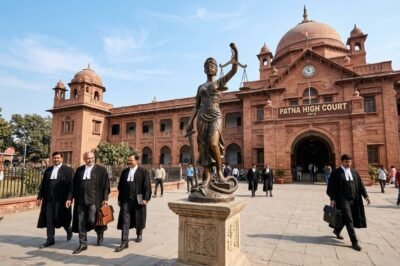
In a move that has sent shockwaves through the political corridors of Bihar and echoed across the judicial landscape of India, the Patna High Court has officially quashed the Bihar government’s ambitious decision to increase the reservation quota for Scheduled Castes (SC), Scheduled Tribes (ST), and Other Backward Classes (OBC) to 65 percent. This landmark judgment, delivered by a division bench comprising Chief Justice K. Vinod Chandran and Justice Harish Kumar, represents a significant check on the executive’s power to redefine social justice frameworks outside the established constitutional boundaries. The ruling addresses the core tension between affirmative action and the fundamental right to equality, specifically scrutinizing the legal validity of the Bihar Reservation Amendment Bill passed in late 2023. For the Nitish Kumar-led administration, which had positioned this hike as a revolutionary step following the state’s comprehensive caste survey, the verdict is a major legal setback. It forces a critical re-evaluation of how regional governments interpret the ‘exceptional circumstances’ clause that allows for exceeding the historically mandated 50 percent ceiling. As the nation watches, this decision not only impacts the immediate recruitment and admission processes in Bihar but also sets a profound precedent for other states contemplating similar legislative expansions of caste-based quotas.
The Genesis of the 65 Percent Reservation Policy
The journey toward the 65 percent reservation policy began with the Bihar government’s decision to conduct a massive, state-wide caste-based survey. This survey, the first of its kind in post-independent India at such a scale, was intended to provide empirical data on the socio-economic status of various communities. Upon the release of the survey findings in November 2023, the state government argued that the data revealed a disproportionate lack of representation for Backward Classes and Extremely Backward Classes relative to their population share. Armed with these statistics, the Bihar legislature unanimously passed the Bihar Reservation (for Scheduled Castes, Scheduled Tribes, and Other Backward Classes) (Amendment) Act, 2023, and a corresponding amendment for educational institutions.
Under the new laws, the quota for Extremely Backward Classes (EBC) was raised to 25 percent, Other Backward Classes (OBC) to 18 percent, Scheduled Castes (SC) to 20 percent, and Scheduled Tribes (ST) to 2 percent. When combined with the existing 10 percent quota for the Economically Weaker Sections (EWS) mandated by the central government, the total reservation in Bihar climbed to a staggering 75 percent. The state government maintained that this expansion was a necessary step to ensure ‘proportional representation’ and to address historical inequities that the 50 percent cap failed to rectify. However, the move was immediately met with legal challenges, with petitioners arguing that the hike was a populist measure that violated the basic structure of the Constitution and the specific directives laid down by the Supreme Court of India in the landmark Indra Sawhney case.
The Indra Sawhney Precedent and the 50 Percent Ceiling
Central to the Patna High Court’s ruling is the 1992 Supreme Court judgment in Indra Sawhney vs. Union of India, popularly known as the Mandal Commission case. In that historic verdict, a nine-judge bench established that while reservation is a tool for social upliftment, it must be balanced against the principle of merit and the rights of the general category. The Supreme Court had explicitly capped the total reservation at 50 percent, stating that exceeding this limit would undermine the constitutional guarantee of equality of opportunity. The Patna High Court observed that the Bihar government failed to provide a compelling legal justification for bypassing this constitutional ceiling, noting that population percentage alone does not constitute an ‘extraordinary circumstance’ as defined by the apex court.
The court’s analysis delved deep into the nuances of Article 16(4) and Article 15(4) of the Constitution. The judges emphasized that reservation is an enabling provision intended to provide adequate representation, not necessarily proportional representation based on population census. By quashing the amendments, the High Court reaffirmed that the 50 percent rule is not a mere technicality but a safeguard against the potential for reservation policies to become exclusionary toward those who do not fall under reserved categories. The judgment points out that any deviation from this norm requires ‘rigorous empirical evidence’ proving that the concerned communities are so marginalized that only an exceeding of the cap can remedy the situation—a threshold the court felt the Bihar government’s caste survey data did not meet.
The Court’s Rationale: Lack of Quantitative and Qualitative Justification
In its detailed breakdown, the Patna High Court criticized the state government for its reliance on what it termed ‘flawed logic.’ The government’s defense was primarily built on the premise that since the combined population of SC, ST, EBC, and OBC communities exceeded 63 percent of the state’s total population, the reservation should be increased accordingly. However, the court noted that the state had not adequately demonstrated how the existing 50 percent reservation was insufficient for these groups to achieve adequate representation in public services and educational institutions. The bench observed that the state had not conducted a thorough qualitative study of the ‘creamy layer’ or the actual progress made by these groups over the decades under the previous reservation regime.
Furthermore, the court highlighted that the state’s decision appeared to be based more on political expediency than on a nuanced administrative necessity. The judges pointed out that the amendments were rushed through without a comprehensive debate on the long-term impact on the efficiency of administration. By striking down the law, the court has signaled that legislative actions involving fundamental rights must be grounded in constitutional morality rather than just legislative majority. This aspect of the ruling serves as a warning to other state governments that look to use caste-based surveys as a primary tool for bypassing established judicial limits on affirmative action.
Political Implications for Bihar’s Governance and Future Elections
The quashing of the reservation hike is a major political blow to the ruling JD(U)-BJP alliance, although the policy was originally championed by Nitish Kumar during his previous alliance with the RJD. For Chief Justice Nitish Kumar, the 65 percent reservation was a cornerstone of his ‘Vikas with Justice’ (Development with Justice) narrative. It was intended to consolidate the ‘Mandal’ vote bank and project Bihar as a leader in social justice. With the High Court setting the decision aside, the opposition, led by Tejashwi Yadav’s RJD, has already begun to capitalize on the situation, accusing the current government of failing to defend the policy effectively in court.
The ruling also places the BJP in a complex position. While the party supported the hike in the legislature to avoid alienating backward class voters, its traditional base often remains wary of excessive reservation. As Bihar approaches its next assembly elections, the reservation issue is set to become a focal point of political mobilization. The state government has already indicated its intention to move the Supreme Court to challenge the High Court’s order. This legal battle will likely be used by all parties to prove their commitment to social justice, potentially leading to demands for the reservation hike to be included in the Ninth Schedule of the Constitution, which provides a degree of immunity from judicial review.
Social and Economic Dimensions: Impact on Recruitment and Education
The immediate fallout of the Patna High Court’s decision is the uncertainty it casts over ongoing recruitment drives and educational admissions in Bihar. Thousands of candidates who applied for government jobs under the 65 percent quota now find themselves in a state of limbo. The state bureaucracy must now revert to the old reservation structure, which could lead to significant delays in administrative appointments. This disruption comes at a time when unemployment remains a critical issue in the state, and any delay in public sector hiring is likely to cause widespread frustration among the youth.
From an economic perspective, the debate over increased reservation often centers on the balance between social equity and administrative efficiency. Proponents of the hike argue that it would have led to a more inclusive workforce, bringing diverse perspectives into governance. Critics, however, argue that expanding quotas beyond the 50 percent mark significantly reduces the pool of talent available through open competition, potentially impacting the quality of public services. The High Court’s ruling essentially sides with the view that while social equity is paramount, it cannot be achieved at the cost of the meritocratic principles that sustain public institutions. This decision forces a conversation on whether affirmative action should move toward more targeted interventions, such as skill development and economic support, rather than just increasing percentage quotas.
Conclusion: Future Legal Recourse and the National Impact
The Patna High Court’s decision to quash the 65 percent reservation hike is far from the end of the road. The Bihar government is expected to file an appeal in the Supreme Court, setting the stage for a constitutional showdown that could redefine reservation policy for the entire country. The central question remains whether the 50 percent limit established in Indra Sawhney is an absolute ‘Lakshman Rekha’ or if it can be breached based on new socio-economic data. Other states like Chhattisgarh and Jharkhand, which have also sought to increase their reservation quotas, will be monitoring the progress of Bihar’s appeal very closely. The outcome will determine if the 103rd Constitutional Amendment (which introduced EWS reservation) has fundamentally altered the 50 percent ceiling or if the original cap remains the governing principle for caste-based affirmative action.
In conclusion, the Patna High Court has reasserted the role of the judiciary as the guardian of constitutional limits. By striking down the Bihar Reservation Amendment, the court has emphasized that social justice must be pursued within the framework of the rule of law. While the political battle over reservation will undoubtedly continue to intensify, this judgment serves as a critical reminder that any effort to reshape the social fabric through legislation must be backed by robust data, constitutional logic, and a respect for the balance of rights. The upcoming proceedings in the Supreme Court will be a watershed moment for Indian democracy, potentially leading to a new interpretation of Article 16 and the future of reservation in India.

































Leave a Reply