
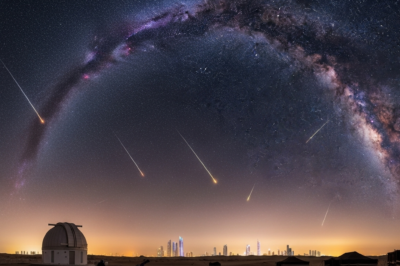
The night sky has long held a mystical allure for the inhabitants of the Arabian Peninsula. From the ancient navigators who used the stars to traverse the shifting sands of the Empty Quarter to modern-day enthusiasts in the high-tech hubs of Dubai and Riyadh, the cosmos remains a source of profound inspiration. As we approach the summer of 2026, the global astronomical community is already buzzing with anticipation for one of the most spectacular celestial displays of the decade: the Perseid meteor shower. While this annual event is a staple for stargazers, the 2026 occurrence promises to be particularly significant for observers in the United Arab Emirates and the wider Middle East due to a rare combination of favorable lunar cycles, clear atmospheric conditions, and the region’s unique geography. For those residing in the GCC, this is not just a scientific event; it is a cultural moment that brings families and hobbyists together under the vast, silent canopy of the desert night.
The Science and History of the Perseid Phenomenon
The Perseid meteor shower is caused by the debris trail left behind by Comet 109P/Swift-Tuttle. As the Earth orbits the Sun, it passes through the thickest part of this debris field every August. The comet itself is a massive object with a nucleus approximately 26 kilometers in diameter, and it takes about 133 years to complete one orbit around the sun. When the Earth hits these particles—mostly composed of dust and ice that are centuries old—they collide with our atmosphere at staggering speeds of up to 59 kilometers per second (nearly 130,000 miles per hour). The friction with the air causes these particles to incinerate, creating the brilliant streaks of light we call meteors or shooting stars. Historically, the Perseids have been recorded for over 2,000 years, with the earliest mentions found in Chinese annals from 36 AD. In medieval Europe, they became known as the ‘Tears of Saint Lawrence,’ as the peak often coincided with the feast day of the saint. Today, the shower is celebrated for its reliability and high frequency, often producing 60 to 100 meteors per hour during its peak.
Why 2026 is a Landmark Year for Middle Eastern Observers
Every year, the primary challenge for meteor hunters is the moon. A bright, full moon can wash out all but the brightest fireballs, reducing a spectacular show to a mediocre one. However, astronomical projections for August 2026 indicate that the Perseids will peak during a New Moon phase. This is the ‘holy grail’ for astronomers. Without the interference of moonlight, the sky remains pitch black, allowing even the faint, delicate ‘trains’ of smaller meteors to be visible to the naked eye. In the UAE and the Middle East, where the humidity can sometimes cause atmospheric haze, having a moonless night is critical for high-contrast viewing. Furthermore, the 2026 peak is expected to align perfectly with the late-night and pre-dawn hours in the UTC+4 and UTC+3 time zones, placing the Middle East in the prime seat for the most intense period of the shower’s activity.
Top Viewing Locations: Escaping the Urban Glow
To truly experience the 2026 Perseids, one must escape the ‘light domes’ of major metropolises. In the UAE, the Mleiha Archaeological Centre in Sharjah is a premier destination, offering a mix of educational programs and dark-sky access. For those willing to drive further, the Al Quaa Milky Way Spot in Abu Dhabi—near the border with Oman—is widely considered the darkest point in the country. This location provides a 360-degree horizon, essential for spotting meteors that may appear low in the sky. In Saudi Arabia, the vastness of the Al-Ula region offers a dramatic backdrop, where ancient rock formations meet the celestial fire. Oman’s Jebel Akhdar and Jebel Shams also provide high-altitude vantage points where the air is thinner and clearer, significantly improving the chances of seeing the ‘long-earth-grazers’ that appear early in the evening.
Essential Gear and Preparation for the Desert Night
While the Perseid meteor shower is best enjoyed with the naked eye—since telescopes and binoculars have a field of view too narrow to catch fast-moving streaks—preparation is key to comfort and success. In the Middle East, even in August, the desert temperature can fluctuate. While it remains warm, the psychological comfort of having a reclining chair or a thick mat cannot be overstated, as you will be looking upward for several hours. Hydration is vital; observers should bring plenty of water and snacks. From a technical standpoint, the most important ‘equipment’ is patience. It takes about 20 to 30 minutes for the human eye to fully adapt to the dark. Using a red-light flashlight instead of a white-light smartphone screen is essential to preserve night vision. For those interested in capturing the event, a DSLR or mirrorless camera with a wide-angle lens (f/2.8 or faster) and a sturdy tripod are necessary to take long-exposure shots of the night sky.
The Rise of Astrotourism in the GCC
The 2026 Perseids come at a time when ‘astrotourism’ is booming across the Middle East. Governments in the region are increasingly recognizing the value of their pristine desert environments as assets for sustainable tourism. Projects like the Red Sea Global in Saudi Arabia are actively working to become ‘Dark Sky’ certified, implementing strict lighting regulations to protect the nocturnal environment. In the UAE, the Dubai Astronomy Group regularly hosts mass-viewing events that attract thousands of residents and tourists. This shift reflects a growing public interest in science and space exploration, fueled by the successful Mars missions and astronaut programs of the UAE and Saudi Arabia. The 2026 meteor shower is expected to be a major catalyst for this industry, with hotels and tour operators already planning ‘Star-Gazing Safaris’ and luxury desert camps tailored specifically for the event.
Navigating Potential Challenges: Weather and Dust
Despite the perfect lunar conditions, Middle Eastern observers must contend with two primary environmental factors: heat and dust. August is the peak of summer, and while the night brings some relief, humidity levels along the coast can be stifling. This humidity can also create a ‘haze’ that scatters light and reduces visibility. To mitigate this, seeking higher altitudes—such as the Hajar Mountains—is often the best strategy. Additionally, shamals (dust storms) can occur unexpectedly. Monitoring local meteorological reports from the National Center of Meteorology (NCM) in the days leading up to August 12th is crucial. If a dust storm is present, the particles in the air can completely obscure the stars. However, if the air is clear, the low humidity of the deep interior desert provides some of the best seeing conditions found anywhere on Earth.
Final Reflections: A Connection Beyond the Horizon
The 2026 Perseid meteor shower represents more than just a fleeting streak of light in the sky; it is a reminder of our place in a much larger, more complex universe. In an era dominated by screens and artificial light, the act of lying on the desert sand and looking into the infinite void offers a rare moment of perspective. For the Middle East, a region that is rapidly modernizing and reaching for the stars through its own space agencies, the Perseids serve as a bridge between a rich nomadic past and a high-tech future. Whether you are a professional astronomer or a curious resident, the 2026 shower is an invitation to pause, look up, and witness the raw, unfiltered beauty of the cosmos. As the debris of a comet thousands of years old burns up in our atmosphere, we are reminded that the universe is a dynamic, ever-changing stage, and for one night in August, the Middle East has the best seat in the house.





































Leave a Reply