
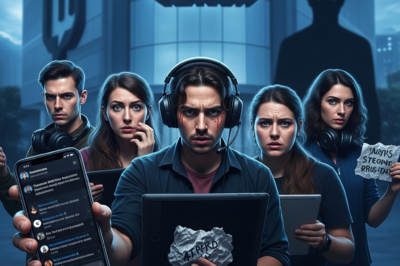
Twitch, the world’s leading live-streaming platform, has long been the digital home for millions of creators, ranging from high-stakes professional gamers to niche hobbyists and ASMR artists. However, a recent report from NPR has ignited a firestorm of controversy that threatens to destabilize the delicate relationship between the platform and its most valuable asset: its creators. The crux of the outrage stems from reports that Twitch is preparing to feed the vast archives of user-generated content—spanning over a decade of live broadcasts, clips, and VODs—into the artificial intelligence training pipelines of its parent company, Amazon. This move has sparked a global conversation about the ethics of data scraping, the erosion of intellectual property, and the potential for AI to replace the very humans that built the platform. As the digital landscape shifts toward a generative AI future, creators are beginning to realize that their personality, voice, and likeness might be the raw materials for their own eventual obsolescence. The backlash is not merely a complaint about technical settings; it is an existential cry for recognition in a world where data is often valued more than the humans who produce it.
The Core of the Controversy: Transparency and Consent
The primary driver of the current backlash is the perceived lack of transparency regarding how creator data is being utilized. For years, streamers have uploaded content to Twitch under the impression that the platform provided a stage for their creativity in exchange for a share of advertising revenue and subscription fees. However, the revelation that Amazon, a multi-trillion-dollar conglomerate, intends to use this data to train its own proprietary AI models changes the fundamental nature of that agreement. Most creators were never explicitly asked for permission to have their likenesses used for machine learning. Instead, these permissions are often buried deep within dense Terms of Service (ToS) agreements that are frequently updated without clear highlights of significant changes. Critics argue that “implied consent” through a terms-of-service update is insufficient for such a transformative use of personal data. The distinction between hosting a video for public viewing and using that same video to train a generative model that can mimic a creator’s voice or style is a legal and ethical chasm. Creators are demanding an opt-in system rather than a default opt-out, arguing that they should have direct control over whether their digital persona contributes to a corporate AI product.
Intellectual Property in the Age of Generative AI
At the heart of the Twitch controversy lies the thorny issue of intellectual property (IP). In the traditional media world, a performer owns their performance, or at the very least, they are compensated for its rebroadcast. In the realm of AI training, the legal landscape is far more nebulous. Amazon’s AI models, which likely include large language models (LLMs) and multimodal systems capable of generating video and audio, require billions of data points to function effectively. Twitch is a goldmine for this data because it features natural, unscripted human interaction, diverse accents, and real-time social dynamics—data that is much harder to come by than the polished text of Wikipedia or the static images of Stock libraries. However, creators argue that their unique “brand” is being harvested without compensation. If Amazon can train an AI to understand the nuances of a high-energy gaming stream or a calming art tutorial, it could theoretically produce synthetic content that competes directly with the original creators. This raises the question: if a platform uses your work to build a tool that makes your work irrelevant, shouldn’t you be compensated for that contribution? Legal experts suggest that the current copyright laws are ill-equipped to handle the nuances of AI training, leaving creators in a vulnerable position where their life’s work is treated as mere training data.
Amazon’s AI Ambitions and the Hunt for Data
To understand why Twitch is taking this path, one must look at the broader strategic goals of Amazon. The company is currently locked in a fierce arms race with tech giants like Google, Microsoft, and OpenAI to dominate the generative AI market. Amazon’s AI offerings, such as Bedrock and its Titan models, are designed to serve enterprise clients and individual consumers alike. However, high-quality video data is the next frontier for AI training. While text-based AI has reached a level of maturity, video-to-video and audio-to-video AI are still in their formative stages. Twitch offers a continuous stream of multimodal data—audio, visual, and textual (via chat)—all synchronized in real-time. This is essentially the “holy grail” for training sophisticated AI that understands human emotion and situational context. By leveraging Twitch content, Amazon can potentially bypass the expensive licensing fees that other AI companies are beginning to pay to traditional media outlets. For Amazon, this is a matter of corporate efficiency and technological dominance. For the creator, it feels like an extractive relationship where the platform extracts value from the user without providing a reciprocal benefit in the new AI economy.
The Economic Disruption of the Creator Economy
The potential economic implications of Amazon’s AI plans are profound. Many Twitch streamers have spent years, sometimes a decade, building a community and a personal brand that generates a living through ads and tips. If AI models trained on Twitch data are used to create “synthetic streamers”—virtual avatars that can broadcast 24/7, never tire, and are fully controlled by the platform—the human creator economy could collapse. These synthetic influencers could be programmed to perfectly align with advertiser needs, avoiding the controversies and unpredictability that come with human streamers. Furthermore, if Amazon uses Twitch data to improve its automated moderation or ad-placement algorithms, it might seem beneficial, but creators fear the technology will eventually be used to automate the creative process itself. There is also the issue of the “value gap.” As AI generates more content, the market may become saturated with high-quality, AI-produced entertainment, driving down the CPM (cost per mille) for human-generated content. Streamers are rightfully worried that they are essentially training their own robotic replacements, providing the blueprints for a system that will eventually exclude them from the revenue loop.
The Threat of Platform Migration and the Rise of Competitors
The backlash has led to a renewed discussion about platform loyalty. In recent years, Twitch has already faced criticism for its revenue-sharing models and changes to its ad policies, leading some high-profile streamers to migrate to competitors like YouTube Gaming or Kick. This AI controversy could be the final straw for many. Kick, in particular, has positioned itself as a creator-centric alternative with a 95-5 revenue split, and while it lacks the infrastructure of Twitch, it offers a refuge for those who feel exploited by Amazon’s policies. However, migration is not a simple solution. Twitch’s “network effect”—the sheer volume of viewers already on the platform—makes it difficult for smaller creators to leave without losing their livelihoods. This creates a power imbalance where Twitch can afford to ignore some level of backlash because it knows the switching costs for creators are prohibitively high. Nevertheless, if a significant number of “tentpole” creators—those who drive the most traffic—decide to leave in protest, it could force Twitch to reconsider its AI data-sharing policies. The collective power of creators is currently being tested, and the outcome will likely set a precedent for how other platforms like TikTok and Instagram handle similar data-harvesting initiatives.
Regulatory Hurdles and the Future of Digital Rights
As the outcry grows, regulators are starting to take notice. In the European Union, the AI Act is already setting some boundaries for transparency and the use of copyrighted material in AI training. In the United States, several high-profile lawsuits, such as those brought by the New York Times against OpenAI, are moving through the courts to determine whether training AI on copyrighted data constitutes “fair use.” The Twitch controversy adds a new layer to this legal battle: the right to one’s likeness and voice. Unlike a static article, a live stream is a performance. Some legal scholars argue that using a person’s voice and movements to train AI could violate “right of publicity” laws, which vary significantly by jurisdiction. If streamers can successfully argue that their digital persona is being misappropriated, it could lead to new regulations that force companies like Amazon to offer clear compensation or opt-in requirements. For now, the future remains uncertain, but the Twitch backlash is a clear signal that the era of tech companies freely harvesting user data for AI training without consequence is coming to an end. The digital rights of the future will be won or lost in the coming months as creators, platforms, and lawmakers navigate this unprecedented technological shift.
Conclusion: A New Social Contract for the Digital Age
The controversy surrounding Twitch and Amazon’s AI training plans is a microcosm of a much larger societal challenge. As artificial intelligence becomes integrated into every facet of our digital lives, the old social contracts between platforms and users are no longer sufficient. We are entering an era where our digital output—our words, our faces, our creative expressions—has become the fuel for a new industrial revolution. For Twitch to regain the trust of its community, it must move toward a more transparent and equitable model that respects the agency of creators. This might involve revenue sharing for AI-derived products, clear and granular opt-in controls, or a commitment to not use creator data for synthetic competitors. Ultimately, the value of Twitch has never been its code or its servers; it has been the vibrant, chaotic, and deeply human community that calls it home. If Amazon loses sight of that in its pursuit of AI dominance, it may find itself with a powerful algorithm but no community left to watch it. The backlash is a reminder that in the age of automation, human creativity and consent must remain at the forefront of innovation.







































Leave a Reply