
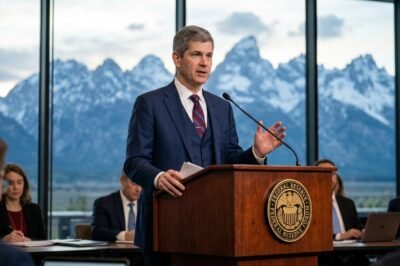
The annual Jackson Hole Economic Symposium has long served as the crucible for global monetary policy, a high-altitude retreat where the world’s most powerful central bankers signal shifts that ripple through trillions of dollars in assets. This year, the spotlight fell squarely on Federal Reserve Chair Kevin Warsh, whose address carried a weight of expectation rarely seen in recent economic history. Standing against the backdrop of the Teton Range, Warsh delivered a sober, uncompromising assessment of the American economy, centered on a singular, echoing refrain: ‘We have work to do’ on inflation. This was not the victory lap some market participants had hoped for; instead, it was a clarion call for continued vigilance and a stark reminder that the path to price stability remains fraught with structural hurdles. For investors, the message was clear: the era of easy money is not returning anytime soon, and the Fed’s commitment to its 2% mandate is an immovable object in the face of political and market pressures. This speech marks a defining moment in the current tightening cycle, setting the stage for a prolonged battle against inflationary pressures that have proven more stubborn than anticipated. Under the intense scrutiny of global economists, Warsh articulated a vision of monetary policy that prioritizes long-term stability over short-term market relief. The gravity of his words was felt immediately across equity and bond markets, as traders recalibrated their expectations for the remainder of the fiscal year. Historically, Jackson Hole serves as a pivot point, and Warsh’s rhetoric suggests a pivot toward a more restrictive and enduring stance. The intricacies of his speech suggest a deep-seated concern regarding the ‘last mile’ of inflation reduction, acknowledging that while the peak may be behind us, the floor is still unacceptably high. As the world watches, the Federal Reserve under Warsh appears prepared to endure the necessary economic cooling to ensure that the specter of the 1970s stagflation does not return to haunt the modern era. This analysis explores the profound implications of his statements, the economic data driving this resolve, and what it means for the future of the global financial system.
## The Inflationary Landscape: Why the ‘Last Mile’ is the Hardest
Inflation has proven to be a multi-headed hydra, and Kevin Warsh’s address focused heavily on the structural components that keep the Consumer Price Index (CPI) above the desired target. While headline inflation has retreated from its pandemic-era highs, core inflation—which strips out volatile food and energy costs—remains sticky, particularly in the services sector and housing. Warsh pointed to the persistence of wage growth as a dual-edged sword: while beneficial for consumers, it creates a feedback loop that businesses often offset by raising prices. The Federal Reserve’s data indicates that service-sector inflation is running significantly higher than the 2% target, driven by a tight labor market where demand for workers continues to outpace supply. Warsh emphasized that the ‘work to do’ involves cooling this demand without triggering a systemic collapse in employment, a delicate balancing act that requires precise, data-dependent adjustments. Statistics cited during the symposium suggest that while supply chain disruptions have largely normalized, the domestic demand-side pressures are now the primary drivers of price increases. This shift from exogenous shocks to internal economic heat means the Fed’s primary tool—interest rates—must remain elevated for longer to dampen the enthusiasm of both corporations and consumers.
## Quantitative Tightening and the Fed’s Balance Sheet Strategy
A critical, yet often overlooked, aspect of Warsh’s speech was the emphasis on the Federal Reserve’s balance sheet. ‘We have work to do’ applies not only to interest rates but also to the reduction of the Fed’s massive holdings of Treasury and mortgage-backed securities. Quantitative Tightening (QT) is the silent partner to rate hikes, serving to drain liquidity from the financial system. Warsh signaled that the pace of QT would remain steady, despite concerns about liquidity in the banking sector. By reducing the balance sheet, the Fed is effectively tightening financial conditions without needing to move the federal funds rate as aggressively in every meeting. This strategy aims to flatten the yield curve and ensure that long-term borrowing costs reflect a more restrictive environment. The implications for the housing market are particularly acute; as the Fed allows mortgage-backed securities to roll off its books, mortgage rates are likely to stay elevated, further cooling a housing market that has been a major contributor to inflationary data through ‘owners’ equivalent rent.’ Warsh’s resolve here suggests that the Fed is willing to tolerate a period of lower growth to ensure the monetary base is right-sized for a post-pandemic economy.
## Global Market Reactions and the Strength of the Dollar
The immediate aftermath of Warsh’s Jackson Hole address saw a surge in the U.S. Dollar Index (DXY) and a corresponding sell-off in risk assets, including equities and cryptocurrencies. Market participants, who had been pricing in a more dovish tone, were forced to adjust to the ‘higher for longer’ reality. For the global economy, a strong dollar presents a complex set of challenges. As the world’s reserve currency, a surging dollar effectively exports inflation to other nations, making their imports of dollar-denominated goods, like oil and technology, more expensive. Warsh acknowledged the global interconnectedness of monetary policy but maintained that the Fed’s primary mandate is domestic price stability. This stance reinforces the ‘U.S. exceptionalism’ in monetary policy, where the Fed’s aggressive posture forces other central banks, such as the ECB and the Bank of England, to follow suit to protect their own currencies. The ripple effects are felt most acutely in emerging markets, where dollar-denominated debt becomes harder to service, potentially leading to credit stresses that the Fed must monitor closely.
## The Labor Market Paradox: Balancing Full Employment with Price Stability
One of the most contentious points of Warsh’s analysis is the state of the U.S. labor market. Traditionally, the Phillips Curve suggests that to lower inflation, unemployment must rise. However, the post-pandemic era has challenged this orthodoxy. Warsh noted that while the labor market remains ‘historically tight,’ there are signs of gradual cooling. The ‘work to do’ involves guiding the economy toward a ‘soft landing,’ where inflation returns to 2% without a significant spike in the unemployment rate. Critics argue that the Fed’s current trajectory makes a recession almost inevitable, yet Warsh pointed to the resilience of the American consumer and the high level of job openings as buffers against a deep downturn. The Fed is looking for a reduction in job vacancies rather than outright layoffs, a nuance that is critical for maintaining social and economic stability. If the Fed can successfully moderate wage growth without causing mass unemployment, it will have achieved a feat rarely seen in economic history.
## Credibility and the Psychology of Inflation Expectations
Perhaps the most vital ‘work’ the Fed has to do is maintaining its credibility. Warsh’s speech was as much about psychology as it was about economics. Central banks rely on the public’s belief that they will actually achieve their inflation targets. If consumers and businesses expect high inflation to persist, they behave in ways that make it a self-fulfilling prophecy—raising prices today in anticipation of higher costs tomorrow. By taking a hardline stance at Jackson Hole, Warsh is attempting to anchor inflation expectations. He signaled that the Fed would rather over-tighten and risk a slowdown than under-tighten and allow inflation to become entrenched in the American psyche. This commitment to the 2% target is the bedrock of the Fed’s long-term strategy, and Warsh’s rhetoric was designed to remove any doubt about the committee’s resolve. The ‘work to do’ is a promise to the markets that the Fed will not blink, regardless of the political calendar or short-term volatility.
## Conclusion: The Road Ahead After Jackson Hole
In the wake of Kevin Warsh’s address at Jackson Hole, the economic path forward is illuminated by a harsh, clear light. The Federal Reserve has signaled that the battle against inflation is entering a new, more grueling phase. While the initial shocks have been absorbed, the ‘work to do’ involves a persistent and disciplined application of monetary pressure. Investors should prepare for a period of lower volatility in interest rate expectations but higher volatility in asset prices as the reality of a restrictive environment sinks in. The coming months will be defined by critical data points—CPI releases, jobs reports, and manufacturing indices—each of which will be viewed through the lens of Warsh’s Jackson Hole mandate. Ultimately, the success of this policy will be judged by whether the Fed can restore price stability without fracturing the broader economy. As we move toward the end of the year, the echo of ‘work to do’ will serve as the guiding principle for a Federal Reserve determined to secure the foundations of the American economy for the next decade.




































Leave a Reply