
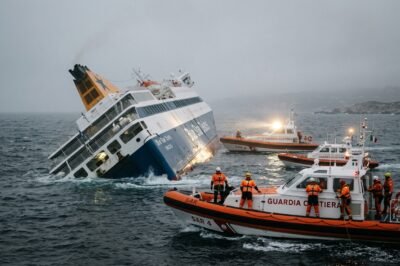
In the pre-dawn shadows of the Mediterranean, where the azure waters meet the rugged coastline of North Cyprus, a scene of tranquility was shattered by a catastrophic maritime disaster. Reports emerged of a ferry boat, carrying approximately 270 souls, succumbing to the waves and capsizing in a sudden, violent turn of events. This incident, documented by the Hindustan Times and global news agencies, serves as a grim reminder of the inherent dangers lurking within the world’s busiest maritime corridors. As the vessel tilted and eventually overturned, the cries for help were swallowed by the vast expanse of the sea, triggering an immediate and desperate search and rescue operation. The scale of the tragedy is underscored by the sheer number of passengers involved, many of whom were seeking passage across the volatile waters of the Levant. This disaster does not exist in a vacuum; it is a manifestation of systemic issues ranging from vessel maintenance failures to the high-stakes migration routes that define modern Mediterranean history. As families await word on their loved ones and authorities scramble to coordinate recovery efforts, the world watches with bated breath, questioning how such a significant loss of life continues to be a recurring theme in 21st-century maritime travel. The following analysis delves into the technical, political, and humanitarian dimensions of this tragedy. H2: The Immediate Rescue Response and Strategic Hurdles. When the distress signal was first broadcast, the response was immediate but complicated by the geography of the North Cyprus coastline. Rescue vessels from the Turkish Coast Guard and local Northern Cypriot authorities were among the first to arrive on the scene. However, coordinating a search area that encompasses hundreds of square miles for 270 individuals is a logistical nightmare. The use of thermal imaging from helicopters and the deployment of divers have been critical components of the operation. Despite these efforts, the choppy waters and the time of day when the capsize occurred significantly hindered the initial search. Rescuers are facing a race against time, as hypothermia becomes a major risk for those in the water. Furthermore, the lack of a centralized maritime coordination center recognized by all neighboring states complicates the sharing of real-time data, which is essential for maximizing the efficiency of search patterns. The search and rescue (SAR) teams have had to navigate not only physical waves but the complexities of international maritime zones, where jurisdiction can often become a point of contention rather than cooperation. H2: Geographic Vulnerability: The Strategic and Dangerous Waters of North Cyprus. North Cyprus occupies a unique and often contested position in the Mediterranean. Its proximity to both the Middle East and mainland Europe makes it a frequent transit point for both commercial and passenger vessels. The waters off its coast are deep and subject to thermal layers that can affect vessel stability and sonar detection. This specific region has seen an uptick in maritime traffic over the last decade, yet the infrastructure to support large-scale emergency responses has not always kept pace with the volume of transit. The capsize of a ferry with 270 people highlights the urgent need for a more robust maritime safety net in this specific corridor. The political status of North Cyprus also plays a role in how international aid is funneled into the region, often creating delays in what should be a seamless humanitarian effort. For years, experts have warned that the Eastern Mediterranean is becoming a bottleneck for safety, where the intersection of tourism, trade, and migration creates a high-risk environment for maritime accidents. H2: Investigating the Root Causes: Overloading vs Structural Failure. While the official investigation is still in its infancy, maritime experts are pointing toward two primary possibilities: overcrowding or a critical mechanical failure. A ferry designed for a certain capacity can become dangerously unstable if it exceeds that limit, particularly in rough seas where the center of gravity shifts with every wave. On the other hand, aging vessel fleets that are not subjected to rigorous international safety inspections are prone to hull breaches or engine failures that can lead to rapid capsizing. The report that 270 passengers were on board will be scrutinized against the vessel’s certified capacity. If the boat was indeed overloaded, it raises questions about port security and the enforcement of passenger manifests. Conversely, if a structural failure was the culprit, it highlights the need for stricter global standards for ferry maintenance and seaworthiness. Many vessels operating in these peripheral waters are sold several times over, often ending up in the hands of operators who bypass the stringent regulations found in more central European ports. H2: The Socio-Political Context of Mediterranean Crossings. This disaster cannot be understood without acknowledging the human stories of those on board. While some ferries in the region serve tourists and locals, many are used by individuals seeking a better life in Europe. The Mediterranean has become one of the deadliest migration routes in the world. The desperation that leads 270 people to board a single vessel is often driven by conflict, economic instability, and the search for safety. This incident off North Cyprus is a microcosm of a much larger global crisis. The political discourse surrounding these crossings often focuses on border security, but the human cost, as evidenced by this capsizing, demands a shift toward humanitarian protection and safe passage. The international community must reconcile its policy goals with the moral imperative to prevent such mass casualties at sea. The sociological impact on the local communities in North Cyprus, who often become the first responders to these tragedies, is also profound, creating a cycle of trauma and grief that transcends national borders. H2: International Maritime Law and Post-Accident Accountability. In the wake of such a tragedy, the question of legal responsibility becomes paramount. Under the United Nations Convention on the Law of the Sea (UNCLOS), coastal states have specific obligations regarding search and rescue within their designated zones. However, the unique legal status of North Cyprus complicates the application of these international treaties. Who is ultimately responsible for the safety of the passengers? Is it the flag state of the vessel, the port of departure, or the authorities in whose waters the accident occurred? Establishing a clear chain of accountability is essential not only for providing justice to the victims and their families but also for preventing future occurrences. Legal experts will be looking closely at the vessel’s registration and the insurance protocols that were in place, or lack thereof, which often characterize the shadow fleet of ferries operating in less regulated waters. Without a clear precedent for accountability, the families of the 270 passengers may find themselves in a legal vacuum, unable to seek compensation or answers. H2: Technological Solutions and Future Maritime Safety Protocols. To prevent a repeat of the North Cyprus disaster, a paradigm shift in maritime technology is required. This includes the mandatory installation of real-time passenger tracking systems and automated stability sensors that can alert a crew—and shore-based monitors—long before a vessel reaches a critical tipping point. Furthermore, the use of satellite AIS (Automatic Identification System) data can help coastal guards monitor vessel behavior and identify ships that are behaving erratically or are in distress before a formal SOS is even sent. Enhanced drone surveillance could also provide a faster, more cost-effective way to monitor vast stretches of the Mediterranean, ensuring that when a capsize does happen, the response time is measured in minutes rather than hours. Investing in these technologies is no longer an option but a necessity for any region that hosts significant maritime traffic. The integration of Artificial Intelligence to predict weather patterns and their impact on specific vessel types could also play a major role in preventing capsizing events. H2: Conclusion: A Call for Global Solidarity and Reform. The capsizing of the ferry off North Cyprus is a somber milestone in the history of Mediterranean maritime incidents. With 270 lives hanging in the balance, the immediate priority remains the rescue and recovery of every individual. However, once the waves settle, the international community must engage in a rigorous process of reflection and reform. We cannot continue to allow vessel safety to be compromised by political disputes or economic shortcuts. This tragedy must serve as a catalyst for a more unified approach to maritime safety, one that prioritizes human life above all else. Whether through stricter enforcement of international shipping laws, better regional cooperation, or the deployment of life-saving technology, the goal must be clear: a sea where no journey ends in such a devastating loss. Our thoughts remain with the survivors and the families of those missing, even as we strive to ensure that such a report never has to be written again. The future of Mediterranean travel depends on our ability to transform this grief into actionable policy changes.
Tragic Ferry Capsizing off North Cyprus: A Comprehensive Analysis of the Maritime Disaster and Search Operations
Posted by
Stories





-

Hunkkaar Teaser Analysis: Aneet Padda’s Gritty Transformation and the Evolving Landscape of Indian Thrillers
-

Mithila Palkar: The Relatable Queen of Indian Web Series and Her Meteoric Rise
-

Wamiqa Gabbi: The Meteoric Rise of Indian Web Series’ Most Versatile Leading Lady
-

Triptii Dimri Biography: The Evolution of India’s Newest Cinematic Sensation and Web Series Star
-

Wamiqa Gabbi: The Rise of India’s New Digital Icon and the Future of OTT Stardom
-

Mithila Palkar: The Unstoppable Evolution of India’s Digital Darling and Her Journey to the Silver Screen
-

Mithila Palkar: The Comprehensive Journey of India’s Web Series Sensation and Digital Pioneer
-

Mithila Palkar: The Relatable Queen of Indian Web Series and Her Inspiring Journey to Stardom
-

Sobhita Dhulipala Biography: The Meteoric Rise of India’s Most Versatile Web Series Star
-

Mithila Palkar: The Unstoppable Journey of India’s Digital Darling and Web Series Queen
-

Triptii Dimri: The Complete Biography of India’s Newest Cinematic Sensation and Web Series Icon
-

Wamiqa Gabbi: The Ethereal Rise of India’s Most Versatile Web Series Star
-

Sobhita Dhulipala: The Unstoppable Rise of India’s Most Versatile Web Series Icon
-

Wamiqa Gabbi: The Meteoric Rise of the New Queen of Indian Web Series and Her Unstoppable Journey to Stardom
-

Triptii Dimri: The Meteoric Rise of India’s New Cinema Sweetheart and Web Series Icon
-

Wamiqa Gabbi: The Versatile Queen of Indian OTT and Her Phenomenal Rise to Stardom
-

Tripti Dimri Biography: The Rise of India’s New National Crush and Her Journey from Laila Majnu to OTT Stardom
-

Wamiqa Gabbi Biography: The Meteoric Rise of India’s Newest OTT Sensation and Versatile Powerhouse
-

Wamiqa Gabbi Biography: The Meteoric Rise of the Digital Queen of Indian Web Series
-

The Rise of Wamiqa Gabbi: A Deep Dive into the Journey of India’s Most Versatile OTT Sensation
-

The Meteoric Rise of Triptii Dimri: Biography, Acting Prowess, and the Journey of India’s Newest Cinema Sensation

Launching Soon: The Future of News with Our E-Newspaper
In the ever-evolving landscape of media and technology, we are thrilled to announce the upcoming launch of our innovative e-newspaper, set to redefine the way news is consumed in the digital age. Embracing the convenience and accessibility that the digital world offers, our e-newspaper aims to deliver real-time news updates, insightful articles, and interactive features directly to your devices. With a commitment to journalistic integrity and a passion for storytelling, we are dedicated to keeping you informed, engaged, and connected, no matter where you are. Stay tuned for the launch of our e-newspaper, where the future of news awaits at your fingertips.
Recent News
- The Viral Oversight: Delhi Police Constable Faces Inquiry Over BRICS Summit Social Media Reel

- Until it’s not possible, it’s possible – Zak Brown and McLaren’s Bold Title Ambitions After Barcelona

- Apple iPhone 17 Pro price drops to Rs 69,990 at Croma with exchange bonus; get free case and 10% off… – Moneycontrol.com

- The Audiophile’s Dilemma: Why the Galaxy Z Fold8 Still Trails the Ultra Series in Sonic Performance

- Joe Root Makes History: The First Batter to Breach the 2,000-Run Barrier Against Three Nations in 147 Years of Test Cricket

- India Secures Substantial 1.64 Million-Tonne Steel Quota in EU Markets: A Strategic Analysis of Trade and Growth

Politics
- Sanjeev Sanyal’s Stand: Why ‘Dhurandhar’ Is a Cultural Narrative, Not Propaganda

- Strategic Reshuffle: Analyzing the Impact of Sachin Pilot Replacing Bhupesh Baghel in Punjab

- The Pentagon’s High-Stakes Hunt: Mass Polygraph Tests and the Investigation into the Iran War Data Leak

- PM Modi Recycles Half Water-Half Air Line At Shri Ram College, 13 Years After Big Launch Speech – NDTV

- The India-Iran-USA Triad: Deciphering the Geopolitical Fallout of the Modi-Pezeshkian Meeting

- Rupee gains 47 paise as record FCNR inflows boost forex liquidity – The Times of India

Categories
- Art & Culture 101
- Auto 85
- Beauty 15
- Blog 270
- Books 7
- Business 359
- Celebrities 217
- Crime Files 139
- Democracy 308
- Education 84
- Entertainment 154
- Environment 133
- epaper 1
- Fashion 37
- Food 58
- Gadgets 86
- Guide 150
- Handicrafts 11
- Health 268
- Healthy Living 107
- History 5
- incidents 159
- Lifestyle 40
- Music 6
- Photography 15
- Politics 433
- Science & Technology 160
- Sports 245
- Tech 126
- Television 2
- Travel 68
- Travel & Tourism 30
- Trends 44
- Weather 8
- Web Series 97
- Workout 4
- World 656
Leave a Reply