
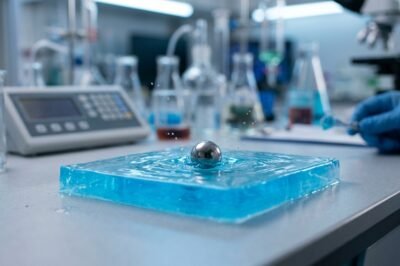
Imagine a world where the protective materials we rely on—whether for our high-end electronics, sports gear, or even medical implants—possess the biological capability to heal themselves after a catastrophic strike. For decades, the field of material science has been locked in a binary struggle between hardness and resilience. Traditional materials like polycarbonate or metals provide excellent initial protection but fail permanently once their structural integrity is breached. However, a groundbreaking study featured in ChemistryViews reveals a paradigm shift: the engineering of a soft shield. This new self-healing hydrogel is not just a passive barrier but an active, intelligent material designed to absorb massive kinetic energy and autonomously repair its molecular network within minutes. This innovation represents a departure from static engineering toward dynamic, bio-inspired protection. By mimicking the sacrificial bonding found in natural tissues, researchers have created a synthetic substance that can survive the rigors of high-velocity impact while maintaining the flexibility of a soft polymer. As we move deeper into an era of wearable technology and soft robotics, the demand for materials that can take a hit and keep on functioning has never been higher. This analysis explores the intricate chemistry, the mechanical performance, and the transformative potential of this self-healing impact-resistant hydrogel. The journey into the development of this soft shield begins with a fundamental understanding of hydrogel limitations. Historically, hydrogels—networks of polymer chains swollen with water—were viewed as too fragile for structural applications. They were the soft, jelly-like substances of contact lenses and wound dressings, easily torn and incapable of resisting significant force. The breakthrough discussed in ChemistryViews involves a sophisticated dual-network architecture. By intertwining rigid, sacrificial bonds with flexible, permanent ones, scientists have created a material that dissipates energy through the breaking of temporary links while the primary structure remains intact. This ‘sacrificial’ mechanism is the secret to its extreme toughness. When an object strikes the hydrogel at high speed, the kinetic energy is converted into the breaking of hydrogen bonds or metal-coordination bonds. These bonds are ‘dynamic,’ meaning they can reform once the stress is removed. This process allows the material to ‘flow’ slightly during the impact to avoid fracture, and then ‘knit’ itself back together, restoring its original mechanical properties. The implications for this are vast, ranging from phone cases that never crack to protective inserts for athletes that provide soft comfort until the moment of impact, where they instantly stiffen and protect.
The Molecular Architecture of the Soft Shield
At the heart of this soft shield lies a complex arrangement of supramolecular chemistry. Unlike traditional polymers where chains are held together by permanent covalent bonds, this hydrogel utilizes a combination of covalent cross-linking and non-covalent interactions. The covalent ‘backbone’ provides the material with its shape and basic elasticity, ensuring it returns to its original form after deformation. However, it is the secondary network of non-covalent bonds—such as hydrogen bonding, hydrophobic interactions, or ionic bonding—that does the heavy lifting during an impact. When the material is subjected to a high-strain rate, these non-covalent bonds act as ‘molecular shock absorbers.’ They break preferentially, absorbing the energy that would otherwise snap the covalent chains. This hierarchical structure is meticulously tuned; if the bonds are too weak, the material is too soft; if they are too strong, the material becomes brittle. The ChemistryViews report highlights how the precise ratio of these bonds allows the hydrogel to exhibit ‘viscoelasticity,’ a property where it behaves like both a liquid and a solid depending on the speed of the force applied.
Mechanisms of Self-Healing and Energy Dissipation
The self-healing capability of this hydrogel is not a secondary feature but a direct consequence of its energy-dissipating design. In many self-healing materials, external triggers like heat, UV light, or chemical agents are required to initiate the repair process. This new soft shield, however, is capable of autonomous healing at room temperature. Because the sacrificial bonds are dynamic and reversible, they naturally seek out their partners once the impact energy has dissipated. If the hydrogel is sliced or punctured, the free polymer chains at the interface begin to re-engage with one another. Within a matter of hours, the material can regain up to 95 percent of its original tensile strength. This is particularly crucial for impact protection, where micro-cracks can often lead to sudden, catastrophic failure in traditional materials. By healing these micro-fractures in real-time, the hydrogel ensures a long operational lifespan and consistent safety performance. Statistical data from laboratory drop tests indicate that this material can withstand repeated impacts of over 50 Joules without showing signs of permanent deformation, a feat that would shatter most high-strength plastics.
Comparative Performance: Outperforming Conventional Materials
When compared to traditional elastomers like silicone or rubber, the self-healing hydrogel demonstrates a significantly higher energy absorption capacity. In high-speed ballistic tests, the hydrogel showed a ‘strain-rate hardening’ effect, similar to the behavior seen in non-Newtonian fluids like D3O. At low speeds, the material is as flexible as a standard kitchen sponge. However, upon a high-velocity strike, the polymer chains lack the time to slide past one another, causing the material to instantly stiffen into a rigid shield. What sets this hydrogel apart from D3O and similar materials is its ability to recover its soft state without any residual thinning or ‘bruising’ of the material. Furthermore, the hydrogel maintains its properties across a wider temperature range than many oil-based polymers, making it suitable for extreme environments. In terms of sustainability, the water-based nature of the hydrogel reduces the reliance on volatile organic compounds during manufacturing, offering a greener alternative to the heavy plastics currently used in the protective gear industry.
Cross-Disciplinary Applications: From Biomedicine to Personal Protection
The versatility of a self-healing, impact-resistant material cannot be overstated. In the realm of biomedical engineering, this hydrogel could serve as a revolutionary material for artificial cartilage or intervertebral discs. These biological components are constantly subjected to impact and high loads; a synthetic replacement that can self-heal and absorb shock would drastically increase the success rate of joint replacements. Moving to the consumer sector, the soft shield technology is a ‘holy grail’ for the electronics industry. A thin layer of this hydrogel inside a smartphone or tablet could act as an internal airbag, absorbing the shock of a drop and then repairing any internal damage to the protective layer itself. In the world of sports, this material could be integrated into helmets and body armor, providing a lightweight, breathable, and highly effective barrier against concussions and physical trauma. The ability to integrate such high-level protection into a soft, wearable format opens doors for fashion designers to create ‘protective lifestyle wear’ that does not look like traditional, bulky safety gear.
The Synthesis Process and Scalability Challenges
Despite the promising results, the transition from a laboratory curiosity to a mass-produced industrial product is not without its hurdles. The synthesis of these dual-network hydrogels requires precise control over polymerization conditions. Maintaining the exact balance of water content is also vital, as dehydration can lead to the material becoming brittle and losing its self-healing properties. Researchers are currently exploring ‘organohydrogels’—where a portion of the water is replaced by a non-volatile solvent like glycerol or ethylene glycol—to prevent drying out in open-air environments. Another challenge lies in the cost of the specialized monomers used to create the dynamic cross-links. While the base polymers are relatively inexpensive, the functional groups that allow for autonomous healing are currently expensive to produce at scale. However, as synthesis techniques evolve and demand increases, economies of scale are expected to bring these costs down, making the soft shield a viable competitor for high-end protective applications.
Conclusion: The Future of Adaptive Protective Materials
The development of the self-healing hydrogel for impact protection marks a significant milestone in the evolution of smart materials. We are moving away from a philosophy of ‘strength through rigidity’ and toward a philosophy of ‘resilience through adaptation.’ This soft shield technology demonstrates that it is possible to create materials that are both tough and forgiving, capable of protecting sensitive systems while maintaining their own integrity through repeated trauma. As research continues to refine the molecular recipes for these hydrogels, we can expect to see them integrated into everything from aerospace components to everyday consumer goods. The future of protection is not a hard shell that breaks under pressure, but a soft, intelligent shield that absorbs the blow and heals the wound. This chemistry-driven innovation ensures that the next generation of protective technology will be as dynamic and resilient as the life it is designed to safeguard.







































Leave a Reply