
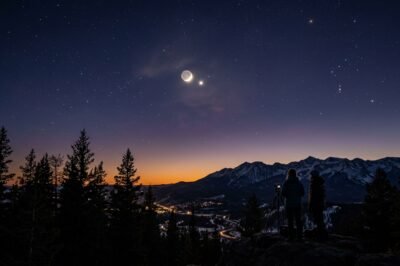
The nocturnal canopy has long beckoned the curious and the scholarly, serving as humanity’s most ancient and profound tapestry, a canvas upon which the laws of physics and the beauty of the cosmos are perpetually displayed. Recently, a breathtaking astronomical event captured the attention of observers worldwide, as reported by english.news.cn: the brilliant planet Venus appeared in close proximity to the crescent moon. This celestial rendezvous, known in astronomical terms as a conjunction, is far more than a mere visual delight; it is a complex interplay of orbital mechanics, atmospheric conditions, and perspective that offers a unique window into the workings of our solar system. For thousands of years, such alignments have inspired mythologies, guided explorers, and fueled the rigors of scientific inquiry. In the modern era, where urban light pollution often obscures the heavens, the striking visibility of Venus alongside our natural satellite serves as a powerful reminder of our place in the universe. This analysis delves deep into the science behind this event, exploring why Venus shines with such intensity, the geometry required for such a pairing, and what these occurrences signify for both professional astronomers and casual stargazers alike. By understanding the intricate movements of these celestial bodies, we gain a greater appreciation for the clockwork precision of the heavens and the shared human experience of looking upward in wonder.
The Geometry and Mechanics of Celestial Conjunctions
To understand the phenomenon of Venus appearing next to the Moon, one must first grasp the concept of a conjunction. In positional astronomy, a conjunction occurs when two celestial bodies share the same right ascension or ecliptic longitude as observed from Earth. While they appear to be close neighbors in the sky, this is an illusion of perspective. In reality, the Moon is approximately 384,400 kilometers away, while Venus, even at its closest approach, remains millions of kilometers distant. The alignment happens because the planets and the Moon all travel along a similar path across the sky known as the ecliptic. This path represents the plane of Earth’s orbit around the Sun. Because most major bodies in our solar system orbit in nearly the same plane, they frequently appear to pass one another from our terrestrial vantage point.
However, these meetings are not as common as one might expect due to the slight inclinations of their orbits. The Moon’s orbit is tilted at about five degrees relative to the ecliptic, while Venus’s orbit has an inclination of about 3.4 degrees. This means that for a close conjunction or an occultation (where one body passes directly in front of another) to occur, the timing must be precise. Astronomers often use the term "appulse" to describe the moment when the two bodies reach their minimum apparent separation. During the recent event featured by english.news.cn, the visual proximity was particularly striking, providing a perfect opportunity for educational outreach and scientific photography. These events are predictable to the second thanks to Kepler’s laws of planetary motion and modern computational models, yet their visual impact remains as fresh and surprising as it was to the first human observers who tracked the stars from the plains of Mesopotamia.
Venus: The Radiant Jewel of the Night Sky
Venus is often referred to as the Evening Star or the Morning Star, depending on its position relative to the Sun. As the second planet from the Sun and Earth’s closest planetary neighbor, it is the brightest natural object in the night sky after the Moon. The reason for its intense brilliance lies in its unique atmospheric composition. Venus is shrouded in a thick layer of clouds composed primarily of sulfuric acid. These clouds have a very high albedo, reflecting about 70 percent of the sunlight that hits them. In comparison, the Moon has a much lower albedo, reflecting only about 12 percent of the light it receives. The contrast between the Moon’s larger, but dimmer surface and Venus’s smaller, but intensely bright point of light creates a stunning visual dynamic during a conjunction.
Beyond its brightness, Venus is a planet of extremes. Its thick atmosphere traps heat through a runaway greenhouse effect, making its surface hot enough to melt lead. Studying Venus during these public-facing astronomical events allows scientists to discuss the importance of planetary atmospheres and the lessons we can learn about Earth’s own climate. When Venus is near the Moon, it provides a sense of scale that is otherwise difficult to comprehend. Seeing the "star" of Venus so close to the familiar craters and plains of the Moon reminds us that our neighbor is a world of its own, with a complex history and a destiny that is intertwined with the evolution of the inner solar system. The brightness of Venus during these events is measured in magnitude; at its peak, it can reach a magnitude of -4.7, bright enough to cast faint shadows in extremely dark locations.
The Aesthetic Harmony of the Crescent Moon and Earthshine
The visual appeal of a Venus-Moon conjunction is significantly enhanced when the Moon is in its crescent phase. This phase occurs when the Moon is positioned between the Earth and the Sun, with only a small sliver of its sunlit side visible to us. During these times, observers often notice a phenomenon known as "earthshine" or the "Da Vinci Glow." This is a faint, ghostly illumination of the otherwise dark portion of the Moon’s disk. It is caused by sunlight reflecting off Earth’s clouds and oceans, hitting the Moon, and then bouncing back to our eyes. When this soft, subtle light is paired with the piercing brilliance of Venus, the resulting scene is one of the most beautiful sights in nature.
This particular alignment is a favorite among photographers because it allows for a wide range of exposure techniques. Capturing the detail of the bright crescent while maintaining the visibility of the earthshine and the pinpoint light of Venus requires a delicate balance. Scientifically, the crescent phase is significant because it highlights the rugged topography of the lunar limb. The shadows cast by mountains and crater walls are elongated, revealing the Moon’s true character as a battered and ancient world. The presence of Venus nearby serves as a reference point, helping the eye to focus and appreciate the depth of the celestial field. It is a moment where science and art converge, as the mathematical precision of the lunar orbit produces an image that has inspired poets and painters for millennia.
Historical and Cultural Interpretations of Planetary Alignments
Throughout human history, the movements of Venus and the Moon have been meticulously recorded and interpreted. In ancient Babylon, astronomers kept detailed tablets of Venus’s appearances, associating the planet with the goddess Ishtar. To the Maya, Venus was of paramount importance, and their Dresden Codex contains sophisticated tables for predicting its cycle with incredible accuracy. They viewed the planet as a powerful deity, Kukulcan, whose movements influenced war and agriculture. When Venus appeared near the Moon, it was often seen as a significant omen, sometimes representing the union of celestial deities or a period of profound transition.
In the maritime history of the West, these celestial bodies were vital for navigation. Sailors used the position of the Moon and bright planets like Venus to determine their location on the open sea before the advent of GPS. The "Lunar Distance Method" was a complex but effective way to find longitude. Seeing the Moon and Venus together provided a reliable set of coordinates for those brave enough to traverse the oceans. Even today, the symbolic power of the crescent moon and star persists, appearing on the flags of numerous nations and as a central icon in various faiths. The event reported by english.news.cn is part of a long lineage of human observation, connecting us to our ancestors who looked at the same two objects and sought to find meaning in their dance.
The Role of Citizen Science and Modern Observation Techniques
The democratization of technology has transformed how we experience events like the Venus-Moon conjunction. In the past, such sights were the province of those with expensive telescopes or specialized knowledge. Today, high-quality digital cameras and smartphones equipped with night-mode capabilities allow millions of people to capture and share these images instantly. This has given rise to a vibrant community of citizen scientists who contribute to our collective understanding of the sky. By sharing photos from different geographic locations, observers can demonstrate the effects of parallax and atmospheric refraction, providing real-world data on how our position on Earth changes our view of the heavens.
Furthermore, social media and news outlets like english.news.cn play a crucial role in alerting the public to these events. Science communication has never been more important, as it helps to foster a sense of global community. When people in Beijing, London, and New York all look at the same alignment on the same night, it reinforces a shared perspective of our planet as a "pale blue dot" in a vast cosmic ocean. For many, a conjunction is an entry point into a lifelong interest in STEM (Science, Technology, Engineering, and Mathematics). It prompts questions about how far away the planets are, what they are made of, and whether life could exist elsewhere. These moments of wonder are the catalysts for the next generation of astronomers and aerospace engineers.
Future Implications: Predicting the Next Lunar-Planetary Rendezvous
As we look to the future, the predictability of our solar system remains one of the triumphs of modern science. We know that Venus and the Moon will continue their periodic meetings, with some being closer and more dramatic than others. Astronomers are already looking forward to future occultations, where the Moon will actually hide Venus from view for a short period. These events are scientifically valuable because they allow researchers to study the atmosphere of Venus as it is backlit by the planet’s transit, or to precisely measure the lunar topography as the planet disappears behind the Moon’s jagged edge. Each conjunction is a data point in our ongoing effort to map the dynamics of the solar system with ever-increasing precision.
The Educational Impact of Visible Astronomy
The visibility of these events serves as a vital educational tool. In a world increasingly dominated by digital screens, the physical reality of the night sky provides a tangible connection to the laws of nature. Schools and planetariums often use conjunctions as "teachable moments" to explain gravity, light, and orbital paths. Because they can be seen with the naked eye, they are accessible to everyone, regardless of their access to specialized equipment. This inclusivity is essential for building a scientifically literate society that values exploration and discovery.
Conclusion: The Eternal Rhythm of the Cosmos
In conclusion, the appearance of Venus next to the Moon is a reminder of the silent, graceful movements that define our existence in the universe. While the news report from english.news.cn may capture a single moment in time, it represents a cycle that has been ongoing for billions of years and will continue long after we are gone. By analyzing the science of conjunctions, the unique properties of Venus, and the historical context of these observations, we gain more than just facts; we gain a sense of perspective. These celestial events encourage us to pause, look up, and contemplate the vastness of space and the beauty of the physical laws that govern it. As we continue to explore our solar system with robotic probes and future manned missions, the simple sight of two bright lights in the twilight sky will remain a source of inspiration and a testament to the enduring mystery of the cosmos.






































Leave a Reply