
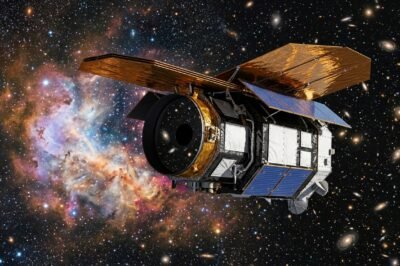
The cosmos is a vast, enigmatic theater, and for decades, humanity has been slowly pulling back the velvet curtains to glimpse the wonders within. From the grainy, pioneering images of the early 20th century to the breathtaking clarity of the Hubble Space Telescope and the groundbreaking infrared sensitivity of the James Webb Space Telescope (JWST), our vision has continually improved. Now, a new protagonist is preparing to take center stage: NASA’s Nancy Grace Roman Space Telescope. Named after the visionary often referred to as the ‘Mother of Hubble,’ this upcoming mission is not just another step in celestial observation—it is a giant leap in cosmic surveying. Originally slated for a rigorous five-year primary mission, recent engineering assessments and propellant analyses have revealed a thrilling possibility: the Roman Space Telescope could remain operational for ten years or more. This potential doubling of its lifespan offers an unprecedented opportunity to observe the evolution of the universe, providing a decade-long window into the mysteries of dark energy, the elusive nature of dark matter, and the hidden population of planets orbiting distant stars. As the scientific community prepares for its May 2027 launch, the realization that Roman could be a long-haul veteran changes the very scale of our celestial ambitions, promising a legacy that will span generations of researchers and redefine our place in the galaxy.
The Engineering Marvel of the Wide Field Instrument
At the heart of the Roman Space Telescope lies its Wide Field Instrument (WFI), a 288-megapixel camera that provides a field of view 100 times greater than that of Hubble’s infrared camera. While Hubble is often described as a ‘sniper rifle’—capable of looking incredibly deep into a very small patch of sky—Roman is more akin to a ‘wide-angle lens’ that maintains high resolution across massive swaths of the heavens. This capability is not merely a convenience; it is a fundamental requirement for the large-scale surveys Roman is designed to conduct. By capturing images of millions of galaxies in a single observation, scientists can begin to understand the large-scale structure of the universe in a way that was previously impossible. The sheer volume of data produced by the WFI will be staggering, requiring sophisticated ground systems and artificial intelligence to process the terabytes of information beamed back to Earth daily.
The engineering behind this instrument is a testament to years of development in sensor technology and optical design. The telescope utilizes a 2.4-meter primary mirror, the same diameter as Hubble’s, which was donated to NASA by the National Reconnaissance Office. However, unlike Hubble, Roman’s optics are optimized for wide-field imaging. This allows it to cover the same area of sky in a fraction of the time. If Roman were tasked with replicating the Hubble Ultra Deep Field, it could do so in less than half a day, whereas Hubble required years of cumulative observation. This efficiency is precisely why the prospect of a ten-year mission is so transformative. If the telescope can work at this pace for double its planned lifespan, the catalog of the infrared universe it creates will be the most comprehensive in human history, serving as a foundational map for all future astronomical endeavors.
Fuel Efficiency and the Path to Longevity
One of the primary limiting factors for any space mission is the amount of fuel, or propellant, it can carry. Spacecraft require fuel for station-keeping—maintaining their orbit—and for desaturating reaction wheels, which are used to point the telescope with pinpoint accuracy. The Roman Space Telescope will orbit the second Lagrange point (L2), a stable gravitational point located about 1.5 million kilometers from Earth. While L2 is a popular spot for observatories like JWST and Euclid, it still requires periodic maneuvers to prevent the spacecraft from drifting away. Initial estimates for Roman were conservative, adhering to standard NASA mission planning protocols that account for worst-case scenarios in launch performance and orbital insertion.
However, recent analyses have shown that the mission’s propellant reserves are significantly more robust than initially projected. The launch vehicle’s expected accuracy and the efficiency of Roman’s propulsion system suggest that much less fuel will be used during the initial transit to L2. Furthermore, the telescope’s thermal management and solar pressure compensation systems are performing better in testing than predicted. This means that after the primary five-year mission concludes, Roman will likely have enough fuel to continue operating for another five, or even ten, years. In the world of high-stakes space exploration, ‘over-engineering’ is a virtue that pays dividends in scientific discovery. By building a spacecraft that can endure the harsh environment of deep space for over a decade, NASA is maximizing the return on investment for taxpayers and the global scientific community alike.
A Decade of Investigating the Dark Universe
The primary scientific driver for the Roman Space Telescope is the investigation of the ‘Dark Universe’—the mysterious dark energy and dark matter that together make up about 95% of the cosmos. Dark energy is the name given to the unknown force causing the expansion of the universe to accelerate, while dark matter is the invisible substance that provides the gravitational scaffolding for galaxies. Despite their dominance, neither has been directly observed. Roman aims to change this by measuring the shapes and distances of hundreds of millions of galaxies. By observing how the distribution of these galaxies changes over cosmic time, Roman will provide the most precise measurements to date of the expansion rate of the universe and how dark energy influences that expansion.
With a ten-year mission duration, Roman can perform these surveys with much higher statistical significance. It can revisit the same patches of sky multiple times, allowing for a ‘time-domain’ survey that tracks how objects change over months or years. This is critical for studying supernovae, which serve as ‘standard candles’ for measuring cosmic distances. An extended mission means observing thousands more supernovae than a five-year mission would allow. Each additional supernova is a data point that helps refine our understanding of dark energy’s ‘equation of state.’ If dark energy’s influence changes over time, Roman is the instrument most likely to detect it. A decade of data could potentially resolve the current ‘Hubble Tension’—the discrepancy between different methods of measuring the universe’s expansion rate—which is currently one of the biggest crises in modern physics.
Revolutionizing Exoplanet Discovery through Microlensing
Beyond the large-scale structure of the universe, the Roman Space Telescope is poised to become a powerhouse for finding planets orbiting other stars. While missions like Kepler and TESS have found thousands of planets using the transit method (observing a dip in light as a planet passes in front of its star), this method is biased toward planets that are very close to their host stars. Roman will use a different technique called gravitational microlensing. This phenomenon occurs when the gravity of a foreground star (and any orbiting planets) acts like a magnifying glass, warping and brightening the light of a more distant background star. This method is particularly sensitive to planets that are far from their stars, similar to the distances of Mars, Jupiter, and Saturn in our own solar system.
By conducting a long-term microlensing survey toward the center of the Milky Way, Roman will find thousands of new worlds, including ‘Earth-twins’ and even ‘rogue planets’ that drift through space without a host star. An extended ten-year mission is particularly beneficial for this science because it allows for more ‘observing seasons.’ Microlensing events are rare and unpredictable; the more time Roman spends looking at the dense star fields of the galactic bulge, the more likely it is to capture these fleeting alignments. Furthermore, a decade of observation will allow astronomers to measure the orbits of these distant planets more accurately. This will provide a complete census of the planetary populations in our galaxy, helping us understand whether solar systems like our own are common or are rare cosmic accidents.
Synergy with Hubble and the James Webb Space Telescope
The 2030s are shaping up to be a ‘Golden Age’ for astronomy, with Hubble, JWST, and Roman all potentially operating simultaneously. Each of these telescopes brings a unique strength to the table. Hubble provides high-resolution ultraviolet and visible light data; JWST offers unprecedented sensitivity in the mid-infrared for peering through dust and seeing the first stars; and Roman provides the wide-field context that ties everything together. The synergy between these observatories is more than the sum of its parts. For instance, Roman might discover a rare, ancient galaxy or a bizarre transient event during one of its wide-field surveys. It can then alert the scientific community, allowing JWST to zoom in with its powerful spectroscopy to analyze the object’s chemical composition in exquisite detail.
This ‘tag-team’ approach to science is revolutionized by Roman’s longevity. A five-year mission might have ended just as JWST was entering its middle age. A ten-year mission, however, ensures that these two infrared giants can collaborate for many years. This is especially important for the Roman Coronagraph Instrument (CGI), a technology demonstrator designed to directly image planets around other stars. By using a series of complex masks and mirrors to block out the blinding light of a star, the CGI can reveal the faint glow of an orbiting planet. If Roman stays operational for a decade, it can refine these high-contrast imaging techniques, paving the way for future flagship missions specifically designed to find life on Earth-like planets. The lessons learned from Roman’s long-term performance will inform the design of the next generation of ‘Habitable Worlds’ observatories.
Conclusion: A New Horizon for Astrophysics
The potential for the Nancy Grace Roman Space Telescope to double its mission life is a game-changer for the field of astrophysics. It transforms the mission from a brief, high-intensity survey into a foundational pillar of astronomical research that will influence science for decades. By providing a 10-year baseline of observations, Roman will allow us to see the universe not as a static image, but as a dynamic, evolving system. We will watch the flickering of distant quasars, the movement of stars within our own galaxy, and the subtle gravitational dances of planets in far-flung solar systems. The engineering teams at NASA and its partners have created a vessel capable of surviving the rigors of the deep-space environment far longer than we dared hope, ensuring that the legacy of Nancy Grace Roman—a woman who fought for the stars—continues to inspire and educate.
As we look toward the 2027 launch, the excitement is palpable. Each day that Roman remains operational beyond its primary mission is a gift to science. It represents thousands more galaxies cataloged, dozens more rogue planets discovered, and a clearer understanding of the invisible forces that shape our reality. In an era where the mysteries of the universe seem to grow deeper with every discovery, having a sentinel like Roman watching the infrared sky for over a decade is our best chance at finding answers. The Roman Space Telescope is not just a mission; it is a decade-long odyssey into the heart of the unknown, and its extended life ensures that the voyage will be more productive than we ever imagined.






































Leave a Reply