
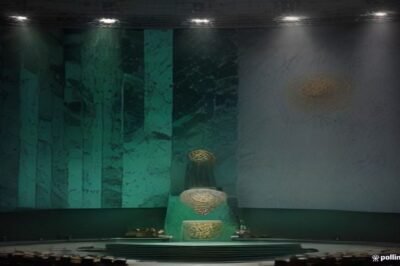
The halls of the United Nations General Assembly have long been the stage for some of the most significant diplomatic shifts in modern history, but few moments have carried the visceral weight of Donald Trump’s confrontational address regarding the Islamic Republic of Iran. With the world’s media spotlight firmly fixed on the green marble podium, the former President delivered what many analysts view as the ultimate binary choice: a comprehensive renegotiation of terms or an unprecedented descent into economic and political isolation. This rhetorical escalation, captured by outlets like NDTV, signifies more than just a momentary surge in tension; it represents the culmination of a ‘maximum pressure’ campaign designed to fundamentally alter the power dynamics of the Middle East. As Trump stood before world leaders, his words were not merely directed at the delegates in the room, but served as a direct challenge to the clerical establishment in Tehran, demanding a total pivot in their regional strategy or the acceptance of a future defined by crippling hardship. This introduction into a new era of ‘hellish’ diplomacy underscores the volatile nature of current international relations, where the lines between economic warfare and kinetic conflict become increasingly blurred, leaving the global community to ponder the consequences of a failure to reach a new consensus.
The Maximum Pressure Doctrine and its Evolution
The core of Donald Trump’s strategy toward Iran is rooted in the dismantling of the Joint Comprehensive Plan of Action (JCPOA), which he famously characterized as one of the worst deals ever negotiated. By withdrawing the United States from this landmark agreement, the administration embarked on a path of ‘maximum pressure,’ a policy designed to starve the Iranian government of the resources necessary to fund its regional proxies and ballistic missile programs. This doctrine is predicated on the belief that economic strangulation will eventually force Tehran to the bargaining table on terms much more favorable to Washington and its allies in the region. The ‘Make Deal or Drive Iran into Hell’ rhetoric is the verbal manifestation of this policy, signaling that the United States is willing to utilize every lever of power at its disposal, short of open war, to achieve its objectives. This approach has fundamentally shifted the diplomatic landscape, moving away from the multilateralism of the Obama era toward a more unilateral and transactional form of foreign policy.
Critics of this doctrine argue that it risks cornering a proud nation with few options other than escalation. By removing the incentives for compliance that were built into the JCPOA, the United States has essentially removed the ‘carrot’ from the equation, leaving only the ‘stick.’ This has led to a series of escalatory actions in the Persian Gulf, including attacks on oil tankers and the downing of high-tech surveillance drones. The ‘maximum pressure’ campaign has also created a rift between the United States and its European allies, who remain committed to the original nuclear deal. This divergence in strategy has tested the strength of the transatlantic alliance and provided an opening for rival powers like Russia and China to deepen their influence in the Middle East by positioning themselves as more stable and predictable partners. The effectiveness of this doctrine remains a subject of intense debate, with proponents pointing to Iran’s shrinking economy and opponents highlighting the increased risk of a catastrophic regional war.
The Economic Fallout: A Nation on the Brink
When Donald Trump speaks of ‘driving Iran into hell,’ the most immediate and visible instrument of that journey is the imposition of draconian economic sanctions. These measures have targeted the lifeblood of the Iranian economy: its oil exports. By eliminating waivers for major importers, the United States has successfully reduced Iran’s oil revenue to a fraction of its former levels. This has resulted in a massive budget deficit for the Iranian government, forcing it to make difficult choices between domestic social spending and military expenditures. The Iranian Rial has suffered a historic collapse, losing a significant portion of its value against the US dollar and fueling rampant inflation. For the average Iranian citizen, this has translated into skyrocketing prices for basic goods, a loss of purchasing power, and a general sense of economic insecurity. The impact on the pharmaceutical sector and medical supplies has also been a point of international concern, as human rights organizations warn of the humanitarian toll these sanctions are taking on the civilian population.
The economic pressure is not limited to oil; it extends to the banking and financial sectors, effectively cutting Iran off from the global financial system. The designation of the Islamic Revolutionary Guard Corps (IRGC) as a foreign terrorist organization was another significant step in this campaign, as the IRGC maintains a vast network of business interests across the Iranian economy. By sanctioning the IRGC, the United States has made it nearly impossible for foreign companies to engage in trade with Iran without risking secondary sanctions. This has led to a mass exodus of European and Asian firms that were previously eager to invest in the Iranian market. The result is an economy in a state of ‘stagflation,’ characterized by stagnant growth and high inflation, which has sparked sporadic protests across the country. While the Iranian leadership has attempted to implement a ‘resistance economy’ to weather the storm, the sheer scale of the US sanctions makes it an uphill battle, potentially creating the domestic instability that the ‘maximum pressure’ campaign seeks to exploit.
Geopolitical Shockwaves: Israel, Saudi Arabia, and the Regional Balance
The ‘Make Deal or Drive Iran into Hell’ ultimatum resonates most strongly in the capitals of Iran’s regional rivals, specifically Jerusalem and Riyadh. For Israel, the Trump administration’s hardline stance is seen as a necessary correction to what they perceived as the flaws of the JCPOA, which they argued did not address Iran’s regional aggression or its long-term nuclear ambitions. Israeli Prime Minister Benjamin Netanyahu has been one of the most vocal supporters of the ‘maximum pressure’ campaign, viewing it as an essential tool to prevent Iran from establishing a ‘land bridge’ from Tehran to the Mediterranean. The increased pressure has also led to a significant realignment in the region, as Israel and several Gulf Arab states have found common ground in their shared opposition to Iranian influence. This ‘enemy of my enemy’ dynamic has led to unprecedented levels of security cooperation and the eventual signing of the Abraham Accords, fundamentally altering the traditional geopolitical map of the Middle East.
Saudi Arabia, too, sees the US pressure as a vital shield against Iranian expansionism. The devastating attacks on Saudi Aramco’s oil facilities, which were widely blamed on Iran, served as a stark reminder of the vulnerability of the region’s energy infrastructure. For the Saudis, the ‘hell’ described by Trump is a state of affairs they believe Iran has already been imposing on its neighbors through its support of Houthi rebels in Yemen and Shiite militias in Iraq. The US rhetoric provides the Kingdom with the assurance that its primary security guarantor is fully committed to containing the Iranian threat. However, this aggressive posturing also places these regional allies on the front lines of any potential conflict. The risk of miscalculation is high, and any move toward ‘hell’ could easily engulf the entire region in a multi-front war that would have catastrophic consequences for global energy markets and international security. The regional power struggle is no longer just a shadow war; it has become a central component of the global diplomatic discourse at the UN.
The European Dilemma and the Role of Global Powers
While the United States has pursued a policy of unilateral pressure, the traditional powers of Europe—specifically the United Kingdom, France, and Germany (the E3)—have found themselves in a difficult position. They remain committed to the JCPOA as the best available means of preventing an Iranian nuclear weapon but are increasingly frustrated by Iran’s own violations of the deal’s limits in response to US sanctions. The ‘Make Deal or Hell’ rhetoric leaves little room for the kind of nuanced diplomacy that Europe favors. Efforts to create financial mechanisms like INSTEX to bypass US sanctions and maintain trade with Iran have met with limited success, as private companies remain terrified of being shut out of the US market. This has led to a perception of European impotence, as they struggle to save a deal that the world’s largest economy is actively trying to destroy. The UN General Assembly becomes the venue where these conflicting visions of international order collide, with European leaders often trying to act as mediators between a recalcitrant Tehran and an uncompromising Washington.
Beyond Europe, the roles of Russia and China are equally pivotal. Both nations have maintained strong ties with Iran, viewing it as a strategic partner and a counterweight to US influence in the Middle East. Russia has provided military support and diplomatic cover for Iran, particularly in the Syrian theater, while China remains a major purchaser of Iranian oil through various ‘gray market’ channels. For Moscow and Beijing, the ‘maximum pressure’ campaign is seen as an example of US hegemony and a violation of international law. They have used their positions on the UN Security Council to block or water down measures aimed at Iran, arguing that the US withdrawal from the JCPOA is the primary cause of the current crisis. The Iranian leadership has increasingly ‘turned to the East’ as a survival strategy, seeking to integrate into the Shanghai Cooperation Organization and other non-Western frameworks. This shift suggests that even if the US manages to ‘drive Iran into hell’ economically, the political and strategic isolation may not be as total as the administration hopes, as other global powers see an opportunity to fill the vacuum.
The UN as a Battlefield of Rhetoric and Reality
The United Nations General Assembly is often criticized as a ‘talking shop,’ but for a story like this, the rhetoric itself is a form of power. When Donald Trump uses phrases like ‘Drive Iran into Hell,’ he is utilizing the UN platform to project American strength and resolve. This ‘diplomacy by ultimatum’ is a departure from the traditional language of international relations, which usually emphasizes cooperation and mutual benefit. In the context of the UN, such language serves to polarize the international community, forcing nations to choose sides in a high-stakes standoff. The Iranian response at the UN has typically been one of defiance, with leaders like Hassan Rouhani or Ebrahim Raisi using their own time at the podium to condemn ‘American imperialism’ and ‘economic terrorism.’ This creates a feedback loop of escalation where each side’s rhetoric reinforces the other’s worst fears, making a diplomatic breakthrough increasingly difficult to achieve.
However, the UN also provides the only venue where these two adversaries might potentially engage in the kind of ‘deal-making’ Trump claims to want. Behind the scenes of the public speeches, there are often frantic efforts by mediators like Switzerland or Oman to facilitate back-channel communication. The ‘Make Deal’ part of the ultimatum is a recognition that, despite the aggressive language, a negotiated settlement remains the preferred outcome for even the most hawkish members of the administration. The problem lies in the ‘entry price’ for such a deal; the US demands a total cessation of enrichment and a dismantling of regional networks, while Iran demands the immediate lifting of all sanctions and a return to the status quo of the JCPOA. The UN General Assembly serves as a barometer for how far apart these two positions are. As long as the rhetoric remains focused on ‘hell,’ the prospects for a ‘deal’ remain dim, but the very presence of both parties in the same building offers a glimmer of hope that a diplomatic off-ramp might still be found before the situation reaches a point of no return.
Conclusion: Future Implications and the Path Forward
The legacy of the ‘Make Deal or Drive Iran into Hell’ ultimatum will likely be felt for decades to come, regardless of the immediate outcome. If this pressure eventually leads to a new, more comprehensive agreement that addresses both nuclear and regional concerns, it will be hailed as a triumph of coercive diplomacy and a validation of the ‘America First’ approach. However, if it leads to a permanent fracturing of the international order, a nuclear-armed Iran, or a devastating regional war, it will be remembered as a catastrophic failure of judgment. The current state of affairs is one of precarious equilibrium; Iran is suffering but hasn’t collapsed, and the US is dominant but hasn’t achieved its core objectives. The danger is that ‘hell’ is not just a destination for Iran, but a potential reality for the entire Middle East if the cycle of escalation continues unabated. The global community must now decide whether to facilitate the ‘deal’ or prepare for the ‘hell,’ as the window for a peaceful resolution continues to narrow in an increasingly polarized world.

































Leave a Reply