
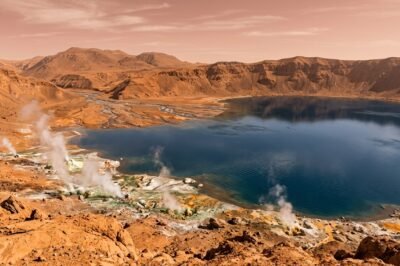
For decades, our collective imagination of Mars has been dominated by images of a rusted, frozen desert—a silent sentinel in the vacuum of space where life, if it ever existed, was a fleeting miracle. However, as our robotic emissaries like Curiosity, Perseverance, and the Mars Reconnaissance Orbiter peer deeper into the planet’s geological past, a far more sophisticated narrative is beginning to emerge. Recent syntheses of data, highlighted by reports from IFLScience and collaborative international research teams, suggest that Mars was not merely damp for a brief window. Instead, the Red Planet possessed a complex, multi-tiered water system that rivaled Earth’s own early hydrological cycles. This system was characterized by long-lived surface lakes, intricate groundwater aquifers that spanned continental distances, and vigorous hydrothermal events driven by internal heat. This paradigm shift suggests that the Martian environment was not just habitable in passing, but was a dynamic, chemically active world capable of sustaining complex prebiotic chemistry for hundreds of millions of years. Understanding this complexity is the key to unlocking the greatest mystery in modern science: whether we are truly alone in the solar system. As we peel back the layers of Martian history, we find a world that was once vibrant, echoing the early conditions of our own home planet.
The Shift in Perspective: From Simple Reservoirs to Complex Networks
The traditional view of Martian water was often binary: either Mars was “warm and wet” or “cold and icy.” Newer research suggests the reality was a sophisticated blend of both, characterized by a highly integrated hydrological cycle. The evidence points toward a planet where water did not just sit in isolated puddles but moved through a global network. This network included massive drainage basins that fed into deep crater lakes, some of which persisted for thousands, if not millions, of years. The sheer scale of these features indicates a stable atmosphere capable of maintaining liquid water on the surface, a feat that requires a significant greenhouse effect that scientists are still working to fully model. Furthermore, the presence of these networks suggests that the water cycle was closed, meaning water evaporated, formed clouds, and precipitated back down as rain or snow, much like it does on Earth today.
Beyond just surface flow, the complexity of these systems is highlighted by the geological diversity found in different regions. In the southern highlands, we see ancient valley networks that resemble terrestrial river systems, while in the northern lowlands, there are indications of vast, ancient shorelines. The interaction between these different reservoirs—the atmosphere, the surface, and the subsurface—points to a planet with a high degree of geodiversity. This is crucial because a complex environment provides more niches for potential life to take hold. If Mars had diverse water systems, it likely had diverse chemical environments, ranging from acidic mountain streams to alkaline lowland lakes, each offering a unique set of ingredients for the recipe of life.
The Hidden Depth: Groundwater Networks and Deep Aquifers
While the surface features of Mars are striking, some of the most compelling evidence for a complex water system lies beneath the ground. Scientists have identified features known as “groundwater sapping valleys,” which are formed when pressurized groundwater erupts onto the surface, carving out deep canyons. This implies that ancient Mars had a massive subterranean plumbing system. These aquifers would have been protected from the harsh radiation of the sun and the volatile changes in the atmosphere, making them perhaps the most stable habitats on the planet. The existence of these deep-seated water sources suggests that even during periods when the surface was inhospitable, life could have thrived in the dark, warm depths of the Martian crust.
The chemical signatures found by rovers also support the idea of long-term groundwater interaction. Minerals like clays and sulfates, which require water to form, are found in layers that suggest they were deposited by rising and falling water tables. In many cases, these minerals appear in sequences that tell a story of changing water chemistry over time. For instance, early Mars may have had neutral-pH water, which later became more acidic as the planet’s volcanic activity increased and the atmosphere thinned. The ability of the Martian crust to store and move such vast quantities of water indicates that the planet was far more geologically active than previously thought, with a core that provided enough heat to keep subsurface water from freezing solid even during the coldest eras.
Hydrothermal Events: The Engine for Potential Life
Perhaps the most exciting aspect of the recent findings is the evidence for ancient hydrothermal activity. On Earth, hydrothermal vents on the ocean floor are teeming with life, powered by chemical energy rather than sunlight. Researchers have found evidence of similar processes on Mars, particularly in areas where volcanic heat interacted with the groundwater. These hydrothermal events would have circulated hot, mineral-rich water through the crust, creating “hot spots” of chemical energy. This process, known as serpentinization, can produce hydrogen and methane—gases that can serve as a primary energy source for microbial life. The discovery of high concentrations of silica and certain metallic ores in specific Martian craters strongly suggests that these vents were once active and widespread.
The implications of hydrothermal activity are profound. It means that Mars had the three essential ingredients for life: liquid water, organic molecules, and a consistent energy source. Unlike surface lakes, which might freeze or evaporate as the climate changed, hydrothermal systems can remain active for extremely long periods, fueled by the planet’s internal heat. This provides a level of environmental consistency that is ideal for the slow process of biological evolution. If we are to find fossils or chemical biosignatures of ancient Martian life, these hydrothermal sites are the most promising locations to look. They represent a bridge between the planet’s geological activity and its potential biological history, marking Mars as a world that was once chemically alive and geologically vibrant.
Analyzing the Sedimentary Record and Mineral Diversity
The story of Martian water is written in its rocks. Sedimentary structures found in Gale Crater by the Curiosity rover provide a high-resolution look at ancient lakebeds. These rocks show clear evidence of cross-bedding and ripple marks, which are the fingerprints of flowing water and waves. By studying the size and shape of the grains in these rocks, geologists can determine the depth and speed of the water that deposited them. The presence of well-rounded pebbles suggests that water transported these materials over long distances, further confirming the existence of persistent river systems. This isn’t just about water presence; it’s about water duration. The thickness of the sedimentary layers suggests that these lakes existed for incredibly long spans of time, providing a stable window for life to emerge.
Mineralogy also plays a key role in our understanding. The detection of phyllosilicates (clays) is particularly important because they typically form in the presence of water with a neutral pH—conditions that are very “life-friendly.” In contrast, the later discovery of jarosite and other sulfates points to a transition toward more acidic conditions. This shift in mineralogy reflects a changing planet, but the fact that these different minerals are often found in close proximity suggests a complex interplay between different water sources and environmental conditions. The variety of minerals found—ranging from carbonates to hematite—paints a picture of a planet with a rich and varied chemical palette, driven entirely by the movement and interaction of water across its surface.
Global Climate Cycles and the Disappearance of Water
One of the biggest questions remaining is how such a complex water system eventually vanished. Current theories suggest that Mars underwent significant climate oscillations, driven by changes in its axial tilt (obliquity). Unlike Earth, which is stabilized by a large moon, Mars wobbles significantly over millions of years. These wobbles would have caused the ice caps to melt and refreeze, drastically altering the atmospheric pressure and the stability of liquid water. During periods of high obliquity, the poles would have received more sunlight, releasing CO2 and water vapor into the air, thickening the atmosphere and potentially allowing for “mega-floods” that carved the massive outflow channels we see today.
However, the long-term trend was one of loss. Without a strong global magnetic field to protect it, the Martian atmosphere was slowly stripped away by the solar wind. As the atmosphere thinned, the boiling point of water dropped, and the greenhouse effect weakened. This led to the transition from the Hesperian period—a time of volcanic activity and episodic flooding—to the Amazonian period, the cold, dry era that persists today. Yet, even in this transition, the water didn’t just disappear into space; a significant portion of it likely retreated into the subsurface or became locked in the polar ice caps. The complexity we observe in the ancient record is a testament to a world that fought to remain wet and active for as long as its planetary physics would allow.
Future Implications for Planetary Exploration
The discovery of a complex water system on ancient Mars fundamentally changes our approach to future missions. We are no longer just looking for “where the water was,” but rather “where the most stable and chemically rich water systems were.” This has led to a focus on sites like Jezero Crater, the landing site of the Perseverance rover, which features a well-preserved river delta. By collecting samples from these specific environments, NASA and the ESA hope to bring back materials that contain the specific chemical fingerprints of a complex hydrological past. These samples could hold the first definitive proof of extraterrestrial life, preserved in the silts and clays of an ancient Martian lakebed.
Furthermore, understanding the history of Martian water is essential for future human exploration. If vast reserves of water still exist as subsurface ice or within hydrated minerals, they could be used to support human colonies, providing drinking water and oxygen, as well as hydrogen for fuel. The complex water systems of the past have left behind a legacy of resources that might one day enable us to become a multi-planetary species. As we continue to analyze the data from our rovers and prepare for sample return missions, the Red Planet continues to transform in our eyes: no longer a dead world, but a fascinating, once-active sibling of Earth that still holds many secrets beneath its dusty red surface. The journey to understand Mars is, in many ways, a journey to understand the origins of life itself across the cosmos.






































Leave a Reply