
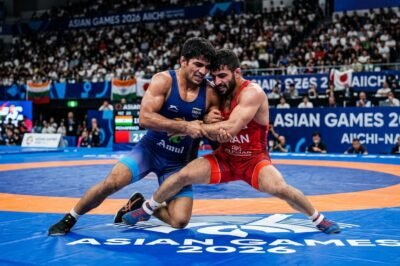
As the countdown begins for the 20th Asian Games, set to illuminate the sporting landscape of Aichi and Nagoya in 2026, the global wrestling community finds itself at a pivotal crossroads. For India, a nation where the scent of the mitti (soil) is synonymous with the sweat and determination of the akhada, the wrestling mat at the Asian Games represents more than just a competition; it is a battleground for national pride and continental dominance. Historically, India has carved a formidable niche in the freestyle and Greco-Roman disciplines, consistently producing legends who have transitioned from the dusty pits of rural villages to the grand podiums of international arenas. The 2026 edition promises a high-octane spectacle, serving as a critical litmus test for the next generation of grapplers following the seismic shifts in the sport’s administrative and competitive landscapes. With high expectations riding on both seasoned veterans and hungry debutants, the upcoming games are poised to define the trajectory of Indian wrestling for the next Olympic cycle. The anticipation is palpable, as fans and analysts alike pore over schedules and training regimens, hoping to witness a repeat of the golden hauls that have defined India’s recent history at this prestigious quadrennial event.
The Historical Significance and Indian Legacy at the Asian Games
Wrestling has always been the cornerstone of India’s sporting identity at the Asian Games. Since the inaugural games in 1951, Indian wrestlers have consistently contributed to the nation’s medal tally, often bridging the gap between being a participant and being a contender. In the last few editions, specifically Incheon 2014, Jakarta-Palembang 2018, and the delayed Hangzhou 2022, India saw a resurgence in its wrestling fortunes. Stars like Bajrang Punia and Vinesh Phogat became household names, but the 2026 games present a different challenge altogether. The transition from the old guard to the new era is in full swing, and Aichi-Nagoya will be the stage where this evolution is finalized.
The 2026 games will be particularly significant as they represent the midway point to the 2028 Los Angeles Olympics. For Indian wrestlers, the Asian Games are often tougher than the Olympics in certain weight categories, given the dominance of Japan, Iran, and the Central Asian nations. The depth of competition in the 57kg and 65kg freestyle categories is legendary, often featuring multiple world champions within the Asian bracket alone. Therefore, a podium finish in Nagoya is not just a continental achievement; it is a clear signal of global intent. The Wrestling Federation of India (WFI) is expected to implement rigorous selection criteria, ensuring that only those in peak physical and mental condition make the cut for this grueling tournament.
Projected Schedule and Venue: Nagoya’s Global Stage
While the official day-by-day minute schedule for 2026 is usually finalized closer to the event, the general structure of the wrestling competition is expected to follow the traditional six-day format. Wrestling is tentatively scheduled to take place at the Nagoya International Exhibition Hall (Portmesse Nagoya), a venue renowned for its state-of-the-art facilities and ability to host high-capacity crowds. The schedule typically begins with the Freestyle categories for men, followed by the Women’s Freestyle, and concluding with the Greco-Roman events.
For Indian fans, the early days of the wrestling competition will be crucial, as the lower weight categories in men’s freestyle have historically been India’s strongest suit. The 57kg and 65kg bouts are expected to be the highlights of the opening days. Following this, the focus will shift to the women’s contingent, where India has seen a massive surge in talent and results. The final days will see the Greco-Roman specialists take the mat. While Greco-Roman has traditionally been a weaker area for India compared to freestyle, recent investments in specialized coaching and international exposure tours are expected to bear fruit in 2026. The technical nature of the Nagoya venue will provide a neutral yet electrifying atmosphere for these high-stakes encounters.
India’s Key Contenders: The Next Generation of Grapplers
The names that dominated the headlines for the last decade are gradually making way for a new crop of athletes. Aman Sehrawat, who has already shown his mettle on the international stage, is expected to be a primary medal contender in the 57kg freestyle category. His speed and tactical intelligence make him a dangerous opponent for anyone in the world. Similarly, in the 65kg category, the search for a successor to the legendary Bajrang Punia is ongoing, with several young talents currently battling it out in the national circuit. These internal trials will be as competitive as the games themselves, ensuring that the representative sent to Nagoya is battle-hardened.
On the women’s side, Antim Panghal has emerged as a beacon of hope. Her technical proficiency and composure under pressure have already earned her accolades at the world level. In the 53kg category, she is expected to be one of the favorites for the gold medal. Alongside her, athletes like Anshu Malik and Sonam Malik continue to refine their skills, aiming to convert their previous international experiences into Asian Games glory. The depth in the women’s team is perhaps the best it has ever been, with multiple athletes capable of reaching the finals. The 2026 games will be the ultimate proving ground for these women to establish themselves as the new icons of Indian sport.
The Continental Challenge: Analyzing Japan, Iran, and Kazakhstan
To understand the magnitude of the challenge facing India, one must look at the giants of Asian wrestling. Japan, as the host nation, will be an unstoppable force, particularly in the women’s categories where they have maintained a near-monopoly for decades. The Japanese system, which emphasizes speed, endurance, and technical perfection, is the gold standard. Competing against them in their home turf will require Indian wrestlers to be tactically superior and physically peak. The 2026 games will likely see Japan fielding their strongest possible lineup to dominate the medal table across all disciplines.
Meanwhile, Iran remains the powerhouse of men’s freestyle and Greco-Roman wrestling. Their wrestlers are known for their immense strength and relentless pressure. For Indian men, the path to gold almost always runs through an Iranian opponent. Kazakhstan and Uzbekistan also pose significant threats, particularly in the heavier weight classes and Greco-Roman styles. These nations have a deep-rooted wrestling culture and provide a level of physicality that is difficult to replicate in training. India’s strategy will need to involve specific game plans for each of these regional rivals, utilizing video analysis and simulated matches to prepare for their unique styles.
Technical Evolution and Rule Changes in Modern Wrestling
The landscape of wrestling is constantly shifting, with United World Wrestling (UWW) frequently updating rules to make the sport more dynamic and spectator-friendly. By 2026, we might see further refinements in the passivity rules and the scoring of high-amplitude throws. Indian wrestlers have sometimes struggled with the tactical side of these rule changes, particularly in high-pressure situations where points are awarded or deducted for passivity. The training camps leading up to Aichi-Nagoya will undoubtedly focus on these nuances, ensuring that the athletes are not just physically prepared but also masters of the rulebook.
Furthermore, the integration of sports science into Indian wrestling has reached a new level. From personalized nutrition plans to biomechanical analysis of techniques, the modern Indian wrestler is backed by a team of experts. This scientific approach is crucial for maintaining weight and recovering between bouts in a tournament as intense as the Asian Games. In Nagoya, the humidity and environmental factors will also play a role, making the role of the support staff just as critical as the performance on the mat. The 2026 games will showcase how far India has come in professionalizing its most traditional sport.
Conclusion: Future Implications and the Road to 2028
The 2026 Asian Games in Aichi-Nagoya will be far more than a single event; they will be the defining moment for Indian wrestling in this decade. A successful campaign will solidify the reputation of the new generation and provide the momentum needed for the Los Angeles 2028 Olympic Games. Conversely, any setbacks will serve as a necessary wake-up call to reassess training methodologies and grassroots development. The stakes are incredibly high, as wrestling remains one of the few sports where India consistently expects and delivers multiple medals on the world stage.
Ultimately, the performance in Nagoya will be a testament to the resilience of Indian wrestlers who have navigated various administrative challenges and personal hurdles to reach the top. As the world watches, the Indian contingent will step onto the mats at Portmesse Nagoya with a billion hopes resting on their shoulders. Whether it is the roar of a successful takedown or the silence of a tactical stalemate, every second of the 2026 wrestling competition will be a chapter in the ongoing saga of India’s quest for sporting excellence. The journey to the podium begins long before the first whistle, and for India’s grapplers, that journey is already well underway.






































Leave a Reply