
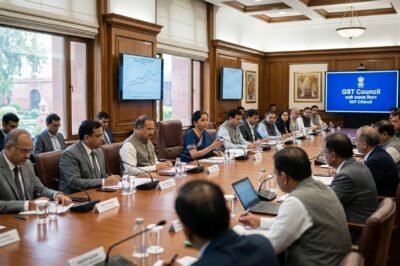
As the Indian economy navigates the complexities of post-pandemic recovery and global inflationary pressures, all eyes are fixed on the upcoming GST Council meeting scheduled for October 8. This high-stakes assembly is not merely another routine administrative gathering; it represents a watershed moment for India’s indirect tax regime. The Central Government is reportedly preparing to table a comprehensive five-pronged reform plan that promises to fundamentally alter the landscape of the Goods and Services Tax (GST) framework. This move comes at a time when the GST collection has shown remarkable resilience, consistently crossing the ₹1.7 lakh crore mark, yet the system remains fraught with classification disputes and compliance hurdles. The proposed reforms are expected to address the long-standing demands for rate rationalization, technological integration, and the simplification of procedural requirements for small and medium enterprises. By focusing on these critical pillars, the Centre aims to foster a more predictable and business-friendly environment, ensuring that the ‘One Nation, One Tax’ vision matures into a seamless reality for investors and consumers alike.
The Genesis of the Five-Pronged Reform Strategy
The upcoming GST Council meeting, presided over by Union Finance Minister Nirmala Sitharaman and attended by state finance ministers, is expected to be one of the most consequential sessions in recent years. The five-pronged reform plan is the result of months of internal deliberations between the Ministry of Finance, the Central Board of Indirect Taxes and Customs (CBIC), and various state-level stakeholders. The core objective of this strategy is to transition from a stabilization phase to a growth-acceleration phase. For years, the GST Council has focused on fixing ‘bugs’ in the system; now, the focus has shifted toward systemic overhaul.
Historically, the GST implementation has faced criticism for its complex multi-tier structure. With over 1,200 goods and services categorized across four primary slabs, the potential for misclassification and litigation is immense. The five-pronged approach seeks to minimize these friction points by introducing transparency and predictability. This strategy is not just about revenue collection but about improving the ‘Ease of Doing Business’ index, which is a top priority for the current administration as it seeks to position India as a global manufacturing hub.
Prong 1: Comprehensive Rate Rationalization and Slab Restructuring
Perhaps the most significant element of the reform plan is the proposed restructuring of the tax slabs. Since the inception of GST in 2017, there has been a persistent debate about the efficiency of the 5%, 12%, 18%, and 28% tiers. The Centre is likely to propose a roadmap for the merger of the 12% and 18% slabs into a single, revenue-neutral standard rate. Economists have long argued that such a merger would eliminate the confusion surrounding several products that currently fall under different slabs despite being of similar utility.
Statistics suggest that a significant portion of GST revenue currently comes from the 18% slab. By rationalizing these rates, the government aims to reduce the inverted duty structure—a phenomenon where inputs are taxed higher than finished products. This issue has particularly hindered the growth of the textile, footwear, and pharmaceutical sectors. The Council will review data from the Group of Ministers (GoM) to ensure that any changes do not lead to a massive revenue shortfall for the states, while simultaneously keeping an eye on the consumer price index (CPI) to avoid fueling inflation.
Prong 2: Leveraging AI and Data Analytics for Compliance
The second pillar of the reform plan centers on the digital transformation of tax administration. The GST Network (GSTN) has accumulated a treasure trove of data over the last seven years. The Centre now plans to deploy advanced Artificial Intelligence (AI) and Machine Learning (ML) algorithms to identify anomalies in real-time. This includes:
- Automated scrutiny of returns to detect mismatches between GSTR-1 and GSTR-3B.
- Risk-based flagging of suspicious transactions that suggest fake invoicing.
- Integration of GST data with Income Tax and Customs databases to create a holistic profile of taxpayers.
By automating the detection of tax evasion, the government can move away from the traditional intrusive audit methods. This ‘faceless’ assessment approach is designed to protect honest taxpayers while creating a credible deterrence for evaders. The proposal also includes the nationwide rollout of biometric-based Aadhaar authentication for new registrations, which has already shown success in pilot projects in states like Gujarat and Andhra Pradesh in curbing ‘fly-by-night’ operators.
Prong 3: Sectoral Relief and Addressing Legal Ambiguities
A major focus of the October 8 meeting will be resolving sector-specific grievances that have led to high-profile legal battles. One of the most sensitive topics is the 18% GST on life and health insurance premiums. Given the low insurance penetration in India, there is a strong political and social demand to either exempt these services or lower the tax to 5%. The five-pronged plan is expected to offer a compromise, perhaps by exempting certain categories of social security insurance or senior citizen health plans.
Additionally, the online gaming industry, which recently faced a 28% tax on the full face value of bets, is seeking clarity on the definition of ‘actionable claims.’ The Council is likely to discuss the impact of this tax on the industry’s growth and whether further refinements are needed. Other sectors like real estate, specifically regarding the input tax credit for commercial construction, and the aviation sector, regarding the taxation of spare parts, are also on the agenda. The goal is to provide definitive legal guidelines to reduce the burden on the judiciary.
Prong 4: Strengthening Cooperative Federalism and Revenue Sharing
GST is often described as the finest example of cooperative federalism in India. However, the end of the five-year compensation period has left several states worried about their fiscal health. The fourth prong of the reform strategy involves creating a sustainable framework for revenue sharing that goes beyond the current compensation cess mechanism. The Council will deliberate on:
- The future of the Compensation Cess, which was extended until March 2026 to repay loans taken during the pandemic.
- Potential new revenue-sharing models that incentivize states to improve their own tax administration.
- The possible inclusion of petroleum products and electricity under the GST ambit, a move that requires a high degree of consensus among states.
While the inclusion of petrol and diesel remains a contentious issue due to the heavy reliance of states on Value Added Tax (VAT) from these items, the Centre might propose a phased approach, starting with natural gas or aviation turbine fuel (ATF). This would be a significant step toward lowering logistics costs across the country.
Prong 5: Empowering MSMEs through Procedural Simplification
The final prong is dedicated to the Micro, Small, and Medium Enterprises (MSMEs). Recognizing that the compliance burden disproportionately affects smaller players, the Centre will propose several ease-of-doing-business measures. These include the simplification of the quarterly return filing system and a more lenient approach toward minor clerical errors in documentation. There is also a proposal to increase the threshold for the Composition Scheme, allowing more businesses to pay a flat tax rate with minimal paperwork.
Furthermore, the government aims to streamline the refund process for exporters within the MSME category. Delays in GST refunds can lead to liquidity crunches, and the reform plan envisions a fully automated, end-to-end electronic refund system. By supporting MSMEs, the government hopes to stimulate job creation and ensure that the benefits of GST reform trickle down to the grassroots level of the Indian economy.
Future Implications: Shaping the Global Economic Narrative
The successful adoption of this five-pronged reform plan on October 8 could mark the beginning of ‘GST 2.0.’ For the broader economy, these reforms are expected to lead to a more stable tax environment, attracting higher levels of Foreign Direct Investment (FDI). As global corporations look for alternatives to China, a simplified and efficient tax regime makes India a more attractive destination for global supply chains. Moreover, the focus on technology and data transparency will likely lead to a gradual increase in the tax-to-GDP ratio without the need for frequent rate hikes.
In conclusion, the upcoming GST Council meeting is about more than just tax rates; it is about the vision for India’s economic governance. By addressing structural issues through a multi-dimensional approach, the Centre is signaling its commitment to fiscal discipline and economic modernization. While the road to consensus among diverse states is always challenging, the potential rewards—a more efficient market, lower costs for consumers, and a robust revenue stream for the government—make these reforms essential for India’s journey toward becoming a five-trillion-dollar economy. The outcomes of the October 8 meeting will undoubtedly set the tone for the nation’s fiscal policy for years to come.




































Leave a Reply