
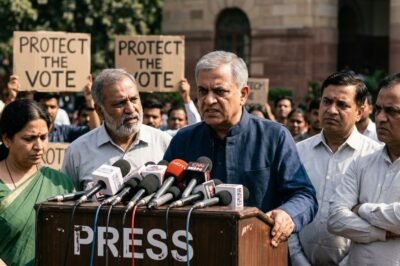
The democratic fabric of any nation is woven with the delicate threads of institutional trust, and when that trust begins to fray, the entire structure of the state is placed at significant risk. The recent developments on October 8, regarding the Chief Election Commissioner (CEC) and the SIR controversy, represent a watershed moment in contemporary political history. As opposition leaders intensify their rhetoric, the accusation of ‘vote chori’—a term synonymous with systemic electoral theft—has moved from the fringes of political discourse to the very heart of national debate. This analysis explores the deepening chasm between the electoral oversight body and the political factions that claim their mandate has been subverted. The stakes could not be higher; at risk is not just the tenure of a few officials, but the very legitimacy of the electoral process that serves as the foundation of the state. As we peel back the layers of this confrontation, we find a complex interplay of legal technicalities, constitutional mandates, and raw political ambition that threatens to reshape the landscape of the republic for years to come. The events of October 8 are not merely a transient political spat but a symptom of a much deeper malaise within the governance framework.
The Genesis of the CEC-SIR Controversy and Institutional Friction
To understand the current impasse, one must look back at the origins of the friction between the Chief Election Commissioner and the Significant Incident Report (SIR) protocols that have become the flashpoint of this crisis. The CEC, historically seen as an impartial arbiter of the public will, has found itself under unprecedented scrutiny following the release of internal memos that suggest a disconnect between reported outcomes and field data. This friction is not merely administrative; it is fundamentally philosophical. On one side, the Commission maintains that it is adhering to strict procedural guidelines designed to ensure stability. On the other, the opposition views these same procedures as opaque barriers designed to mask irregularities. The SIR, intended as a tool for transparency, has instead become a weapon of political warfare, with each side interpreting its findings through a lens of self-interest.
Furthermore, the administrative machinery that supports the CEC has been accused of bureaucratic inertia. In several key constituencies, the delay in addressing SIR-related grievances led to an atmosphere of suspicion. When the Election Commission failed to provide a timely rebuttal to the initial claims of procedural lapses, it created a vacuum of information that the opposition was quick to fill with a narrative of collusion. This institutional friction has now reached a boiling point, as the opposition formally announced on October 8 that they would no longer recognize the authority of the CEC unless a complete overhaul of the reporting mechanism is implemented. This sets the stage for a prolonged period of political instability where the very rules of the game are in question.
Unpacking ‘Vote Chori’: The Rhetoric of Electoral Theft
The term ‘vote chori’ is more than just a catchy slogan; it is a powerful emotional and political tool used to mobilize the masses against perceived injustice. On October 8, opposition leaders used this phrase repeatedly to frame the CEC’s actions as a deliberate attempt to subvert the democratic will of the people. They argue that the ‘theft’ is not happening at the ballot box alone, but through the digital and administrative manipulation of the results post-voting. By focusing on the ‘chori’ or theft aspect, the opposition is successfully painting the current administration and the Election Commission as a unified front against the common citizen. This rhetoric is particularly effective in regions where the margin of victory was slim, and where any minor discrepancy in the SIR can be magnified into evidence of a grand conspiracy.
However, the government and the CEC have dismissed these claims as baseless ‘political theater’ designed to explain away the opposition’s own failures at the polls. They point to the fact that the SIR system was developed with bipartisan input and that the protocols are more rigorous than they have ever been. Despite these reassurances, the perception of ‘vote chori’ persists. The psychology of electoral loss often seeks an external scapegoat, but in this instance, the scale of the protest suggests something more substantial than mere bitterness. The opposition has presented what they call ‘statistical anomalies’—patterns in the data that they claim defy the laws of probability. While the Election Commission maintains these are the result of demographic shifts, the ‘vote chori’ narrative has already taken hold in the public consciousness, making it difficult for any subsequent audit to be seen as truly independent.
Constitutional Framework and the Limits of CEC Authority
At the heart of this row is a fundamental question about the constitutional limits of the Chief Election Commissioner’s power. Does the CEC have the unilateral right to override SIR findings if they believe those findings to be flawed or politically motivated? This legal gray area has become a battleground for constitutional experts. The opposition argues that the CEC is a servant of the constitution, not its master, and that the suppression of ‘significant incident’ data is a violation of the public’s right to information. They contend that by failing to act on the SIR warnings, the CEC has effectively abandoned its mandate to ensure a ‘free and fair’ election. This leads to a terrifying prospect: a situation where the guardian of democracy is perceived as its gravedigger.
On the legal front, multiple petitions have been filed in the high courts, seeking to define the scope of the CEC’s discretionary powers. The current framework gives the Commissioner broad latitude to maintain the integrity of the process, but it does not explicitly state how to handle a total breakdown of trust between the commission and the candidates. If the courts rule in favor of the opposition’s demand for greater transparency, it could lead to a retrospective opening of the vote counts, a move that would be unprecedented and potentially chaotic. Conversely, if the courts uphold the CEC’s current position, the opposition has threatened to take the protest to the streets, bypassing the legal system entirely in favor of ‘people’s power.’ This constitutional tension highlights the need for a more robust and clearly defined legal charter for the Election Commission that can withstand the pressures of modern, hyper-polarized politics.
International Scrutiny and the Global Perception of Democracy
The CEC-SIR row has not remained a purely domestic affair; it has caught the attention of international observers and democratic watchdogs. In an era where democratic backsliding is a global concern, the events in our country are being viewed as a litmus test for the resilience of democratic institutions in the Global South. International organizations have expressed concern over the ‘vote chori’ allegations, noting that a lack of transparency in electoral reporting is a common precursor to authoritarian shifts. The Hindu’s reporting on October 8 has been cited by foreign news outlets as evidence of a deepening crisis that could affect foreign investment and diplomatic relations. Stability is a prerequisite for economic growth, and the current political turmoil is making international markets nervous.
Moreover, the opposition has actively sought to internationalize the issue, briefing foreign diplomats on what they describe as the ‘death of democracy’ at the hands of a compromised Election Commission. While the government decries this as an invitation for foreign interference, the reality is that in a globalized world, the internal health of a democracy is everyone’s business. If the CEC cannot convincingly refute the allegations of the SIR controversy, the country’s ranking in global democracy indices is likely to plummet. This is not just a matter of prestige; it has tangible consequences for trade agreements and international cooperation. The world is watching to see if our institutions can self-correct or if they will double down on a path of opacity and confrontation.
The Role of the Judiciary as the Final Arbiter
With the executive and the legislature at loggerheads, and the Election Commission’s reputation in tatters, all eyes have turned to the judiciary. Historically, the courts have been reluctant to interfere in electoral matters once the process has begun, citing the need for finality. However, the sheer scale of the October 8 protests and the gravity of the ‘vote chori’ claims may force the hand of the Supreme Court. The judiciary now finds itself in a precarious position: if it intervenes too aggressively, it risks being seen as overstepping its bounds; if it remains passive, it may be accused of being a bystander to the erosion of democratic norms. The recent statements from the Chief Justice suggest that the court is aware of the ‘extraordinary circumstances’ surrounding the CEC-SIR row.
Legal analysts suggest that a middle path might be the creation of an independent, judicial-led commission to review the SIR findings. This would allow for a ‘cooling off’ period where both the CEC and the opposition can present their evidence before a neutral body. However, the opposition has expressed skepticism about any commission that does not have the power to disqualify officials or order re-polls. The judiciary’s role is not just to interpret the law, but to preserve the public’s faith in the system. As we move past the October 8 highlights, the legal maneuvers in the coming weeks will determine whether the constitutional crisis can be resolved through the rule of law or if it will descend into a protracted political conflict that leaves the nation divided for a generation.
Future Implications: A Republic at the Crossroads
Looking ahead, the implications of the CEC-SIR row are profound and far-reaching. The events of October 8 mark the beginning of a new era of political confrontation where the basic mechanics of voting are no longer agreed upon by all parties. This ‘new normal’ is a dangerous one. If every election is met with a ‘vote chori’ narrative and a protest against the CEC, the peaceful transfer of power—the hallmark of any successful democracy—becomes impossible. We are seeing the birth of a permanent state of electoral contestation, where the results are only accepted if they favor the incumbent or if the opposition is too weak to protest. This undermines the very concept of a mandate and turns the ballot box into a source of division rather than a tool for consensus.
In the long term, the only way out of this crisis is a comprehensive reform of the Election Commission itself. This must include making the CEC’s appointment process more transparent, giving the SIR a statutory basis that ensures public disclosure, and creating a faster legal track for electoral disputes. Without these reforms, the ghost of the October 8 row will continue to haunt every subsequent election. The opposition’s vow to continue their protest signifies that they are prepared for a long battle. For the government and the CEC, the challenge is to move beyond defensive rhetoric and provide the transparency that the public is clearly demanding. The survival of the republic depends on its ability to prove that its elections are not just ‘held’ but are truly ‘won’ through the fair and transparent will of the people. Failure to do so will only embolden those who seek to circumvent the democratic process entirely.






































Leave a Reply