
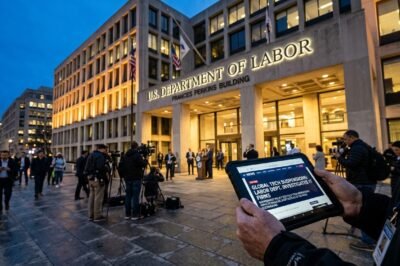
The recent announcement that the United States Department of Labor (DOL) has suspended several prominent Information Technology (IT) firms—including industry behemoths like Cognizant, Infosys, Tata Consultancy Services (TCS), Wipro, Capgemini, and HCL—from the permanent labour certification (PERM) process has sent shockwaves through the global technology sector. This move, reported by major news outlets such as Telegraph India, represents one of the most significant regulatory interventions in the H-1B to Green Card pipeline in recent history. For decades, these companies have served as the backbone of the American tech infrastructure, providing essential talent to Fortune 500 companies while navigating the complex web of US immigration law. The suspension of PERM certifications is not merely a bureaucratic hurdle; it is a fundamental disruption to the career trajectories of thousands of highly skilled international professionals and a direct challenge to the operational models of the world’s largest consulting firms. As the industry grapples with this development, the broader implications for talent acquisition, corporate compliance, and US-India economic relations have become the central focus of analysts and policymakers alike. This analysis delves deep into the mechanics of the suspension, the underlying regulatory environment, and the long-term consequences for the technology landscape, examining how a single administrative shift can redefine the future of global labor mobility and innovation.
The PERM Process: A Gateway to Permanent Residency
To understand the gravity of the current suspension, one must first grasp the technicalities of the Permanent Labour Certification, commonly known as the PERM process. Managed by the Office of Foreign Labor Certification (OFLC) within the Department of Labor, PERM is the mandatory first step for most employment-based green cards (EB-2 and EB-3 categories). Under this system, an employer must prove to the US government that there are no qualified, willing, and available American workers to fill the position in question. This involves a rigorous recruitment process, including newspaper advertisements and internal job postings, followed by a verification that the foreign worker will be paid at least the prevailing wage for that specific role and geographic area.
For the ‘Big Tech’ consulting firms named in the suspension, PERM is the primary vehicle for transitioning their H-1B workforce to permanent residency. Because the H-1B visa has a six-year limit, the ability to file a PERM application and secure an approved I-140 petition is critical for extending a worker’s stay indefinitely. Without access to PERM, these companies face a ticking clock for their most experienced senior developers, architects, and project managers. The suspension essentially freezes the green card queue for these firms, creating a backlog that could take years to resolve once—or if—the suspension is lifted. This administrative bottleneck threatens to drain the talent pool of some of the most innovative companies operating on US soil.
Audit Triggers and the Suspension Mechanism
The suspension of these firms usually stems from what the DOL terms ‘supervised recruitment’ or a program-wide audit. While the Department of Labor does not always publicly disclose the specific infractions leading to such a broad suspension, industry experts point to several recurring triggers. Often, these include patterns of non-compliance found during individual audits, such as failures to properly document the rejection of US applicants or inconsistencies in job descriptions. When the DOL notices a systemic pattern across hundreds or thousands of applications from a single employer, it may move to suspend the standard PERM processing for that entity, requiring every future application to undergo ‘supervised recruitment’—a process where a DOL officer oversees every step of the hiring process.
This level of scrutiny is incredibly resource-intensive for both the government and the employer. In a supervised recruitment scenario, the employer must submit all recruitment materials to the DOL for pre-approval, and the DOL may even direct the employer on where and when to advertise. For firms like Infosys or Tata, which may file thousands of PERM applications annually, the transition from streamlined filing to supervised oversight is equivalent to a full-scale suspension of their standard operating procedures. It effectively halts the high-volume ‘talent factory’ model that these firms have perfected over the last twenty years, forcing a radical shift in how they manage their international human capital.
Profiling the Impacted Giants: From TCS to Capgemini
The list of impacted companies reads like a ‘Who’s Who’ of the global IT services industry. Tata Consultancy Services (TCS) and Infosys are the crown jewels of the Indian tech sector, with combined employee counts reaching into the hundreds of thousands globally. Cognizant, while headquartered in the US, maintains the majority of its workforce in India and is a top petitioner for H-1B visas. Wipro and HCL follow closely, representing the vanguard of digital transformation services for global clients. Even Capgemini, a French-headquartered multinational, is heavily impacted due to its massive offshore and near-shore delivery centers that rely on the US labor market for high-end consulting engagements.
These companies are not just service providers; they are the primary engines of the Indian economy and critical partners for US businesses seeking to reduce operational costs through outsourcing and managed services. For these firms, the US market typically accounts for 50% to 70% of their total revenue. Any disruption in their ability to deploy and retain talent in the US hits their bottom line directly. Investors have historically viewed PERM and H-1B stability as a bellwether for the health of these stocks. The suspension news has already led to increased volatility in the Nifty IT index and prompted emergency briefings for institutional investors who fear a prolonged regulatory battle could erode the competitive advantage of the traditional Indian IT model.
The Strategic Shift in US Labor Enforcement
The suspension must be viewed within the broader context of evolving US labor policy. Over the past several years, there has been an increasing emphasis on ‘Hire American’ initiatives across multiple administrations. The Department of Labor has significantly bolstered its investigative arms, focusing on ‘H-1B dependent’ employers—those for whom a large percentage of the workforce consists of visa holders. The DOL’s current stance reflects a move toward more aggressive enforcement of labor protections, aimed at ensuring that the PERM process is not being used as a loophole to bypass local labor markets in favor of cheaper, more dependent foreign workers.
This enforcement surge is characterized by a ‘quality over quantity’ approach. Regulators are looking more closely at ‘roving employees’—consultants who are moved from one client site to another—and whether their PERM applications accurately reflect their actual work locations and duties. By suspending these major firms, the DOL is sending a powerful message to the entire industry: the era of high-volume, automated PERM filing is over. Companies are now expected to demonstrate a hyper-local commitment to the US workforce, or face administrative sanctions that can derail their entire US growth strategy. This shift indicates that compliance is no longer a ‘check-the-box’ activity but a core strategic risk that requires board-level oversight.
Operational Hurdles and Talent Retention Challenges
The immediate consequence of the suspension is an internal crisis of talent retention. For an Indian software engineer working in the US on an H-1B visa, the PERM application is the light at the end of the tunnel. It represents the possibility of long-term stability for their family, including the ability for spouses to work and children to remain in the country. When a firm is suspended from the PERM process, it creates a sense of profound uncertainty among the workforce. Experienced professionals may begin looking for ‘Green Card friendly’ employers—often smaller firms or product-based giants like Google or Microsoft that may not be under the same level of departmental scrutiny.
Furthermore, the operational cost of managing a ‘supervised’ recruitment process is astronomical. Each application requires dedicated legal and HR resources to interface with the DOL, manage a specific set of advertisements, and document every single interaction with potential US applicants. For a company like Wipro or HCL, which operates on relatively thin margins in a competitive bidding environment, these added costs can make certain US-based projects unviable. There is also the risk of litigation; if the DOL finds that these companies have systematically discriminated against US workers during their previous PERM filings, it could lead to massive fines and permanent debarment from all foreign labor programs.
Global Competitiveness and the India-US Tech Nexus
The geopolitical dimension of this suspension cannot be ignored. The tech partnership between the US and India is a cornerstone of the bilateral relationship, often cited in high-level diplomatic meetings. Indian IT firms provide the ‘muscle’ for American innovation, handling everything from legacy system maintenance to cutting-edge AI and cloud migration. By restricting the flow of permanent labor certification, the US risks pushing these firms to move their operations elsewhere—perhaps to Canada, the UK, or back to India—potentially leading to a ‘reverse brain drain’ that could benefit America’s economic competitors.
Conversely, some argue that this move is necessary to force the IT services industry to evolve. For years, critics have argued that the ‘body shopping’ model—sending workers from India to the US for short-term gains—is unsustainable and suppresses domestic wages. This suspension may accelerate the trend of ‘onshoring,’ where companies like Infosys and TCS hire thousands of US college graduates and set up delivery centers in states like Indiana, North Carolina, and Texas. While this transition is expensive and slow, it may be the only way for these firms to remain compliant with the increasingly protectionist stance of US labor regulators.
Conclusion: Navigating a New Era of Regulatory Compliance
The suspension of Cognizant, Infosys, TCS, Wipro, Capgemini, and HCL from the PERM process is a watershed moment for the global technology industry. It marks the end of an era of relatively frictionless labor mobility for the world’s largest IT service providers and signals the beginning of a period characterized by intense regulatory oversight and administrative friction. For the companies involved, the path forward involves a double-pronged strategy: aggressive legal defense and a fundamental restructuring of their US recruitment practices. They must prove to the Department of Labor that they are not merely ‘visa mills’ but are genuine contributors to the US economy that prioritize local hiring wherever possible.
For the thousands of employees caught in the middle, the situation is a reminder of the fragility of the US immigration system. The ‘Green Card backlog’ for Indian nationals is already estimated to be decades long; this suspension adds another layer of complexity to an already broken system. As we look to the future, the resolution of this crisis will likely involve a mix of policy reform and corporate adaptation. Whether through legislative changes to the H-1B program or a total overhaul of the PERM process, one thing is certain: the relationship between the US government and the giants of the Indian IT sector has changed forever. Stakeholders must now prepare for a landscape where compliance is the ultimate competitive advantage and the ability to navigate the intricacies of Washington’s regulatory environment is just as important as the ability to write clean code.






































Leave a Reply