
The Escalating Tensions in the Heart of the Capital
The political landscape in New Delhi has reached a boiling point as the recent ‘anti-CEC’ protests have sent shockwaves through the administrative and social fabric of the capital city. As the Civil Justice Party (CJP) prepared for its high-profile ‘Tiranga’ protest, the Delhi Police took unprecedented measures to manage the gathering, eventually shutting down parts of Central Park in Connaught Place. This development is not merely a localized law and order issue but represents a significant friction point between civil society’s right to dissent and the state’s mandate to maintain public order. The core of the grievance lies in the perceived lack of transparency regarding the selection and functioning of the Chief Election Commissioner (CEC), an office that stands as the bedrock of Indian democracy. In an era where electoral integrity is under constant global scrutiny, these protests highlight a deep-seated anxiety among political factions regarding the mechanisms that govern the democratic process. The heavy police deployment and the closure of one of Delhi’s most iconic commercial hubs reflect the high stakes involved in this confrontation.
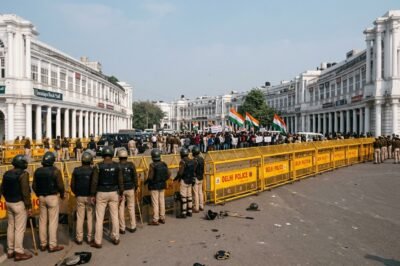
For residents and commuters, the disruption was immediate and palpable. Connaught Place, often referred to as the heart of Delhi, became a fortress as barricades were erected and security personnel in riot gear patrolled the vicinity. The Delhi Police’s stance—offering a ‘suitable place’ for a smaller gathering while denying access to the central hub—illustrates the delicate balancing act the administration must perform. By restricting the movement of the ‘Tiranga’ march, authorities aimed to prevent potential gridlock in a city already prone to massive traffic snarls, yet critics argue that such measures dilute the impact of symbolic protests. This analysis delves deep into the legal, social, and political ramifications of this standoff, examining how the convergence of administrative caution and political fervor is shaping the narrative of Indian governance in real-time.
The Core of the Contention: Why the Anti-CEC Protest?
The genesis of the current unrest lies in a long-standing debate over the independence of the Election Commission of India (ECI). Protesters argue that the current legislative framework for appointing the Chief Election Commissioner and other Election Commissioners provides the executive branch with disproportionate influence. For decades, the ECI has been lauded as a gold standard for conducting free and fair elections, but recent shifts in policy and the introduction of new appointment laws have triggered a wave of skepticism. The ‘anti-CEC’ sentiment is fueled by the demand for a more bipartisan selection process, involving the Chief Justice of India and leaders of the opposition, to ensure that the office remains insulated from partisan politics.
The CJP’s decision to call for a ‘Tiranga’ protest—using the national flag as a symbol of constitutional reclamation—was a strategic move designed to resonate with the broader public. By framing the issue as a defense of the Republic’s foundational values, the organizers sought to move the debate beyond the narrow confines of party politics. However, the intensity of the mobilization caught the administration off guard. The demands for transparency are not just about the individuals holding the office but about the systemic safeguards that prevent any single entity from exerting control over the electoral machinery. This protest serves as a litmus test for the public’s trust in institutional autonomy, reflecting a broader trend where constitutional bodies are being scrutinized with unprecedented vigor.
Security Lockdown: Delhi Police and the Shutting of Connaught Place
The logistical response from the Delhi Police was swift and comprehensive. Citing the need to maintain public order and prevent the disruption of essential services, the authorities announced the closure of Central Park and several entry points to Connaught Place. This move was strategically aimed at dispersing the crowd before it could reach a critical mass at the city’s most visible landmark. By suggesting an alternative, ‘suitable place’ for a smaller gathering, the police attempted to uphold the letter of the law regarding the right to protest while simultaneously stripping the event of its primary stage. This tactic of ‘controlled demonstration’ is becoming increasingly common in urban policing, where the goal is to minimize the socio-economic footprint of political unrest.
The closure of Central Park, a site that typically hosts thousands of tourists, shoppers, and office-goers, resulted in a surreal silence in one of the world’s busiest commercial districts. Security experts point out that the dense layout of Connaught Place makes it a difficult area to manage during large-scale agitations, as the radial roads can quickly become traps for both protesters and the public. The deployment of drones and the monitoring of social media feeds allowed the police to track the movement of CJP supporters in real-time. While these measures were successful in preventing a major law and order incident, they have also raised questions about the shrinking space for public discourse in the physical environment of the capital.
Political Symbolism of the ‘Tiranga’ Protest
The use of the ‘Tiranga’ or the Indian National Flag in these protests is a deeply symbolic choice that carries immense emotional and political weight. By carrying the flag, the CJP and associated groups are attempting to claim the moral high ground, suggesting that their struggle is for the nation itself rather than a specific electoral gain. Historically, the tricolor has been a powerful tool for mobilization in India, from the independence movement to contemporary anti-corruption drives. In the context of the anti-CEC protests, the flag represents the demand for a democratic process that is as inclusive and transparent as the ideals the flag embodies.
This symbolic appropriation, however, often leads to a battle of narratives. While the protesters view themselves as defenders of the flag, the administration often views large-scale marches with the flag as a potential security risk that could be exploited by miscreants. The standoff in Delhi highlights how symbols are contested in the public square. The CJP’s insistence on a ‘Tiranga’ march was designed to create a visual spectacle that would be difficult for the media to ignore and even more difficult for the police to suppress without appearing to act against national symbols. The resulting stalemate, characterized by the closure of public spaces, underscores the friction between symbolic politics and administrative pragmatism.
Socio-Economic Impact of Central Delhi Closures
Beyond the political noise, the closure of Connaught Place has significant economic implications. As one of the premier retail and business hubs in the country, any disruption in CP translates into millions of rupees in lost revenue for shopkeepers, restaurateurs, and street vendors. On the day of the protest, footfall dropped by an estimated 70-80 percent, as nervous shoppers stayed away and businesses were forced to shutter their doors early. For the local business community, which is still recovering from the long-term effects of the pandemic and changing consumer habits, such interruptions are a major cause for concern. The New Delhi Traders Association (NDTA) has frequently voiced its frustration over the frequent use of the area as a protest site, arguing that the economic health of the district should not be sacrificed for political theatre.
Furthermore, the traffic diversions necessitated by the security lockdown caused a ripple effect across the city. Key arterial roads connecting North and South Delhi were choked, leading to hours-long delays for commuters. This loss of productivity and the added stress on the city’s infrastructure highlight the hidden costs of political instability. When a central district is locked down, the impact is felt far beyond the immediate vicinity, affecting the supply chains of small businesses and the daily lives of thousands of workers who depend on the metro and bus networks that converge at Rajiv Chowk. This economic dimension adds another layer of complexity to the government’s handling of the protests, as they must weigh the right to protest against the right of citizens to carry out their daily commerce.
Legal and Constitutional Framework of Public Demonstrations
The current standoff brings to the fore the enduring legal tension between Article 19(1)(a) and 19(1)(b) of the Indian Constitution, which guarantee the right to free speech and peaceful assembly, and the ‘reasonable restrictions’ that can be imposed in the interest of public order and sovereignty. The Delhi Police’s decision to restrict the protest site is based on Section 144 of the Code of Criminal Procedure, a colonial-era law that allows the executive to prohibit the assembly of four or more people. While the courts have repeatedly held that the right to protest is a fundamental aspect of a vibrant democracy, they have also acknowledged that this right is not absolute and must be balanced against the safety of the general public.
Legal scholars point out that the concept of a ‘suitable place’ for protest is a subjective one. What the police deem ‘suitable’ may be seen by protesters as an attempt to ‘ghettoize’ dissent, moving it to locations where it can be easily ignored by the powers that be. In several landmark judgments, the Supreme Court of India has emphasized that the state must facilitate peaceful protests rather than merely suppressing them. However, in the high-security environment of the capital, especially near sensitive zones like the Election Commission headquarters and Parliament, the threshold for imposing restrictions is significantly lower. The legal battle over where and how the ‘Tiranga’ protest can proceed will likely set a precedent for future political mobilizations in the city.
Conclusion: Future Implications for Indian Democracy
The anti-CEC protests and the subsequent security lockdown in Delhi are indicative of a larger trend in Indian politics: a growing lack of consensus on the rules of the democratic game. As long as there is a perception that the institutions meant to oversee elections are being compromised, the streets of the capital will continue to be a site of contestation. The government’s response—relying on heavy-handed security measures and the closure of public spaces—may provide a temporary solution to maintain order, but it does little to address the underlying grievances of the protesters. For the long-term health of the democracy, a dialogue regarding the transparency of the ECI is essential.
Looking ahead, the movement of the ‘Tiranga’ protest and the police’s management of it will be closely watched by international observers and domestic stakeholders alike. If the state continues to restrict protests to ‘suitable’ yet invisible locations, it risks alienating a significant section of the populace that feels unheard. Conversely, the organizers of the protest must ensure that their movement remains peaceful and does not become a tool for chaos. The path forward requires a re-evaluation of how public space is used and how constitutional offices are protected from the vagaries of partisan politics. Only through a commitment to both order and open dialogue can the capital move past this gridlock and toward a more resilient democratic future.




































Leave a Reply