
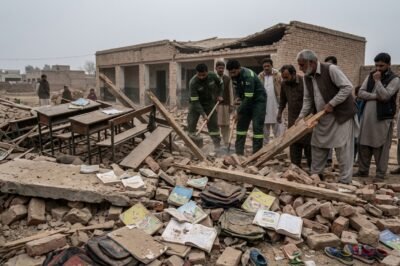
The sudden and catastrophic failure of a school roof in rural Pakistan has sent shockwaves through the international community, leaving a trail of devastation that transcends mere statistics. Reports from the BBC and local emergency responders confirm that at least 33 innocent pupils and their dedicated teacher were crushed to death when the weight of the structure gave way during a standard school day. The silence of the morning lessons was replaced by a thunderous roar of concrete and the desperate cries of survivors, marking one of the deadliest structural failures in the region’s recent history. This tragedy is not merely a localized accident; it serves as a harrowing indictment of the systemic failures in public safety, architectural integrity, and the chronic underfunding of educational infrastructure in South Asia. As parents stand vigil over the rubble, the world watches with heavy hearts, demanding answers for why children seeking an education had to pay the ultimate price. The gravity of this loss cannot be measured in words alone, as an entire generation in this small community has been hollowed out, leaving behind a vacuum of grief and a profound demand for structural accountability across the nation.
The Timeline of a Preventable Catastrophe
The incident occurred during the peak of the morning session when the school was at its highest occupancy. Witnesses describe a sequence of events that unfolded in mere seconds. There was no warning, no precursor of a slow crumble; instead, the entire slab of the roof descended upon the classroom where the primary-level students were gathered. Local villagers were the first to arrive on the scene, using their bare hands to pull back layers of dust and debris before formal rescue teams could navigate the difficult terrain. The teacher, who is being hailed as a hero by the community, reportedly attempted to shield several students with her own body, though the sheer force of the collapse made survival impossible for many in the center of the room.
As emergency services from nearby urban centers arrived hours later, the scale of the disaster became clearer. Hospitals were quickly overwhelmed, and the lack of heavy lifting equipment hampered early recovery efforts. This delay in the golden hour of rescue highlights the logistical nightmares often faced by rural districts in Pakistan, where the distance between specialized medical care and remote villages can mean the difference between life and death. The initial death toll rose steadily as bodies were recovered from beneath the heavy beams and unreinforced concrete, eventually settling at the tragic figure of 33 children and their educator.
Structural Vulnerabilities and the Role of Poor Construction
An investigation into the cause of the collapse points toward a lethal combination of aging infrastructure and substandard building materials. In many parts of Pakistan, rural school buildings are constructed using “junk” materials—bricks of low density, sand mixed with insufficient cement, and a total lack of steel reinforcement. These structures are often built by local contractors without the oversight of qualified civil engineers. Over time, the seasonal monsoon rains, which bring heavy moisture and humidity, penetrate the porous materials, leading to internal rot and the weakening of load-bearing walls. The roof, often the heaviest part of these simple buildings, becomes a ticking time bomb.
Furthermore, the absence of routine maintenance checks exacerbated the risk. In many government-run schools, there is no allocated budget for structural audits. Cracks in the walls or sagging ceilings are often ignored or patched with plaster rather than being treated as critical structural warnings. This incident serves as a grim reminder that the cost-cutting measures taken during construction or the neglect of maintenance protocols are paid for in human lives. For a country that is frequently subjected to seismic activity, the lack of earthquake-resistant design in public buildings remains a glaring oversight that continues to put millions of citizens at risk every day.
The Educational Landscape and Funding Disparities
To understand why this school collapsed, one must look at the broader educational landscape in Pakistan. While urban centers like Lahore, Islamabad, and Karachi boast modern facilities, the rural periphery is often left with the remnants of colonial-era buildings or hastily constructed shelters. The budget for education, while a significant portion of the national expenditure on paper, is often siphoned off through corruption or redirected toward more politically visible projects. This has led to the phenomenon of “ghost schools”—buildings that exist on paper but are either abandoned or used for livestock—while the functioning schools are so dilapidated that they are literally falling apart.
The loss of 33 students is not just a family tragedy; it is a significant hit to the human capital of the region. In many of these areas, families make immense sacrifices to send their children to school, hoping that education will be the ladder out of poverty. When the very institution meant to provide a future becomes a tomb, the social contract between the state and the citizen is shattered. Experts argue that without a massive influx of transparent funding and a complete overhaul of the provincial education departments, similar tragedies are inevitable in the thousands of other schools that currently sit in a state of disrepair across the country.
Socio-Economic Impact and the Burden of Grief
The economic impact on the affected families is profound and multifaceted. Many of these families are agrarian laborers who rely on the promise of their children’s future earnings for their old-age security. Beyond the financial loss, the psychological trauma is immeasurable. Survivors who were pulled from the wreckage now face a lifetime of Post-Traumatic Stress Disorder (PTSD) in a region where mental health services are virtually non-existent. The loss of a teacher, who often serves as the most respected intellectual figure in a rural village, also halts the educational progress of the remaining children for years to come.
Community leaders have expressed a sense of betrayal. The grief has manifested in protests, with local residents blocking main roads and demanding that government officials be held criminally liable for the negligence. This surge in public anger is a reflection of a deeper dissatisfaction with the governance of public safety. The socio-economic fabric of the village has been permanently altered, as the communal experience of burying nearly three dozen children in a single day creates a collective trauma that will span generations. The economic cost of rebuilding and providing restitution, while necessary, can never replace the lost potential of those young lives.
Comparative Analysis: A Pattern of Negligence
This is not the first time Pakistan has faced such a tragedy. History shows a recurring pattern of structural failures during natural disasters and even in normal weather conditions. During the 2005 earthquake, thousands of school buildings collapsed, killing over 17,000 students. At that time, the government promised to implement stricter building codes and ensure that all new schools were built to international safety standards. However, nearly two decades later, the evidence suggests that those promises have largely gone unfulfilled. The comparison between the 2005 disaster and this current collapse shows that the lessons of the past have not been institutionalized.
In contrast to neighboring countries that have invested heavily in the safety of public infrastructure, Pakistan’s progress has been slow. While India and Bangladesh have faced similar challenges, they have made strides in mandatory building certifications for schools. The persistent lack of accountability in the Pakistani construction sector, combined with a lack of political will to prioritize child safety over other expenditures, creates a dangerous environment. This incident must be the final wake-up call; the pattern of negligence is clear, and the data suggests that without a centralized, independent safety commission, more structures will fail.
Global Reactions and the Path Forward
The international community has reacted with a mix of condolences and calls for reform. UN agencies and international NGOs have offered support for the rebuilding process, but they have also emphasized the need for transparency in how funds are used. There is a growing consensus that international aid for education in Pakistan should be contingent on meeting specific safety benchmarks. This external pressure may be the only way to bypass the domestic bureaucratic hurdles that have prevented progress for so long. The path forward requires a three-pronged approach: immediate structural audits of every public school, the prosecution of contractors who used substandard materials, and a permanent increase in the maintenance budget.
Conclusion: Future Implications and Necessary Reforms
The collapse of the school roof in Pakistan is a tragedy that was as predictable as it was preventable. Moving forward, the government must treat school safety as a matter of national security. Future implications suggest that if immediate action is not taken, the trust in the public education system will reach an all-time low, leading to higher dropout rates and a further decline in literacy. There must be a move toward decentralizing the maintenance of schools, giving local school boards the power and the funds to make immediate repairs. Only through a combination of strict legal enforcement, transparent financial management, and a cultural shift that values the lives of the most vulnerable can we ensure that such a catastrophe never happens again. The 33 children and their teacher deserve more than just a moment of silence; they deserve a legacy of change that protects every other student in the nation.




































Leave a Reply