
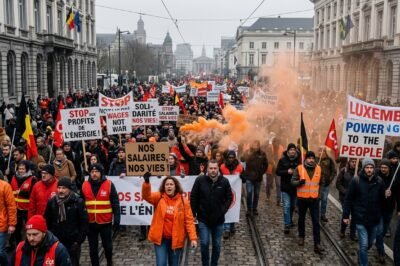
From the cobblestone streets of Brussels to the historic plazas of Rome, a wave of social unrest is sweeping across the European continent with a fervor not seen in decades. As the global economy grapples with the lingering shadows of a post-pandemic recovery and the sharp shocks of the conflict in Ukraine, the primary concern for millions of households is no longer just the geopolitical stability of the region, but the sheer feasibility of daily survival. Protests in Belgium, Italy, Portugal, and France have signaled a breaking point for the working class, who find themselves squeezed between skyrocketing energy bills, soaring food prices, and wages that have remained stubbornly static for years. This is not merely a localized phenomenon; it is a systemic crisis that threatens the social contract of the European Union. As citizens march under banners demanding justice and affordability, the political elite find themselves at a crossroads, forced to balance fiscal responsibility with the urgent need for direct social intervention. The scenes captured by international news outlets depict a continent in turmoil, where the economic fallout of supply chain disruptions and energy scarcity has converged into a perfect storm of domestic instability. The following analysis explores the root causes, regional specifics, and broader market implications of this escalating crisis.
The Macroeconomic Catalyst: Inflation and the Energy Vacuum
The core of the current unrest lies in the unprecedented surge in inflation, which has decimated the purchasing power of the average European citizen. For much of the past year, the Eurozone has faced double-digit inflation figures, driven primarily by the volatility of natural gas and electricity prices. Following the sanctions on Russian energy exports, the European market was forced to pivot toward more expensive alternatives, such as liquefied natural gas (LNG) from the United States and Qatar. While this pivot successfully averted a total energy blackout during the winter months, it came at a staggering cost. The pass-through effect of these energy costs has permeated every sector of the economy, from industrial manufacturing to the local bakery, leading to a general rise in the consumer price index (CPI) that has outpaced wage growth by a significant margin.
Beyond energy, food inflation has become a critical pain point. Europe’s reliance on global agricultural inputs, which were heavily impacted by the disruption of grain shipments from the Black Sea region, has led to a dramatic increase in the cost of basic staples. For low-income households in nations like Portugal and Italy, where a larger percentage of disposable income is spent on essentials, these price hikes are not merely an inconvenience but a threat to basic security. The result is a growing sense of betrayal among the public, who feel that the costs of geopolitical maneuvers and corporate profit-taking are being unfairly shouldered by those least able to afford them. This sentiment is the fuel that has ignited the protests currently paralyzing major European hubs.
Belgium and France: The Frontlines of Labor Action
In Belgium and France, the protests have been characterized by highly organized labor movements and large-scale industrial action. In Brussels, the heart of the European Union, tens of thousands of workers have taken to the streets to demand better wage indexation and a cap on energy prices. Belgium is one of the few countries with an automatic wage indexation system, which should theoretically protect workers from inflation. However, unions argue that the current calculation methods do not reflect the true cost of living and that employers are seeking to bypass these protections to maintain profit margins. The strikes have effectively shut down public transport and grounded flights, highlighting the leverage that organized labor still holds in these northern social democracies.
France, meanwhile, continues to be a hotbed of dissent as the government of Emmanuel Macron attempts to navigate a complex fiscal landscape. The French protests are not just about the cost of living but are also deeply intertwined with broader dissatisfaction over pension reforms and the perceived erosion of the social safety net. In cities like Paris and Lyon, the energy sector has seen massive walkouts, with refinery workers demanding a more equitable share of the record profits reported by energy giants like TotalEnergies. The French public remains divided, yet the sheer volume of protesters suggests that the “Gilets Jaunes” or Yellow Vest spirit has been reignited, this time with a more focused economic agenda that targets the widening gap between the elite and the working class.
Italy and Portugal: Structural Vulnerabilities Exposed
The situation in Southern Europe presents a different but equally troubling set of challenges. In Italy, the protests have focused on the ending of the “Citizens’ Income” social support program and the general precariousness of the labor market. Italy has long struggled with stagnant productivity and high youth unemployment, and the current inflation crisis has only exacerbated these structural weaknesses. Protesters in Rome and Milan are calling for a national minimum wage—a policy Italy currently lacks—as well as increased subsidies for small businesses that are struggling to keep the lights on. The Italian government faces the difficult task of managing a massive debt-to-GDP ratio while trying to appease a restive population that is increasingly skeptical of European-mandated austerity.
Portugal, often praised for its economic recovery over the past decade, is now seeing its own streets fill with disgruntled citizens. The protests in Lisbon have focused heavily on the housing crisis, which has been intensified by the influx of foreign investment and a surge in tourism. For many Portuguese workers, the cost of living is not just about the price of bread or petrol, but the impossibility of finding affordable housing in their own cities. When combined with low average wages compared to Northern Europe, the inflationary pressure has created a sense of hopelessness among the youth. The Portuguese protests serve as a reminder that even the “success stories” of the Eurozone are not immune to the social friction caused by rapid economic shifts and rising inequality.
The Energy Paradox and Industrial Sovereignty
A significant aspect of the protests is the public’s perception of the energy sector. There is a growing narrative across Europe that while ordinary people are being told to reduce their consumption and endure hardship, energy companies are recording windfall profits. This “energy paradox” has led to calls for more aggressive taxation on excess profits and a fundamental restructuring of the European energy market. Protesters argue that the current market model, which often ties electricity prices to the price of the most expensive production method (typically gas), is inherently flawed and protects producers at the expense of consumers. This has sparked a debate about industrial sovereignty and the need for Europe to reclaim control over its critical infrastructure.
Furthermore, the transition to green energy, while necessary for long-term climate goals, is being viewed with suspicion by some segments of the protesting public. The “Green Deal” and other environmental regulations are seen as adding additional costs to an already overburdened populace. In many protest circles, there is a demand for a “just transition” that ensures the costs of moving away from fossil fuels are not born solely by the working class. If the European leadership fails to integrate social justice into its environmental policies, the current cost of living protests may morph into a broader anti-environmental movement, potentially derailing the continent’s climate ambitions.
Market Implications: The Euro and Investor Anxiety
From a financial perspective, the persistent unrest across these four major economies is beginning to weigh on investor sentiment. The Euro has experienced significant volatility as markets price in the risk of political instability and the potential for a prolonged economic slowdown. When major economies like France and Italy face widespread strikes, it disrupts supply chains and lowers industrial output, which in turn affects GDP growth projections. Institutional investors are closely watching the European Central Bank (ECB) as it tries to curb inflation through interest rate hikes. However, these hikes also increase the cost of borrowing for the very governments that are being asked to provide more social spending, creating a fiscal “catch-22.”
The bond markets are particularly sensitive to these developments. As protests put pressure on governments to increase spending, concerns about debt sustainability resurface, especially for high-debt nations like Italy. If social unrest leads to a change in government or a shift toward populist economic policies, we could see a widening of bond spreads within the Eurozone, reminiscent of the sovereign debt crisis a decade ago. Furthermore, consumer confidence indices across Belgium, France, and Portugal have hit multi-year lows. When consumers are fearful of the future and focused only on essentials, discretionary spending collapses, leading to a broader stagnation that can be difficult to reverse through monetary policy alone.
Political Fallout: The Rise of Populism and Union Power
The political landscape of Europe is being reshaped by these protests. Traditional centrist parties are finding it increasingly difficult to hold their ground against the rising tide of both left-wing and right-wing populism. In Italy and France, populist leaders have been quick to capitalize on the cost of living crisis, framing it as a failure of the globalist elite and the European Union’s bureaucracy. This political polarization makes it harder for governments to implement the necessary structural reforms required for long-term stability. Instead, they are often forced into short-term, reactionary measures that may provide temporary relief but fail to address the underlying economic imbalances.
On the other hand, the protests have seen a significant resurgence in the power of labor unions. After decades of declining influence, unions are once again at the center of the political stage, acting as the primary voice for the disenfranchised. This shift could lead to a new era of industrial relations in Europe, characterized by more frequent collective bargaining and a greater emphasis on worker protections. While this may improve conditions for employees, it also poses a challenge for businesses that are already dealing with high operational costs. The tension between labor demands and corporate viability will likely be a defining feature of the European economic landscape for the foreseeable future.
Conclusion: A Continent at a Crossroads
The cost of living protests in Belgium, Italy, Portugal, and France are not isolated incidents but a collective cry for a more equitable economic order. They represent a fundamental challenge to the current trajectory of the European Union and its ability to protect its citizens from global economic shocks. As the winter progresses, the pressure on governments to provide tangible relief will only increase. Whether through direct energy subsidies, wage increases, or radical market reforms, the response to these protests will determine the social and political stability of the region for years to come. The era of cheap energy and stable prices is over; the new reality is one of volatility and competition for resources.
Ultimately, the resolution of this crisis will require more than just financial engineering. It will require a renewed commitment to social cohesion and a recognition that economic policy cannot be divorced from the lived experience of the population. If Europe can navigate this period of unrest by fostering a more resilient and fair economy, it may emerge stronger. However, if the grievances of the protesters are ignored or met with further austerity, the cracks in the European project may become permanent. The world is watching as these four nations navigate their discontent, providing a litmus test for the future of democratic capitalism in the 21st century. The stakes could not be higher, and the path forward remains fraught with both peril and the potential for profound transformation.





































Leave a Reply