
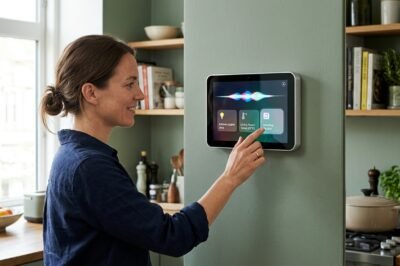
In the high-stakes theater of Silicon Valley, Apple Inc. is preparing for a performance that could either solidify its dominance in the smart home sector or reopen deep wounds from its past. The tech giant is reportedly betting heavily on its new ‘HomeView’ device, a wall-mounted smart display that serves as the command center for the modern household. However, the move has raised eyebrows across the financial and tech sectors, primarily because the device relies on the same core Siri AI technology that recently cost the company a staggering $250 million in a class-action settlement. For years, Apple has marketed privacy as a fundamental human right, a cornerstone of its brand identity that justifies its premium pricing. Yet, the ghost of Siri’s past—marked by allegations of unauthorized recordings and privacy breaches—continues to haunt the Cupertino giant. As Apple pivots toward its ‘Apple Intelligence’ era, the HomeView device represents a daring attempt to integrate a historically flawed voice assistant into the most intimate spaces of our lives. The question remains: can Apple convince consumers that the technology that led to a quarter-billion-dollar payout is now safe enough to manage their homes, or is this a calculated risk that threatens the very foundation of user trust?
The $250 Million Shadow: Revisiting the Siri Privacy Settlement
To understand the skepticism surrounding the HomeView device, one must first look back at the legal turmoil that has plagued Apple’s voice assistant. The $250 million settlement mentioned in recent reports stems from a long-running class-action lawsuit where plaintiffs alleged that Apple’s Siri-enabled devices, particularly iPhones, were recording private conversations without user consent. These ‘accidental triggers’ were supposedly reviewed by third-party contractors as part of a ‘grading’ program, leading to a massive outcry regarding the exposure of confidential medical information, business deals, and intimate personal moments. This breach was not just a technical glitch; it was a PR nightmare that challenged Apple’s narrative of being the ‘privacy-first’ alternative to Google and Amazon.
Despite the settlement, Apple has maintained that it has overhauled its processes. The company transitioned to on-device processing for many Siri requests and implemented more transparent opt-in features for data sharing. However, the underlying architecture of Siri—the way it listens for ‘Hey Siri’ and processes acoustic triggers—remains a descendant of the very system that caused the litigation. For financial analysts, the concern isn’t just about the $250 million payout, which is a fraction of Apple’s annual revenue, but the potential for future litigation if the HomeView device exhibits similar behavior in a home setting, where privacy expectations are at their absolute peak.
HomeView: Apple’s Strategic Entry into the Smart Home Market
The HomeView device is positioned as a direct competitor to the Amazon Echo Show and the Google Nest Hub. It is rumored to be a sleek, tablet-like display designed to be mounted on walls or placed on surfaces, running a new operating system tentatively called ‘homeOS.’ The device is expected to leverage ‘Apple Intelligence’—the company’s proprietary suite of generative AI features—to provide a more contextual and proactive user experience. By integrating Siri at the heart of this device, Apple aims to bridge the gap between its mobile ecosystem and the burgeoning smart home market, where it has historically lagged behind competitors.
Strategically, HomeView is more than just a new screen; it is a hub for the ‘Matter’ smart home standard. Apple’s goal is to become the central nervous system for household automation, controlling everything from smart locks and lights to thermostats and security cameras. The financial implications are significant. By capturing the home hub market, Apple can drive sales across its entire hardware lineup and increase the stickiness of its services, such as Apple Music and iCloud. However, the reliance on a voice-first interface means that Siri’s performance and perceived reliability are the make-or-break factors for this product’s success.
The Technology Paradox: Reusing Siri in the Age of Generative AI
There is a curious paradox at play in Apple’s engineering departments. On one hand, the company is touting a ‘completely reimagined’ Siri powered by Large Language Models (LLMs) and on-device processing. On the other hand, the foundational voice-recognition triggers and the legacy framework that led to the privacy lawsuits are still integrated into the system. Critics argue that by building HomeView on this ‘same’ technology, Apple is essentially putting old wine in a new bottle. The risk is that the fundamental flaws in how Siri distinguishes between a command and background noise may not have been fully resolved, leading to a resurgence of the same privacy issues that led to the $250 million settlement.
From a technical standpoint, Apple is leveraging its custom silicon—the A-series and M-series chips—to ensure that as much processing as possible stays on the device. This is a significant shift from the cloud-heavy processing that characterized the era of the Siri settlement. By processing ‘Apple Intelligence’ locally, Apple hopes to mitigate the risk of data leaks. However, the complexity of a home environment, with its varied acoustics and multiple occupants, presents a much tougher challenge for AI than a controlled office or personal mobile environment. The HomeView must be perfect in its execution to avoid becoming a $250 million liability for the second time.
Market Competition and the Battle for the Living Room
The smart home display market is currently dominated by Amazon, which holds a massive lead with its Echo Show series. Amazon has successfully integrated Alexa into millions of homes by offering low-cost hardware and a robust ecosystem of third-party ‘skills.’ Google follows closely with its Nest Hub, leveraging the power of Google Assistant and its search capabilities. Apple’s entry into this space with HomeView is remarkably late, which puts the company in the position of having to offer something truly revolutionary to gain market share. Analysts expect Apple to price the HomeView at a premium, consistent with its branding, which means the device must offer superior privacy and seamless integration to justify the cost.
The competitive landscape is further complicated by the rise of AI-first hardware. We are seeing a shift away from simple voice commands toward proactive AI agents. If HomeView can successfully implement Apple Intelligence to anticipate user needs—such as suggesting a commute route based on a calendar event or automatically adjusting home lighting for a scheduled movie night—it could leapfrog the Echo Show. However, if Siri remains the ‘bottleneck’ due to its historical inaccuracies and the baggage of its past legal failures, Apple may find itself struggling to move units in a saturated market.
Financial Implications: Ecosystem Lock-in and Hardware Margins
For investors, the HomeView device represents a vital expansion of Apple’s hardware ecosystem. Apple’s business model relies heavily on ‘The Walled Garden’—once a user owns an iPhone, they are more likely to buy an iPad, a Mac, and an Apple Watch. A dedicated home device is the missing link in this chain. If HomeView becomes the primary way users interact with their homes, it guarantees that they will stay within the Apple ecosystem for years to come. This ‘lock-in’ effect is a primary driver of Apple’s massive market capitalization and its ability to maintain high margins even in a fluctuating economy.
Furthermore, the success of HomeView could stimulate the ‘Services’ segment of Apple’s business. A wall-mounted display is the perfect vehicle for Apple TV+, Apple Fitness+, and Apple Music. Each HomeView unit sold represents a potential gateway for recurring monthly revenue. However, the financial risk is equally high. If the device fails to gain traction, or worse, if it triggers a new wave of privacy investigations, it could lead to multi-billion-dollar losses in brand equity and legal costs. The $250 million settlement was a warning shot; a second major privacy failure could lead to regulatory interventions that hamper Apple’s AI ambitions globally.
Privacy as a Product: Marketing vs. Reality
Apple has spent billions of dollars on advertising campaigns that feature slogans like ‘Privacy. That’s iPhone.’ This branding has been incredibly effective in differentiating Apple from its competitors who rely on ad-supported models. With the HomeView device, Apple is essentially asking consumers to put a ‘privacy-first’ camera and microphone in their kitchens and bedrooms. This is the ultimate test of the ‘Privacy as a Product’ strategy. If Apple can prove that its new Siri technology is fundamentally different and more secure than the version that led to the settlement, it will set a new standard for the industry.
To achieve this, Apple is expected to introduce new hardware-level privacy features, such as physical camera shutters and dedicated ‘secure enclave’ chips for voice data. But hardware is only half the battle. The software must be equally robust. The ‘Apple Intelligence’ framework promises to hide user identities through ‘Private Cloud Compute’ when off-device processing is necessary. Whether this is enough to satisfy privacy advocates and regulators remains to be seen. In the age of AI, the definition of privacy is evolving, and Apple is attempting to lead that evolution while carrying the heavy baggage of its previous mistakes.
Conclusion: The Future of Apple Intelligence in the Home
The launch of the HomeView device is a defining moment for Apple. It marks the first major hardware manifestation of the ‘Apple Intelligence’ era and serves as a referendum on the future of Siri. While the $250 million settlement serves as a cautionary tale, it also provided Apple with a blueprint of what NOT to do. By doubling down on the same Siri brand but with a radically different underlying architecture, Apple is betting that it can turn its greatest weakness into its greatest strength. Success will mean a new era of home automation where privacy and convenience coexist. Failure, however, could be far more expensive than any settlement the company has faced before. As we move closer to the official unveiling, the tech world and financial markets alike will be watching to see if Apple’s bet on Siri pays off or if the ghost in the machine is still very much alive.







































Leave a Reply