
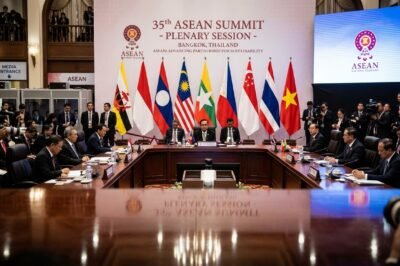
The Association of Southeast Asian Nations (ASEAN) finds itself at a critical juncture, navigating a geopolitical landscape that is shifting more rapidly than its traditional consensus-based diplomacy can often handle. As the regional bloc attempts to assert its ‘centrality’ in the Indo-Pacific, it is increasingly squeezed between the hammer of rising US-China competition and the anvil of internal fragmentation. The Economist recently highlighted a growing sense of urgency—a realization that ‘time is running out’ for the organization to address systemic crises like the civil war in Myanmar and the intensifying disputes in the South China Sea. This sense of temporal pressure is not merely about scheduling summits; it is an existential challenge to the ‘ASEAN Way,’ the doctrine of non-interference and unanimous agreement that has defined the bloc since 1967. As leaders gather for successive high-level meetings, the gap between the speed of external threats and the pace of internal decision-making has never been more glaring, suggesting that if ASEAN cannot modernize its mechanisms, it risks becoming a secondary actor in its own neighborhood.
The Myanmar Crisis: A Test of Credibility and Patience
The crisis in Myanmar remains the most significant internal stain on ASEAN’s reputation. Since the 2021 military coup, the bloc’s ‘Five-Point Consensus’ has yielded almost no tangible results. The junta’s continued violence against its own people and its refusal to engage in meaningful dialogue with the National Unity Government (NUG) have exposed the limitations of ASEAN’s diplomatic toolkit. For years, the organization has prided itself on ‘quiet diplomacy,’ yet as the conflict evolves into a full-scale civil war, the influx of refugees and the rise of transnational crime—including the notorious scam centers in border regions—are spilling over into neighboring member states. This spillover effect is forcing countries like Thailand and Singapore to reconsider the efficacy of the non-interference principle.
Furthermore, the Myanmar situation has created a diplomatic vacuum. While ASEAN has barred Myanmar’s military leaders from high-level summits, this policy has led to a fragmented engagement strategy. Some members, frustrated by the lack of progress, have initiated independent diplomatic tracks, undermining the unified front that the bloc strives to present. The ‘time’ referred to in recent critiques is precisely the window of opportunity to prevent Myanmar from becoming a permanently failed state, which would destabilize the entire region’s economic and security architecture for decades.
South China Sea: The Slow Pace of the Code of Conduct
The South China Sea continues to be a flashpoint where the clock is ticking against ASEAN’s interests. China’s assertive maritime activities, including the construction of artificial islands and the harassment of Philippine and Vietnamese vessels, have created a ‘new normal’ on the water. Meanwhile, negotiations for a legally binding Code of Conduct (CoC) have dragged on for over two decades. Critics argue that while ASEAN negotiates the wording of a framework, the reality on the ground—or rather, on the water—is being fundamentally altered by Beijing’s ‘salami-slicing’ tactics. Each delay in the CoC process benefits the status quo established by military presence rather than international law.
This delay is not just a matter of diplomatic stubbornness; it reflects deep-seated divisions within the bloc. Countries like Cambodia and Laos, which have significant economic ties to China, are often hesitant to sign on to language that explicitly condemns Chinese maritime claims. Conversely, claimant states like the Philippines and Vietnam are pushing for more robust protections of their Exclusive Economic Zones (EEZs). This lack of cohesion allows external powers to deal with ASEAN members individually rather than as a powerful collective, further diminishing the bloc’s leverage in territorial disputes.
Economic Integration and the Rivalry of Giants
On the economic front, ASEAN remains a bright spot, yet even here, time is of the essence. The Regional Comprehensive Economic Partnership (RCEP) has provided a framework for trade, but the looming threat of ‘de-risking’ and ‘friend-shoring’ by the United States and the European Union creates a complex environment for Southeast Asian manufacturers. As global supply chains shift away from China, ASEAN countries like Vietnam, Malaysia, and Indonesia are competing to attract high-value investment. However, to truly benefit from this shift, the bloc must accelerate its internal integration. Differences in digital trade standards, labor laws, and infrastructure quality remain significant hurdles.
Moreover, the US-China rivalry has forced ASEAN into a balancing act that is becoming increasingly difficult to sustain. The United States’ Indo-Pacific Economic Framework (IPEF) and China’s Belt and Road Initiative (BRI) represent competing visions for regional development. While ASEAN leaders frequently state they ‘do not want to choose sides,’ the reality of modern economics—especially in sectors like semiconductors, green energy, and 5G—often requires making choices that have geopolitical consequences. The ‘time’ to build a resilient, integrated regional economy that can withstand these external shocks is narrowing as protectionist policies gain traction globally.
The Institutional Reform Dilemma: Challenging the ASEAN Way
For ASEAN to remain relevant, institutional reform is no longer a luxury but a necessity. The current requirement for total consensus on every major decision often leads to the ‘lowest common denominator’ outcomes, where statements are so diluted they lack any real impact. Proposals to move toward a ‘minus-X’ voting system or a more empowered Secretariat have been met with resistance by member states wary of ceding sovereignty. However, the slow decision-making process is a major liability in an era of rapid technological change and sudden security crises.
Internal observers suggest that the bloc needs to move beyond being a ‘talk shop’ and develop mechanisms for conflict resolution and crisis management that do not require 100% agreement. The expansion of the bloc’s membership to include Timor-Leste also adds a new layer of complexity, requiring the organization to manage even more diverse economic and political interests. Without streamlining its bureaucracy and decision-making processes, ASEAN risks being bypassed by smaller, more agile ‘minilateral’ groups like the Quad or AUKUS, which can react to regional challenges with greater speed and focus.
Conclusion: Navigating the Future with Limited Time
The conclusion drawn by many analysts is that ASEAN cannot afford to remain static. The challenges of the mid-2020s are fundamentally different from those of the Cold War era when the organization was founded. To survive and thrive, the bloc must find a way to reconcile its tradition of consensus with the need for decisive action. This involves faster implementation of the Five-Point Consensus on Myanmar, a firmer and more unified stance on the South China Sea, and a rapid acceleration of digital and economic integration. If ASEAN fails to act within this closing window of opportunity, it may find itself sidelined as external powers dictate the security and economic architecture of Southeast Asia. The clock is indeed ticking, and for the ASEAN leaders, the time for diplomatic platitudes has passed; the time for strategic transformation is now.





































Leave a Reply