
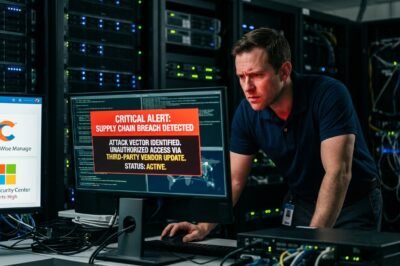
The global cybersecurity landscape is currently reeling from a sophisticated supply-chain attack targeting ConnectWise, a dominant force in the Managed Service Provider (MSP) software market. This breach, which has been disseminated through various professional channels including LinkedIn, poses an existential threat to the security of thousands of Microsoft 365 tenants worldwide. For years, MSPs have been the silent backbone of the modern digital economy, managing the infrastructure of small to mid-sized businesses with a level of trust that is now being exploited with surgical precision. This latest incident is not merely a software bug but a calculated infiltration of the trusted relationships between service providers and their clients. As news of the exposure spreads, IT departments and financial analysts are scrambling to assess the damage, realizing that the compromise of a single administrative tool like ConnectWise ScreenConnect or its RMM platforms can grant attackers the ‘keys to the kingdom.’ The gravity of this situation cannot be overstated; it represents a convergence of technical vulnerability and social engineering that targets the very heart of corporate productivity tools, specifically the Microsoft 365 suite, which houses the world’s most sensitive corporate communications and intellectual property.
The Anatomy of a Modern Supply Chain Catastrophe
To understand the depth of the ConnectWise breach, one must first understand the role of Remote Monitoring and Management (RMM) tools. These platforms are designed to give MSPs unfettered access to their clients’ systems to perform updates, troubleshoot issues, and maintain security posture. However, this same level of access makes them a primary target for state-sponsored actors and cybercriminal syndicates. In this specific supply-chain attack, threat actors identified vulnerabilities within the ConnectWise infrastructure that allowed for the injection of malicious scripts into the automated workflows used to manage Microsoft 365 environments. By compromising the automation engine, attackers bypassed traditional multi-factor authentication (MFA) protocols that would normally protect individual user accounts.
Statistics from recent cybersecurity reports indicate that supply-chain attacks have increased by over 300% in the last twenty-four months. The ConnectWise incident is particularly alarming because it leverages the ‘Partner of Record’ status that many MSPs hold within the Microsoft ecosystem. This status often grants the MSP broad administrative privileges over a client’s Azure Active Directory (now Microsoft Entra ID), enabling the attacker to create new global administrators, export sensitive emails, and even deploy ransomware across the entire tenant without the end-user ever noticing a discrepancy. The breach demonstrates a shift from ‘smash and grab’ tactics to long-term persistence, where attackers remain dormant within a network for months, quietly harvesting data before making their presence known.
Why Microsoft 365 Tenants are the Ultimate Prize
Microsoft 365 has become the ubiquitous operating system of the modern office. From financial spreadsheets in Excel to confidential legal strategies discussed in Teams, the platform is a goldmine for corporate espionage. Attackers targeting these tenants through ConnectWise are not just looking for credit card numbers; they are looking for leverage. By gaining access to Microsoft 365, cybercriminals can execute ‘Business Email Compromise’ (BEC) attacks at a massive scale. They can intercept invoices, alter bank details, and redirect millions of dollars in payments by masquerading as trusted executives or vendors. Because the traffic originates from within a legitimate, compromised tenant, it often bypasses standard spam filters and security gateways.
Furthermore, the integration of OneDrive and SharePoint into daily business operations means that a breach of this magnitude exposes not just communication but the very storage architecture of a corporation. Data suggests that 60% of small businesses that suffer a major data breach fail within six months. The financial implications for the MSPs involved are equally dire, as they face litigation, loss of reputation, and astronomical insurance premiums. The exposure of Microsoft 365 tenants via a trusted third party like ConnectWise highlights a critical flaw in the ‘shared responsibility model’ of cloud computing, where the security of the management layer is often neglected in favor of securing the endpoint.
The LinkedIn Factor: Exploiting Professional Trust
What sets this particular attack apart is the reported use of LinkedIn as a vector for both intelligence gathering and the distribution of malicious narratives. Threat actors have been observed using spoofed LinkedIn profiles of ConnectWise executives or support staff to reach out to IT managers. These messages often contain ‘urgent security patches’ or ‘compliance updates’ that, when clicked, initiate the supply-chain compromise. This social engineering tactic preys on the professional trust established on the platform. LinkedIn’s role as a trusted professional network makes users less likely to scrutinize a link or a file sent from someone who appears to be a legitimate industry peer.
Moreover, LinkedIn has been used by attackers to map out the relationships between MSPs and their high-value clients. By analyzing ‘Recommendations,’ ‘Skills,’ and public employee lists, cybercriminals can identify which MSPs manage which Microsoft 365 tenants. This reconnaissance allows for a highly targeted ‘spear-phishing’ campaign that increases the success rate of the breach. The intersection of professional social media and technical vulnerabilities creates a multi-dimensional threat landscape that traditional antivirus software is ill-equipped to handle. It necessitates a new approach to cybersecurity that includes social media monitoring and employee psychological training to recognize these advanced deceptive tactics.
Financial Repercussions and the Cost of Trust
The financial markets are sensitive to any news involving major tech players like ConnectWise and Microsoft. While ConnectWise is a private company, the ripple effects are felt throughout the publicly traded tech sector. Insurance companies are already reacting to the news, with reports suggesting that cyber-liability premiums for MSPs could rise by as much as 40% in the wake of this attack. The cost of remediation is also staggering; a single tenant recovery can cost upwards of $50,000 in forensic analysis, legal fees, and data restoration. For an MSP managing hundreds of tenants, the total cost can quickly spiral into the tens of millions.
Investors are increasingly looking at ‘Cyber Risk’ as a key metric for valuation. Companies that rely heavily on third-party management tools without adequate ‘Zero Trust’ architectures are being viewed as high-risk assets. The ConnectWise breach serves as a case study in ‘systemic risk,’ where a failure in one node of the network (the MSP tool) leads to a cascading failure across the entire ecosystem. This has led to a surge in demand for cybersecurity firms that specialize in supply-chain auditing and third-party risk management (TPRM). The market is shifting from a ‘prevention’ mindset to a ‘resilience’ mindset, where the ability to recover from a breach is valued just as highly as the ability to prevent one.
Mitigation Strategies and the Zero-Trust Mandate
In response to this crisis, security experts are advocating for an immediate transition to a Zero Trust architecture. This means moving away from the idea that any entity—even a trusted management tool—should have permanent, high-level access to a Microsoft 365 tenant. Instead, MSPs should implement ‘Just-In-Time’ (JIT) and ‘Just-Enough-Access’ (JEA) protocols. These methods ensure that administrative privileges are only granted when a specific task needs to be performed and are revoked immediately after completion. This limits the ‘blast radius’ of any potential compromise within the ConnectWise platform.
- Audit Partner Relationships: Organizations must immediately review the delegated administrative privileges (DAP) and granular delegated administrative privileges (GDAP) within their Microsoft 365 admin centers.
- Enable Advanced Logging: Ensure that Unified Audit Logs are enabled to track any unauthorized changes to global admin settings or mail flow rules.
- Mandate Hardware-Based MFA: Move beyond SMS or app-based MFA to hardware keys like YubiKeys, which are much harder for supply-chain attackers to bypass.
- Isolate RMM Tools: Run RMM agents on isolated network segments to prevent lateral movement if the management platform is compromised.
The technical community is also calling for greater transparency from software vendors. The delay between the discovery of a vulnerability and the public disclosure can often give attackers a weeks-long head start. In the case of ConnectWise, the speed at which the LinkedIn community shared indicators of compromise (IoCs) was faster than official corporate communications in some instances, proving the value—and the danger—of rapid information sharing in the digital age.
The Road Ahead: Future Implications for Global SaaS Ecosystems
The ConnectWise supply-chain attack is a watershed moment for the SaaS and MSP industries. It forces a long-overdue conversation about the security of the tools we use to secure ourselves. In the future, we can expect to see much tighter regulation regarding how MSPs handle client data and what security standards they must adhere to. Governments around the world are already looking at ‘Cyber Duty of Care’ laws that could hold software providers legally responsible for vulnerabilities that lead to mass data breaches. This would fundamentally change the economics of software development, prioritizing security over speed-to-market.
As we move deeper into the era of AI-driven cyberattacks, the lessons learned from the ConnectWise incident will be vital. Attackers will use AI to automate the discovery of supply-chain vulnerabilities, making these attacks more frequent and harder to detect. The only defense is a collaborative one, where software vendors, service providers, and end-users work in a transparent ecosystem built on the principles of Zero Trust. The LinkedIn alert was a warning shot; the next attack could be even more devastating if the industry fails to adapt. For now, the focus remains on containment and the difficult task of rebuilding the trust that was so easily exploited.







































Leave a Reply