
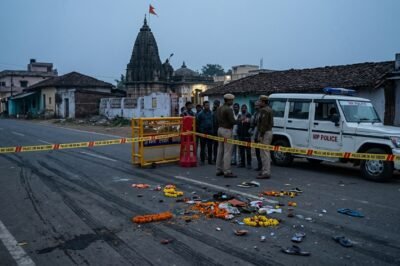
In a heart-wrenching incident that has sent shockwaves across the state of Madhya Pradesh, a peaceful religious gathering turned into a site of profound grief when a speeding truck ploughed through a group of devotees near a local temple. According to preliminary reports from NDTV and local authorities, at least 12 people have lost their lives in this catastrophic accident, while several others remain in critical condition. The tragedy occurred during the early hours of the day when the air was thick with the sounds of prayer and the scent of incense, only to be replaced by the screeching of tires and the screams of the injured. This incident serves as a grim reminder of the persistent dangers that lurk on the highways of India, particularly near locations where public congregations and high-speed traffic lanes intersect without adequate protective infrastructure. The loss of a dozen lives in a single moment of mechanical or human failure underscores the urgent need for a systemic overhaul of road safety protocols and crowd management strategies during religious festivals and daily temple visits in rural and semi-urban corridors.
The survivors of the crash, many of whom are currently battling for their lives in district hospitals, describe a scene of utter chaos and devastation. Witnesses claim that the truck, which appeared to be traveling well above the legal speed limit for that specific stretch of road, lost control before veering into the pedestrian area where devotees had gathered for morning rituals. The impact was so severe that many victims were killed instantly, leaving the community in a state of mourning and disbelief. This detailed analysis explores the multifaceted dimensions of this tragedy, from the immediate emergency response to the long-term policy implications that must be addressed to prevent such a loss of life from occurring ever again. As the families of the deceased begin the painful process of identifying their loved ones, the nation watches as the state government and local police initiate a high-level probe into the circumstances that led to this avoidable disaster.
The Anatomy of the Tragedy: How the Incident Unfolded
The timeline of the accident reveals a sequence of events that highlights a failure in both traffic enforcement and infrastructure safety. According to the police reports cited by NDTV, the truck was transporting heavy industrial or agricultural goods when it approached the temple precinct. The road in this area is known for its narrow turns and a lack of adequate lighting, factors that often contribute to late-night and early-morning collisions. On this specific day, a larger than usual crowd had gathered at the temple due to an auspicious religious calendar date, meaning many devotees were parked or standing near the edge of the road. As the truck approached, witnesses say it began to swerve uncontrollably, suggesting either a sudden mechanical failure, such as a brake burst, or the driver falling asleep at the wheel after a long, uninterrupted haul.
Local law enforcement noted that there were no significant barriers or speed breakers to slow down heavy vehicles entering the temple zone. The absence of such basic safety measures allowed the vehicle to maintain high momentum even as it drifted into the pedestrian zone. The sheer mass of the truck compared to the defenseless devotees resulted in a high mortality rate within seconds. By the time the vehicle came to a halt, the devastation was complete. Nearby residents were the first to reach the scene, attempting to pull survivors from beneath the wreckage using whatever tools they had at hand. The delay in professional emergency services, often a characteristic of rural accidents in India, meant that the golden hour for trauma care was largely spent in the hands of untrained but well-meaning bystanders.
A Detailed Breakdown of the Casualties and Emergency Response
The casualty count of 12 dead is expected to rise given the severity of the injuries reported among the survivors. Medical professionals at the nearest state-run hospital have indicated that many of the admitted patients suffered from multiple fractures, internal hemorrhaging, and severe head trauma. The lack of specialized trauma centers in the immediate vicinity of the accident site forced many of the critically injured to be transported over long distances to larger cities, further complicating their chances of recovery. This incident highlights the stark disparity in healthcare access between urban and rural Madhya Pradesh, where a localized disaster can quickly overwhelm existing medical infrastructure.
In the aftermath of the collision, the state government mobilized disaster management teams to assist in the recovery efforts. The identification process has been particularly difficult due to the nature of the injuries and the fact that many devotees were traveling from distant villages without carrying formal identification documents. Public health experts argue that the lack of onsite medical kiosks at high-traffic religious sites is a major oversight that contributes to higher mortality rates in such events. The coordination between the police, the fire department, and local volunteers was hampered by the narrow access roads, which were quickly choked with the vehicles of concerned relatives and onlookers, creating a secondary logistical challenge for the ambulances trying to reach the scene.
Investigating the Driver, the Vehicle, and the Nightmarish Conditions
A central focus of the ongoing investigation is the status of the truck driver and the mechanical health of the vehicle. Reports suggest that the driver fled the scene immediately after the impact, a common occurrence in India due to the fear of mob violence following road accidents. However, the police have since impounded the vehicle and are using transport department records to track down the owner and the operator. Preliminary inspections of the truck suggest that it may have been overloaded, a rampant issue in the logistics industry that significantly increases the stopping distance of heavy vehicles and makes them prone to rolling over or losing steering control on uneven surfaces.
Furthermore, the investigation must look into the labor conditions of the trucking industry. Drivers are often forced to work grueling hours with minimal sleep to meet tight delivery deadlines set by contractors. If the driver was found to be fatigued or under the influence of substances used to stay awake, it shifts a portion of the culpability onto the transport companies that prioritize profit over public safety.
Key Factors in the Investigation:
- The mechanical integrity of the truck’s braking system and steering column.
- The total weight of the cargo at the time of the accident compared to the legal limit.
- The driver’s logbook and history of previous traffic violations.
- The presence or absence of clear signage indicating a slow-moving pedestrian zone near the temple.
These factors combined to create a perfect storm of risk that ended in the deaths of 12 innocent people.
The Economic and Social Burden of Road Fatalities in Rural Regions
Beyond the immediate human tragedy, accidents of this magnitude impose a significant economic burden on the affected families and the state. Most of the devotees who visit such temples in Madhya Pradesh come from lower-to-middle-income backgrounds, often serving as the primary breadwinners for their households. The sudden loss of an adult male or female in such a family can lead to a spiral of poverty for the survivors. While the government usually announces ex-gratia payments to the families of the deceased, these one-time settlements are often insufficient to cover the long-term loss of income and the educational needs of orphaned children. In this case, the Chief Minister has announced a compensation package, but the disbursement process is often mired in bureaucratic red tape.
From a broader perspective, road accidents cost the Indian economy billions of dollars annually in lost productivity and healthcare expenditures. The World Bank has previously noted that India accounts for a disproportionate share of global road fatalities relative to its vehicle population. Each incident like the one in Madhya Pradesh adds to this national crisis. The social fabric of the local community is also torn asunder, as the fear of such accidents may discourage future religious and social gatherings, which are vital for the cultural and economic life of the region. The psychological trauma for the survivors and the witnesses also goes largely unaddressed, as mental health resources are virtually non-existent in these rural corridors.
Government Intervention and the Necessity of Safety Reforms
Following the NDTV report and the subsequent public outcry, there have been loud calls for the Madhya Pradesh government to implement more stringent safety regulations around religious sites. This includes the mandatory installation of high-visibility solar lighting, the construction of pedestrian subways or overpasses where highways pass through villages, and the permanent deployment of traffic police during peak festival hours. The Ministry of Road Transport and Highways must also accelerate its efforts to implement the Motor Vehicles (Amendment) Act, which carries heavier penalties for overloading and reckless driving.
However, legislation alone is not enough. There needs to be a cultural shift in how road safety is perceived and practiced. This involves educating drivers about the importance of rest and speed management, as well as sensitizing local communities to the dangers of standing near high-speed lanes. The role of the National Highways Authority of India (NHAI) is also critical; they must conduct a safety audit of the specific stretch of road where this accident occurred to identify any engineering flaws that may have contributed to the driver losing control. If the road geometry is found to be faulty, immediate corrective measures must be taken to prevent a repeat of this tragedy.
Future Implications: Preventing Temple-Adjacent Road Hazards
The tragedy in Madhya Pradesh should serve as a watershed moment for the administration. As the state moves toward modernization, the safety of its citizens must not be sidelined in the pursuit of faster transport and industrial growth. The future of road safety in India depends on a multi-pronged approach that combines advanced engineering, strict law enforcement, and comprehensive public awareness. For religious sites that attract thousands of people daily, a ‘safety zone’ should be established where the speed limit is strictly capped at 20-30 km/h, enforced by automated speed cameras and physical barriers.
In conclusion, the death of 12 devotees near a temple is not just an ‘accident’—it is a failure of the safety net that the state is supposed to provide for its people. As we mourn the lives lost, we must also demand accountability from the transport sector and the authorities responsible for road maintenance. Only through a transparent investigation and the subsequent implementation of rigorous safety standards can we hope to ensure that a pilgrimage remains a journey of faith and not a descent into disaster. The lessons learned from this horrific event must be documented and shared across all states to ensure that the blood spilled on the roads of Madhya Pradesh leads to a safer future for every traveler in the country.






































Leave a Reply