
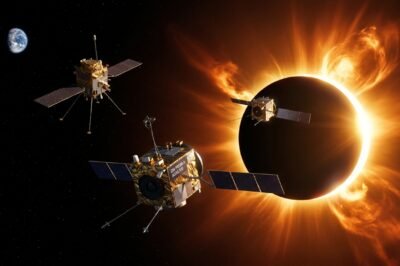
The vast, roiling atmosphere of our sun is no longer a mystery to be solved by solitary nations; instead, it has become the focal point of an unprecedented era of international scientific synergy. In a landmark achievement for global space exploration, the European Space Agency’s (ESA) Proba-3 mission and the Indian Space Research Organisation’s (ISRO) Aditya-L1 spacecraft have successfully performed a joint observation of early-stage Coronal Mass Ejections (CMEs). This collaborative feat represents a paradigm shift in how we monitor the sun’s volatile behavior, utilizing two distinct yet complementary vantage points to capture data that was previously impossible to acquire. As solar activity ramps up toward the peak of Solar Cycle 25, the ability to observe the ‘inner corona’—the region closest to the solar surface—has become the holy grail of heliophysics. By combining the revolutionary ‘formation flying’ technology of Proba-3 with the strategic positioning of Aditya-L1 at the Lagrange Point 1, scientists can now visualize the birth of solar storms with terrifying clarity. This partnership not only marks a technical triumph but also underscores the growing importance of the Indo-European space corridor in safeguarding Earth’s technological infrastructure from the unpredictable temper of our host star, signaling a new chapter in our quest to predict and mitigate the impacts of space weather on our digital civilization.
The Precision Choreography of ESA’s Proba-3
The Proba-3 mission is widely regarded as one of the most ambitious engineering challenges ever undertaken by the European Space Agency. Unlike traditional satellites that operate as single units, Proba-3 consists of two separate spacecraft—an Occulter and a Coronagraph—that fly in tandem with millimeter-scale precision. By maintaining a constant distance of approximately 144 meters from each other, the Occulter satellite precisely blocks the blinding disk of the sun, allowing the Coronagraph satellite to observe the faint solar corona. This setup effectively creates a ‘giant coronagraph’ in space, mimicking a natural solar eclipse that can last for hours rather than the few minutes experienced on Earth.
This ‘formation flying’ is achieved through a complex suite of sensors, including GNSS receivers, laser rangers, and optical cameras, all managed by autonomous onboard software. The technical requirements are staggering; the satellites must maintain their alignment while traveling at thousands of miles per hour, ensuring that the shadow cast by the Occulter falls perfectly onto the lens of the Coronagraph. This allows for the observation of the ‘inner corona,’ a region where the solar wind is accelerated and where Coronal Mass Ejections originate. Historically, this area has been difficult to study because the sun’s glare is so intense that it overwhelms satellite sensors, but Proba-3’s long-baseline occultation provides a level of detail that single-body satellites simply cannot match.
India’s Aditya-L1: A Sentinel at the Lagrange Point
While Proba-3 provides high-resolution snapshots of the sun’s immediate vicinity, India’s Aditya-L1 offers a constant, unblinking eye from a much greater distance. Launched by ISRO, Aditya-L1 is stationed at the first Lagrange Point (L1), about 1.5 million kilometers from Earth. This unique gravitational ‘sweet spot’ allows the spacecraft to remain in a stable position relative to the Earth and the sun, providing an uninterrupted view of our star without the interference of planetary eclipses or atmospheric distortion. The primary instrument involved in this joint observation is the Visible Emission Line Coronagraph (VELC), designed to study the solar corona’s temperature, velocity, and density.
The integration of Aditya-L1’s data with Proba-3’s observations creates a stereoscopic understanding of solar events. While VELC tracks the movement and evolution of CMEs from a strategic distance, Proba-3 captures the initial eruption phase with extreme close-up detail. This dual perspective is critical for mapping the trajectory and magnetic complexity of solar flares. ISRO’s contribution highlights India’s rising status as a premier space power, demonstrating that its homegrown technology is capable of contributing to the most sophisticated international scientific campaigns. The synergy between ESA’s formation flying and ISRO’s L1 positioning provides a multi-layered diagnostic tool for solar physicists worldwide.
Understanding Coronal Mass Ejections and Solar Dynamics
Coronal Mass Ejections (CMEs) are massive bursts of solar wind and magnetic fields that are ejected from the sun’s corona into space. These eruptions can contain billions of tons of magnetized plasma and travel at speeds of several million miles per hour. When a CME is directed toward Earth, it can interact with our planet’s magnetosphere, causing geomagnetic storms. These storms are responsible for the beautiful auroras seen at high latitudes, but they also pose a significant threat to modern technology. The joint observation by Proba-3 and Aditya-L1 focused on the ‘early stage’ of these ejections—the moment the magnetic loops on the sun’s surface snap and propel plasma outward.
By studying this early phase, scientists hope to solve the mystery of ‘coronal heating.’ Interestingly, the sun’s corona is millions of degrees hotter than its surface, a phenomenon that contradicts basic thermal logic. The data gathered from these joint observations will provide clues into how energy is transferred from the solar interior to the outer atmosphere. Furthermore, observing the acceleration phase of a CME allows for more accurate modeling of its arrival time at Earth. Statistics from previous solar cycles suggest that major CMEs occur more frequently during the solar maximum, making the timing of this mission critical for the current decade’s space weather readiness.
The Economic Stakes of Space Weather Monitoring
The financial implications of space weather are far from theoretical. In a world increasingly dependent on satellite-based navigation, global telecommunications, and interconnected power grids, a massive solar storm could cause economic disruption on a scale rarely seen in history. Lloyd’s of London has previously estimated that a ‘Carrington-class’ solar event could cause between $600 billion and $2.6 trillion in damages to the U.S. economy alone. The vulnerability of the global GPS network, which synchronizes everything from financial transactions to airline flight paths, means that even a moderate geomagnetic storm can lead to significant revenue losses and logistical chaos.
The collaborative data from Proba-3 and Aditya-L1 provides the foundation for more robust early warning systems. Insurance markets and the aerospace sector are increasingly looking toward such scientific missions to mitigate risks. By improving the ‘lead time’ of a CME warning from hours to days, utility companies can preemptively adjust power grid loads to prevent transformer fires, and satellite operators can move their assets into ‘safe mode.’ This scientific mission, therefore, acts as a form of global infrastructure insurance. The investment in these spacecraft—while costing hundreds of millions of euros and rupees—pales in comparison to the potential multi-trillion dollar cost of an unpredicted solar disaster.
A New Era of Multi-Agency Space Research
The success of the Proba-3 and Aditya-L1 collaboration marks a turning point in international space policy. Traditionally, space agencies operated in silos, often competing for prestige or funding. However, the complexity of modern solar science requires a level of resource-sharing and data integration that no single nation can provide. The ESA-ISRO partnership demonstrates a ‘plug-and-play’ model for international missions, where different technological strengths are combined to achieve a common goal. This cooperation also has geopolitical undertones, strengthening the ties between the European Union and India in the high-tech sector, providing a democratic alternative to other major space-faring blocks.
Furthermore, the data generated from these missions is being shared with the global scientific community via open-access frameworks. This ‘open science’ approach ensures that researchers from universities and institutes worldwide can contribute to the analysis, accelerating the pace of discovery. The partnership also sets a precedent for future missions, such as the proposed joint lunar explorations and Mars transit monitoring. By aligning their orbital assets, ESA and ISRO have proven that the sum of their efforts is significantly greater than the parts, paving the way for a more unified global approach to planetary defense and stellar observation.
Conclusion: Future Implications for Solar Science
As we look toward the future, the joint observations of Proba-3 and Aditya-L1 will likely be remembered as the moment when solar forecasting moved from ‘reactive’ to ‘proactive.’ The detailed mapping of the inner corona provided by Proba-3, combined with the continuous monitoring from Aditya-L1, will allow for the development of the first truly predictive models of solar activity. These models are essential for the next phase of human exploration, including the Artemis missions to the Moon and eventual crewed missions to Mars, where astronauts will be far more vulnerable to solar radiation than they are in Low Earth Orbit.
Ultimately, this mission reinforces the fact that the sun is not just a distant light source, but a dynamic and sometimes dangerous neighbor that requires constant vigilance. The technological breakthroughs in formation flying and high-cadence coronagraphy will influence the design of space telescopes for decades to come. As the data continues to stream in from these two sentinels, our understanding of the solar-terrestrial relationship will deepen, ensuring that as we become an increasingly space-faring species, we do so with the knowledge and foresight necessary to navigate the temperamental environment of our solar system. The partnership between Europe and India has not just observed a CME; it has illuminated the path forward for international cooperation in the final frontier.




































Leave a Reply