
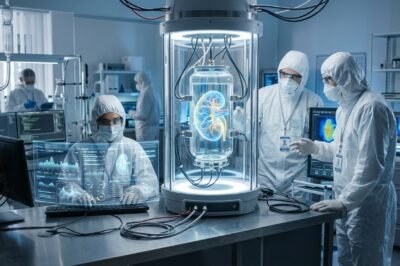
The global organ transplant crisis has long been characterized by a tragic race against the clock. For decades, the medical community has grappled with the agonizing reality that donated organs have a shelf life measured in mere hours. This biological expiration date means that thousands of potentially life-saving kidneys, hearts, and livers are discarded every year simply because they cannot reach a compatible recipient in time. However, a groundbreaking achievement by researchers has effectively shattered this temporal barrier. By successfully reviving pig kidneys that had been frozen for a full year and subsequently transplanting them into living subjects, scientists have demonstrated a proof-of-concept that could fundamentally rewrite the rules of modern medicine. This is not merely a laboratory curiosity; it is the dawn of the ‘organ banking’ era, a shift that promises to transform transplantation from an emergency logistics nightmare into a scheduled, precision-driven medical service. The implications for the hundreds of thousands of patients currently languishing on waitlists are nothing short of revolutionary, signaling a future where the scarcity of viable organs might finally become a relic of the past.
The Science of Vitrification: Turning Biological Matter into Glass
To understand the magnitude of this breakthrough, one must first understand the primary obstacle to long-term organ storage: ice. When biological tissue is frozen using standard methods, water molecules expand and form jagged ice crystals. These crystals act like microscopic shards of glass, shredding cell membranes and destroying the intricate vascular architecture of an organ like the kidney. For years, this physical damage made long-term cryopreservation an impossible dream for complex organs. The breakthrough achieved by the University of Minnesota team involves a process known as vitrification. Instead of simply freezing the organ, researchers use high concentrations of cryoprotectant chemicals—essentially a medical-grade antifreeze—to prevent the formation of ice crystals entirely.
Vitrification allows the organ to transition into a ‘glassy’ or amorphous solid state rather than a crystalline one. By cooling the kidney to temperatures as low as -150 degrees Celsius, biological activity is effectively paused. In this state, the organ can theoretically remain viable for decades. However, vitrification is only half of the battle. The true challenge, and the area where previous attempts have failed, lies in the rewarming process. If an organ is warmed too slowly or unevenly, it undergoes ‘devitrification,’ where ice crystals form during the thawing phase, or it suffers from thermal stress fractures due to uneven expansion. The success of this latest experiment hinges on a revolutionary heating technique that ensures the organ remains intact and functional throughout the transition back to body temperature.
Nanowarming: The Key to Thawing Without Destruction
The secret weapon in this scientific milestone is a process called nanowarming. To overcome the limitations of traditional external heating—which warms the outside of the organ faster than the core—researchers infused the pig kidneys with iron oxide nanoparticles. These nanoparticles are distributed throughout the organ’s internal vasculature via the same cryoprotectant solution used for vitrification. Once the organ is ready to be revived, it is placed inside a specialized electromagnetic coil. When an alternating magnetic field is applied, the iron oxide nanoparticles oscillate rapidly, generating heat from the inside out. This allows for an incredibly rapid and uniform warming of the entire organ, reaching several hundred degrees Celsius per minute.
This uniform heating is critical because it bypasses the temperature zones where ice crystals are most likely to form. By heating the kidney at such a blistering pace, the researchers managed to bring the organ back to a physiological state without the catastrophic cellular damage that usually accompanies thawing. Once the organ reached the desired temperature, the nanoparticles and cryoprotectants were flushed out, leaving behind a pristine, functional kidney. In subsequent tests, these revived kidneys were transplanted into pigs, where they successfully resumed filtering blood and producing urine—the primary metrics of renal health. This successful transition from a frozen ‘glass’ state back to a living, functioning biological pump represents one of the greatest feats in bioengineering of the 21st century.
Economic Implications: Disrupting the Dialysis Market
From a financial and systemic perspective, the ability to store organs for extended periods has massive implications for the healthcare economy. Currently, the treatment of end-stage renal disease (ESRD) is one of the most significant burdens on national healthcare budgets. In the United States alone, Medicare spends tens of billions of dollars annually on dialysis treatments. Dialysis is not a cure; it is an expensive, time-consuming bridge that keeps patients alive while they wait for a transplant that may never come. By enabling the creation of organ banks, the medical industry could significantly reduce the long-term costs associated with chronic kidney disease. A transplant, while expensive in the short term, is vastly more cost-effective over a five-to-ten-year period than continuous dialysis.
The Rise of Organ Banking Infrastructure
The shift toward organ banking will likely spawn a new sector within the biotechnology industry focused on the logistics, storage, and maintenance of vitrified tissues. We can expect to see the emergence of large-scale ‘biorepositories’ that function much like blood banks. These facilities would require specialized equipment, including high-powered electromagnetic induction systems and advanced cryogenic storage tanks. For investors and medical device manufacturers, this represents a multi-billion dollar opportunity. Companies specializing in nanotechnology, cryopreservation chemicals, and specialized surgical robotics will be at the forefront of this transition. Furthermore, the ability to bank organs allows for better immunological matching. Instead of rushing to find the ‘best available’ match within a 12-hour window, doctors can search a global inventory for the ‘perfect’ match, reducing the rates of organ rejection and the subsequent need for expensive life-long immunosuppressant cocktails.
Solving the Logistics of Organ Scarcity and Global Inequality
One of the most heart-wrenching aspects of current transplant medicine is the geographical mismatch between donors and recipients. A viable organ might be available in a rural hospital, but if the ideal recipient is thousands of miles away, the organ often cannot be transported in time. This creates a systemic inequality where patients in major metropolitan hubs with high-density donor pools have a much higher chance of survival. Reviving frozen organs eliminates the tyranny of distance. If an organ can be stored for a year, it can be shipped across oceans via standard cold-chain logistics, opening up a global market for organ exchange.
This capability also dovetails with the burgeoning field of xenotransplantation—the use of animal organs in humans. The study used pig kidneys because of their physiological similarity to human kidneys. If pig organs can be genetically modified to avoid human rejection and then vitrified for long-term storage, we could reach a point where the ‘waiting list’ for a kidney is eliminated entirely. Hospitals could keep a ‘stock’ of various organ types and sizes on hand, ready for immediate use in emergency surgeries or scheduled procedures. This would move transplantation out of the realm of crisis management and into the realm of routine, highly predictable medical intervention, drastically improving outcomes for patients with acute organ failure.
Ethical Considerations and the Path to Human Trials
While the technical success in pigs is cause for celebration, the path to human application is fraught with regulatory and ethical hurdles. The transition from porcine models to human subjects requires rigorous validation to ensure that the cryoprotectants and nanoparticles used in the process leave no toxic residues. There are also concerns regarding the long-term durability of revived organs. While the pig kidneys functioned well in the short term, researchers must prove that a revived organ can last for decades inside a human recipient without premature degradation. Regulatory bodies like the FDA will require extensive longitudinal data before allowing the first human ‘thaw-and-transplant’ procedures.
Ethically, the ability to bank organs raises questions about equitable access. Who gets priority for a banked organ? Will the most perfect matches go to those with the best insurance, or will there be a centralized, transparent system for global distribution? Furthermore, the use of pig organs (xenotransplantation) continues to spark debate regarding animal welfare and the potential for cross-species viral transmission. However, most ethicists argue that the potential to save hundreds of thousands of lives outweighs these concerns, provided that the science is handled with extreme transparency and caution. As we move closer to human trials, the dialogue between scientists, ethicists, and policymakers will be just as crucial as the technology itself.
Conclusion: A New Era of Biological Engineering
The revival of pig kidneys after a year of frozen storage is more than just a scientific ‘first’; it is a fundamental shift in how we perceive the limits of biology. By mastering the transition between the living state and the vitrified state, scientists have effectively paused the clock on biological decay. This achievement paves the way for a future where organ transplantation is no longer a desperate gamble against time, but a logistical triumph of engineering. As the technology of nanowarming and vitrification matures, we may look back on the era of the ‘organ waiting list’ with the same disbelief we currently feel for the era before antibiotics. We are entering a period where ‘on-demand’ organs could become a reality, ensuring that no patient dies simply because a donor was too far away or a match was found too late. The future of transplantation has been rewritten, and it is frozen in time, waiting to be revived.






































Leave a Reply