
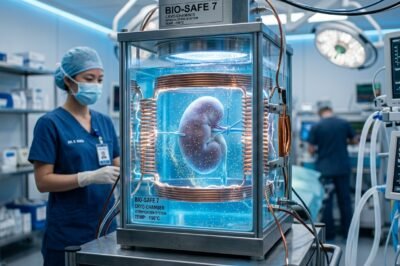
The boundaries of biological time have just been pushed further than ever before, marking a watershed moment in the history of regenerative medicine and transplant surgery. For decades, the primary hurdle in organ transplantation has not been the surgical procedure itself, but the brutal reality of logistics. Organs, once removed from a donor, begin a rapid descent into cellular decay, leaving surgeons with a ticking clock that rarely exceeds a few hours. However, a groundbreaking study recently highlighted by Gizmodo reveals that scientists have successfully revived pig kidneys after they were frozen for an entire year. This achievement is not merely a laboratory curiosity; it represents the first successful demonstration of long-term cryopreservation and recovery of a complex organ, potentially paving the way for a future where organ banks function much like blood banks. By overcoming the twin challenges of ice crystal formation and uneven thawing, researchers have unlocked a door that was previously thought to be bolted shut by the laws of thermodynamics. This breakthrough could fundamentally rewrite the script for the hundreds of thousands of patients currently languishing on transplant waitlists, turning a desperate race against time into a manageable, scalable medical process.
The Staggering Crisis of the Global Organ Shortage
To understand the magnitude of this scientific achievement, one must first look at the grim statistics governing the organ transplant market. In the United States alone, over 100,000 individuals are currently on the national transplant waiting list, with a new person added every ten minutes. Tragically, an average of 17 people die every single day while waiting for an organ that never arrives. The fundamental problem is geographic and temporal mismatch: a donor heart available in New York may be unusable for a recipient in Los Angeles simply because it cannot survive the transit time. Currently, kidneys can only be preserved for 24 to 36 hours on ice, while hearts and lungs have a mere four-to-six-hour window.
This logistical bottleneck leads to a staggering waste of biological resources. Estimates suggest that up to 20% of recovered kidneys and a much higher percentage of other organs are discarded because they cannot be matched and transported to a compatible recipient within the viability window. The ability to freeze an organ for a year without degrading its structural or functional integrity effectively removes the ‘perishability’ factor from the equation. If this technology scales to human organs, it would allow for perfect immunological matching and global distribution, effectively ending the era of ’emergency’ transplants in favor of scheduled, optimized procedures.
The Dual Innovation: Vitrification and Nanowarming
The success of the University of Minnesota team, who led this research, hinges on two distinct yet interconnected technological leaps: vitrification and nanowarming. Traditionally, freezing biological tissue results in the formation of ice crystals. These crystals act like microscopic shards of glass, piercing cell membranes and destroying the delicate vascular architecture of the organ. To prevent this, researchers use cryoprotective agents (CPAs)—essentially medical-grade antifreeze—to turn the organ’s fluids into a glass-like state, a process known as vitrification. While vitrification has been possible for years, the real challenge has always been the ‘thawing’ phase. If an organ warms too slowly or unevenly, it cracks or undergoes ‘devitrification,’ where ice crystals form during the warming process, killing the tissue.
This is where the ‘nanowarming’ revolution comes into play. The researchers infused the pig kidneys with iron oxide nanoparticles alongside the cryoprotectant. When it was time to revive the organ, they placed the kidney inside a specialized electromagnetic coil. This coil generates an alternating magnetic field that vibrates the nanoparticles throughout the organ simultaneously. This creates rapid, uniform heating from the inside out, at a rate of several hundred degrees per minute. This uniform warming prevents the thermal stress and crystallization that previously made long-term storage impossible. The nanoparticles are then flushed out of the organ’s vasculature, leaving it functional and ready for transplantation.
Economic and Market Implications for Healthcare Systems
From a financial perspective, the ability to store and revive organs could disrupt the multi-billion dollar dialysis and chronic disease management industries. Chronic kidney disease (CKD) is a massive drain on global healthcare budgets. In the U.S., Medicare spends over $50 billion annually on CKD, with a significant portion allocated to hemodialysis. A kidney transplant, while expensive in the short term, is vastly more cost-effective over a five-to-ten-year horizon than continuous dialysis. By increasing the supply of viable organs through long-term storage and the potential use of xenotransplantation (animal-to-human), healthcare systems could see a dramatic reduction in long-term maintenance costs for end-stage renal disease.
BioTech Investment and the Rise of Organ Banking
We are likely to see a surge in venture capital flowing into ‘Bio-Logistics’ and cryobiology startups. The infrastructure required to maintain ‘organ banks’—facilities capable of vitrification and magnetic nanowarming on a commercial scale—does not yet exist. This presents a massive opportunity for infrastructure development within the biotech sector. Companies specializing in nanoparticle synthesis, electromagnetic induction systems, and synthetic cryoprotectants are positioned to become the ‘Cisco’ or ‘Amazon’ of the new biological supply chain. Investors are already looking toward the intersection of nanotechnology and surgery as the next high-growth frontier in medical technology.
The Role of Pig Organs in the Future of Medicine
The choice of pig kidneys for this experiment is no accident. Pigs are considered the primary candidates for xenotransplantation because their organs are remarkably similar in size and physiological function to human organs. Recent advancements in CRISPR gene-editing have allowed scientists to ‘humanize’ pig organs by knocking out porcine viruses and altering surface sugars that trigger immediate immune rejection in humans. However, even with genetically perfected pig organs, the logistics of harvesting and immediate transplantation remain difficult. The ability to freeze these genetically modified organs for months or years allows for a ‘buffer’ in the supply chain.
Instead of needing a live donor or a freshly deceased animal on standby, medical facilities could maintain a cataloged inventory of ‘off-the-shelf’ genetically modified organs. This would allow surgeons to select an organ that has been pre-screened and matched for the specific recipient’s immune profile, reducing the reliance on heavy immunosuppressant drugs post-surgery. The synergy between gene-editing and cryopreservation is what will ultimately make xenotransplantation a viable, mainstream medical reality.
Ethical Considerations and the Regulatory Path Ahead
As with any leap in biotechnology, the revival of frozen organs brings complex ethical and regulatory questions. The FDA and other global regulatory bodies will need to establish entirely new frameworks for the safety and efficacy of ‘revived’ organs. Key concerns include the long-term toxicity of the nanoparticles used in the warming process and the potential for latent viruses to emerge from cryopreserved tissues. Furthermore, the use of animal organs on a massive scale raises significant animal welfare concerns that must be addressed through strict ethical guidelines and the eventual goal of lab-grown human organs.
There is also the question of ‘biological equity.’ Will this technology be available to the global population, or will organ banks become exclusive repositories for the wealthy? As the technology moves from pig models to human trials, the medical community must ensure that the standardization of organ storage leads to broader access, rather than a widening gap in healthcare outcomes. The potential for ‘organ commerce’ across borders also necessitates a robust international legal framework to prevent exploitation.
Conclusion: Toward a New Era of Biological Preservation
The successful revival of pig kidneys after a year of frozen storage is a definitive proof of concept that the biological clock can be paused and restarted. We are moving away from a world of ‘scarcity and emergency’ toward a future of ‘surplus and planning.’ While there are still significant hurdles to overcome before a human can receive a kidney that has been stored in a freezer for a year, the technical foundation has been laid. This breakthrough suggests that the ‘Holy Grail’ of transplantation—an unlimited, on-demand supply of viable organs—is no longer a matter of ‘if,’ but ‘when.’ As nanowarming and vitrification technologies mature, we may look back at the 2020s as the decade when humanity finally conquered the expiration date of life-saving tissue.






































Leave a Reply