
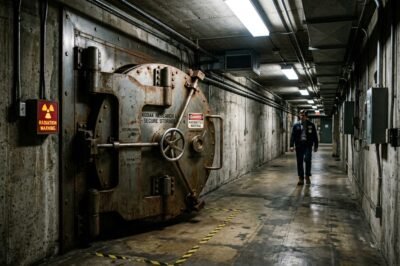
For decades, the name Kodak was synonymous with the preservation of memories, the vibrant saturation of Kodachrome, and the wholesome imagery of the ‘Kodak Moment.’ However, beneath the bustling surface of Eastman Kodak’s sprawling Rochester, New York, headquarters lay a secret that would eventually shock the scientific community and the general public alike. In 1975, at the height of its global dominance, Kodak began operating a uranium-based research device—a small nuclear reactor—hidden in a reinforced concrete bunker beneath a nondescript laboratory. This facility, known as a Californium Neutron Flux Multiplier (CFNM), contained three and a half pounds of highly enriched uranium, the same material used to fuel nuclear weapons. For 31 years, this device hummed quietly beneath the feet of unsuspecting citizens and thousands of employees, assisting in the development of cutting-edge materials and chemical processes that fueled the photography giant’s innovation engine. It was only after its decommissioning in 2006 that the existence of this nuclear footprint became widely known, raising profound questions about corporate transparency, national security, and the lengths to which industrial giants would go to maintain their competitive edge during the Cold War era and beyond.
The Hidden Subterranean Facility of Building 82
The story begins in 1974 when Kodak applied for a license to operate a specialized research tool that required nuclear fuel. By 1975, the device was operational in Building 82 of the Kodak Park complex. Unlike the massive cooling towers associated with commercial nuclear power plants, this reactor was compact and purpose-built for scientific inquiry rather than power generation. It was housed in a sub-basement with walls several feet thick, designed to shield the outside world from radiation. For more than three decades, the facility operated under the radar, literally and figuratively, with very few people outside a specialized circle of scientists and federal regulators even aware of its presence.
This level of secrecy was not necessarily born of malice but of industrial necessity and national security protocols. During the mid-20th century, the boundary between private corporate research and government-sponsored atomic science was often blurred. Kodak, as a major contractor for the U.S. government—providing specialized films for satellite surveillance and high-altitude reconnaissance—maintained a security clearance that allowed for such sophisticated operations. However, the realization that 1.5 kilograms of highly enriched uranium sat in a suburban basement for thirty years remains a startling footnote in the history of American industry, highlighting a period where technological advancement often outpaced public disclosure.
Technical Nuances of the Californium Neutron Flux Multiplier
To understand why Kodak needed a nuclear reactor, one must delve into the specifics of the Californium Neutron Flux Multiplier (CFNM). The device utilized a core of Californium-252 surrounded by plates of highly enriched uranium (HEU). The primary function of this setup was to trigger a controlled chain reaction that produced an intense stream of neutrons. These neutrons were then used for neutron radiography and activation analysis, techniques that allow scientists to peer into the molecular structure of materials without destroying them. In the world of high-end film manufacturing and chemical engineering, the ability to detect trace impurities at the parts-per-billion level was an invaluable asset.
The HEU used in the Kodak reactor was enriched to more than 93 percent, a level typically categorized as ‘weapons-grade.’ While the quantity of three and a half pounds was significantly less than what is required to create a nuclear explosive, the presence of such material in a private corporate setting is exceedingly rare. Most similar research reactors are located at major universities or national laboratories like Oak Ridge or Los Alamos. Kodak’s facility was a unique outlier, representing a peak of corporate research capabilities that few other companies in history have ever matched. The reactor allowed for precise quality control of chemicals, the testing of radiological shielding, and the development of specialized coatings that gave Kodak film its world-renowned clarity and durability.
Strategic Business Rationale for Nuclear R&D
From a business perspective, the investment in a nuclear research device was a calculated move to secure market dominance. During the 1970s and 80s, Kodak was locked in a fierce technological arms race with competitors like Fujifilm and Agfa. Every incremental improvement in film speed, color accuracy, and light sensitivity translated into billions of dollars in revenue. By having an on-site neutron source, Kodak scientists could conduct experiments in real-time, bypassing the logistical hurdles of shipping sensitive samples to government labs. This vertical integration of high-level physics and chemical manufacturing was a hallmark of the company’s ‘golden age,’ where R&D spending was virtually unlimited.
Furthermore, Kodak’s relationship with the defense and aerospace industries necessitated such high-tech tools. The company produced film for the CORONA satellite program and other top-secret surveillance missions. These films had to perform in the harsh radiation environments of outer space. Using their subterranean reactor, Kodak could simulate space radiation and test the resilience of their emulsions. This dual-use capability—serving both the consumer photography market and the national security apparatus—provided a financial and strategic moat that was nearly impossible for competitors to cross. The reactor was not just a scientific tool; it was a pillar of Kodak’s status as a technological superpower.
Post-9/11 Security Shifts and Decommissioning
The landscape for nuclear materials changed drastically following the terrorist attacks of September 11, 2001. In the wake of those events, the federal government began a massive effort to consolidate and secure highly enriched uranium across the country. The presence of weapons-grade material in a corporate basement in Rochester became a significant security liability. Although there were no recorded breaches or safety incidents at the Kodak facility, the potential risk of theft or sabotage necessitated a rethink of the reactor’s necessity. By 2006, the digital revolution had also begun to erode Kodak’s traditional film business, making the high cost of maintaining a nuclear facility harder to justify.
The decommissioning process was a masterclass in logistics and security. In November 2006, under the supervision of the Department of Energy and the Nuclear Regulatory Commission, the HEU was removed from the Rochester site. The material was loaded into specialized, lead-lined transport containers and moved under heavy armed guard to a secure federal site in South Carolina. The reactor itself was dismantled, and the facility was thoroughly decontaminated. It was only after the material was safely off-site that the public was informed of the reactor’s existence. This revealed a long-standing tension between the public’s right to know and the corporate need for security and proprietary research.
Public Perception and the Ethics of Corporate Secrecy
When the news broke that Kodak had been operating a nuclear reactor for over three decades, the reaction in Rochester was a mix of awe and anxiety. Local officials expressed surprise that they had not been briefed on the specifics of the facility, though Kodak maintained that it had always complied with federal reporting requirements. The incident sparked a broader debate about the transparency of corporate research and the potential environmental risks posed by industrial nuclear applications. While the environmental impact of the Kodak reactor was negligible compared to the chemical pollution traditionally associated with film manufacturing, the psychological impact of the ‘nuclear’ label was significant.
The ethics of such secrecy are complex. On one hand, the reactor was a legitimate research tool operated under federal oversight. On the other hand, the proximity of 93-percent enriched uranium to a residential population is a matter of clear public interest. This case study highlights the challenges of oversight in an era where corporations wield power and technology comparable to nation-states. It serves as a reminder that the hidden infrastructures of the 20th century—from underground bunkers to secret research programs—often linger long after the industries that built them have moved on.
Conclusion: The Future of Corporate Innovation and R&D
The story of Kodak’s secret nuclear reactor is more than a historical curiosity; it is a testament to an era of unbridled industrial ambition. It represents a time when a single corporation could bridge the gap between consumer products and high-level nuclear physics. As we look toward the future, the model of corporate innovation has shifted. Today, breakthroughs are more likely to occur in the realms of artificial intelligence, biotechnology, and quantum computing, often through distributed networks rather than centralized, secret laboratories. The physical ‘big science’ of the 20th century is being replaced by the digital ‘big data’ of the 21st.
However, the legacy of the Kodak reactor remains relevant as we navigate new technological frontiers. It forces us to ask what secret infrastructures are being built today in the basements of Silicon Valley or the biopharma hubs of the world. As technology becomes increasingly complex and potentially hazardous, the balance between innovation, security, and public transparency will remain a critical challenge. Kodak’s 31-year nuclear experiment serves as a powerful reminder that the foundations of our modern world are often built on secrets buried just beneath the surface, waiting for time to reveal their true impact.







































Leave a Reply