
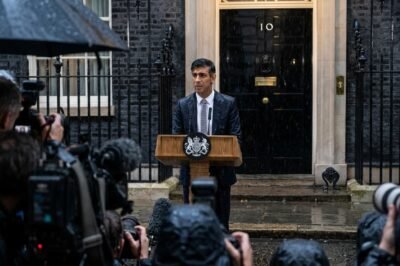
In a move that has sent seismic shockwaves through the heart of Westminster and across the international political landscape, Prime Minister Rishi Sunak has officially called for a surprise general election to be held on July 4, 2024. Standing outside the iconic black door of 10 Downing Street, drenched by a persistent London rain that many commentators immediately seized upon as a metaphor for his party’s current fortunes, Sunak framed the upcoming vote as a fundamental choice between stability and the unknown. This announcement ends months of feverish speculation regarding the timing of the next trip to the polls, which many analysts had predicted would not occur until the autumn of 2024. By choosing a summer date, Sunak is engaging in one of the most significant political gambles in recent British history, attempting to seize the narrative at a moment when economic indicators show the first signs of genuine improvement after years of stagnation and high inflation. The decision to trigger the six-week campaign now is a bold attempt to defy the gravity of double-digit polling deficits that have haunted the Conservative Party for nearly two years, setting the stage for a high-stakes confrontation with a resurgent Labour Party led by Keir Starmer.
The Tactical Timing of the Announcement
The decision to hold the election on July 4 is a deeply calculated move rooted in the Prime Minister’s belief that the economic tide is finally turning. For months, Rishi Sunak has centered his premiership on five key pledges, with the halving of inflation being the most prominent. Just hours before the announcement, official figures confirmed that UK inflation had fallen to 2.3 percent in April, its lowest level in nearly three years and tantalizingly close to the Bank of England’s 2 percent target. By calling the election now, Sunak hopes to capitalize on this ‘feel-good’ economic data before any potential autumn downturn or before the public becomes further disillusioned by the lack of immediate relief in their personal finances despite the macro-economic improvements.
Furthermore, the timing allows the Conservatives to claim victory on several legislative fronts, most notably the Safety of Rwanda Bill. By calling the election for July, the government can argue that they have finally cleared the legal hurdles necessary to begin deportation flights, presenting themselves as the only party with a credible, if controversial, plan to ‘stop the boats.’ Strategists in CCHQ (Conservative Campaign Headquarters) likely calculated that a summer campaign would provide a shorter window for opposition parties to coordinate and would allow the Prime Minister to dominate the news cycle with a series of policy ‘grenades’ designed to expose vulnerabilities in the Labour Party’s platform. However, the risk remains that the electorate may view this as a desperate move by a leader who fears the economic outlook will only worsen by November.
Fourteen Years of Conservative Rule: A Legacy on Trial
The July 4 election will inevitably serve as a referendum on fourteen years of Conservative governance. Since 2010, the UK has navigated a period of unprecedented volatility, including the aftermath of the global financial crisis, the divisive Brexit referendum, a once-in-a-century pandemic, and the cost-of-living crisis exacerbated by the war in Ukraine. Sunak’s challenge is to convince voters that the turbulence of the Boris Johnson and Liz Truss eras is firmly in the past and that his leadership represents a return to fiscal responsibility and adult governance. He must reconcile the party’s record with the current state of public services, particularly the National Health Service (NHS), which continues to struggle with record-breaking backlogs and industrial action from junior doctors.
The Conservative narrative will likely focus on ‘sticking to the plan’ that is supposedly working, contrasted against the ‘uncertainty’ of a Labour government. However, the legacy of the mini-budget under Liz Truss, which saw mortgage rates spike and the pound plummet, remains a significant hurdle for the Prime Minister. Labour has been remarkably successful in pinning ‘Tory economic mismanagement’ to the current financial struggles of British households. To win, Sunak must not only defend his own record but also successfully reframe the last decade and a half as a period of necessary resilience in the face of global shocks, rather than a series of self-inflicted political crises.
Labour’s Path to Power: Keir Starmer’s Transformation
For Keir Starmer and the Labour Party, this election represents the culmination of a four-year project to make the party ‘electable’ again after the heavy defeat of 2019. Starmer has moved aggressively to distance himself from the era of Jeremy Corbyn, purging the far-left elements of the party and adopting a strictly pro-business, fiscally cautious stance. The Labour message for July 4 is remarkably simple: ‘Change.’ By positioning themselves as the party of stability and renewal, Labour aims to capture the ‘middle England’ voters who feel abandoned by the Conservatives. Starmer’s strategy relies on a ‘ming vase’ approach—carrying a lead in the polls carefully without taking any unnecessary risks that could shatter their momentum.
Labour’s platform focuses on five national missions, including securing the highest sustained growth in the G7, making the UK a clean energy superpower, and building an NHS fit for the future. While the Conservatives accuse Labour of having no plan, Starmer has focused on ‘bread and butter’ issues like the cost of living and crime. The party’s ability to maintain discipline over the next six weeks will be crucial. They must avoid being drawn into divisive culture wars and instead keep the focus on the perceived failures of the incumbent government. With a polling lead consistently hovering around 20 points, Labour is currently the heavy favorite, but the party remains wary of complacency, frequently reminding supporters that ‘not a single vote has been cast.’
Economic Context and Market Reactions
The financial markets reacted with characteristic caution to the election news. Historically, markets prefer certainty, and the confirmation of a date—even a surprise one—removes one layer of ambiguity from the UK economic forecast. Sterling remained relatively stable against the Dollar and the Euro following the announcement, suggesting that investors had already priced in a potential summer or autumn vote. However, the FTSE 100 showed some sensitivity in sectors most likely to be affected by a change in government, such as energy and private water companies, which Labour has pledged to reform or more strictly regulate.
From a macroeconomic perspective, the election comes at a delicate time. The Bank of England is widely expected to begin cutting interest rates later this summer. A change in government could influence the speed and depth of these cuts depending on the fiscal policies proposed in the manifestos. If a Labour government is perceived as likely to increase borrowing to fund public investment, bond yields could see upward pressure. Conversely, if the Conservatives propose significant tax cuts to win over voters, the markets may react with skepticism regarding the impact on national debt. For now, the ‘fiscal guardrails’ established by Jeremy Hunt and Sunak seem to have provided a level of credibility that was missing during the Truss premiership, keeping market volatility in check during the initial stages of the campaign.
Key Battlegrounds and Public Sentiment
The map of the 2024 election is drastically different from 2019. The so-called ‘Red Wall’—traditionally Labour-voting areas in the North of England and the Midlands that flipped to Boris Johnson—appears to be returning to the Labour fold. Simultaneously, the Conservatives are facing a ‘Blue Wall’ threat in the South of England, where the Liberal Democrats are targeting affluent, pro-EU seats. Furthermore, the rise of Reform UK, a right-wing populist party, threatens to siphon off conservative-leaning voters who feel the government has been too soft on immigration and net-zero targets. This multi-front battle makes the path to a Conservative majority incredibly narrow.
Public sentiment remains deeply divided but characterized by a general sense of fatigue. Years of political infighting, high energy bills, and the ongoing housing crisis have left many voters feeling cynical about the ability of any party to effect real change. Key issues defining the door-to-door campaign will include:
- The NHS: Waiting lists remain at historic highs, and voters consistently rank healthcare as a top priority.
- Immigration: Both ‘legal’ migration levels and ‘small boats’ crossings remain highly emotive topics for the Conservative base.
- Cost of Living: Despite falling inflation, the prices of food and energy remain significantly higher than they were two years ago.
- Housing: A lack of affordable housing and high rental costs are mobilizing younger voters.
Conclusion on Future Implications
The UK general election on July 4 will be a defining moment for the country’s direction in the mid-21st century. If Rishi Sunak succeeds in his gamble, it will be hailed as one of the greatest political comebacks in history, validating his ‘stick to the plan’ philosophy and potentially leading to a further period of center-right consolidation. However, should Keir Starmer secure the keys to 10 Downing Street, it would mark the end of a dominant era of Conservative rule and the beginning of a new chapter focused on public sector investment and a closer, albeit still distanced, relationship with the European Union. Beyond the immediate results, the election will test the resilience of the UK’s democratic institutions and its ability to navigate a world increasingly defined by geopolitical instability and economic transition. As the campaign unfolds, the world will be watching to see if the British public chooses to maintain the current course or demands a fundamental reset of the national agenda. The outcome will not only determine the next Prime Minister but will also shape the UK’s economic policy, social contract, and global standing for the decade to come.




































Leave a Reply