
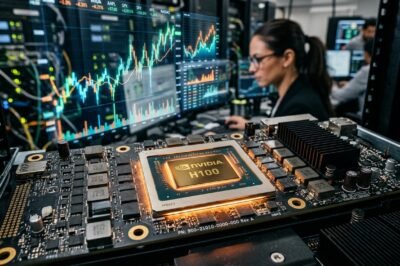
Wall Street has long been accustomed to the rhythmic ebbs and flows of the semiconductor cycle, yet what occurred this week transcends the traditional boundaries of market performance. Nvidia Corporation, once a niche provider of graphics hardware for gaming enthusiasts, has officially cemented its status as the primary engine of the global technological economy. As the company reported its latest quarterly earnings, the financial world stood in collective awe: revenue has not just grown; it has tripled, fueled by an insatiable, almost frantic demand for the chips that power generative artificial intelligence. For investors, the jump in share price was a validation of a multi-year bull case; for the broader industry, it was a signal that the AI revolution is no longer a speculative bubble but a structural shift in how humanity computes. Jensen Huang, Nvidia’s CEO, described this as the beginning of the ‘next industrial revolution,’ where data centers are becoming AI factories, turning raw data into valuable intelligence. This meteoric rise has pushed Nvidia’s valuation into the stratosphere, challenging the long-standing dominance of traditional tech titans and forcing every major global enterprise to rethink their capital expenditure strategies in the face of a new hardware-first reality.
The Unprecedented Financial Surge: Breaking Down the Numbers
The raw data released in Nvidia’s fiscal report is nothing short of breathtaking. The company reported quarterly revenue of $26 billion, a staggering 262% increase from the previous year. This growth is not merely a percentage game; it represents billions of dollars in incremental hardware sales that few analysts thought possible just twenty-four months ago. Net income followed an even more aggressive trajectory, surging by over 600% as the high margins on enterprise-grade AI chips like the H100 and the upcoming Blackwell series began to pad the bottom line. The market responded with immediate fervor, pushing shares up by double digits in after-hours trading and adding hundreds of billions to the company’s market capitalization in a single session.
Beyond the top-line revenue, the quality of earnings has also improved. Nvidia’s gross margins have expanded to over 78%, a figure typically reserved for high-end software companies rather than hardware manufacturers. This margin expansion is a testament to the lack of viable alternatives for high-performance AI training. Organizations are essentially paying a premium for time-to-market; every week they wait for an Nvidia chip is a week they fall behind in the global AI race. The financial results also included a significant increase in the company’s dividend and the announcement of a ten-for-one stock split, moves designed to make ownership more accessible to retail investors and signal long-term confidence from the board of directors.
Data Center Dominance: The Epicenter of the AI Boom
The core of Nvidia’s success lies within its Data Center division, which now accounts for the vast majority of its total revenue. This segment reported sales of $22.6 billion, up 427% year-over-year. This explosive growth is driven by a diverse set of customers, ranging from ‘hyperscale’ cloud service providers like Microsoft, Amazon, and Google, to consumer internet giants like Meta, who are racing to build the infrastructure required to train the next generation of Large Language Models. These companies are not just buying chips; they are building massive, warehouse-sized supercomputers that require thousands of interconnected GPUs to function.
Furthermore, the shift toward ‘Sovereign AI’ is creating a new demand vertical. Governments around the world, from the Middle East to Europe and Japan, are investing in domestic AI infrastructure to ensure they do not depend on foreign entities for their data processing needs. They view AI as a matter of national security and economic sovereignty, leading to multi-billion dollar procurements of Nvidia hardware. This diversification of the customer base provides a cushion against any potential cooling in the spending habits of the major US tech giants, as regional and national projects pick up the slack. The H100 ‘Hopper’ architecture remains the gold standard, but the transition to the ‘Blackwell’ architecture is already being factored into future growth projections, promising even more efficiency and power.
The Software Moat: Why Hardware is Only Half the Story
While the physical chips grab the headlines, Nvidia’s true competitive advantage lies in its software ecosystem, primarily CUDA (Compute Unified Device Architecture). For over fifteen years, Nvidia has cultivated a massive community of developers who write software specifically for its hardware. This has created a powerful ‘moat’ that makes it incredibly difficult for competitors like AMD or Intel to gain a foothold. Moving a massive AI model from Nvidia to a different hardware provider isn’t just a matter of swapping a chip; it requires rewriting thousands of lines of optimized code, a risk few CTOs are willing to take during a competitive gold rush.
In addition to CUDA, Nvidia is expanding its enterprise software offerings. Products like Nvidia AI Enterprise provide the ‘operating system’ for AI, allowing companies to deploy and manage models with ease. By bundling software services with their hardware, Nvidia is transitioning into a full-stack platform company. This strategy ensures long-term recurring revenue and deeper integration into the workflows of their clients. As the industry moves from the ‘training’ phase of AI to the ‘inference’ phase—where the models are actually used by consumers to generate text or images—Nvidia’s software stack will be critical in maintaining their lead over specialized ASIC (Application-Specific Integrated Circuit) chips designed by cloud providers.
Supply Chain Constraints and the Manufacturing Race
The biggest threat to Nvidia’s continued ascent is not necessarily a lack of demand, but the physical limitations of production. The complexity of manufacturing an AI chip is immense, involving advanced packaging techniques like CoWoS (Chip on Wafer on Substrate) pioneered by TSMC (Taiwan Semiconductor Manufacturing Company). Throughout the past year, Nvidia has been supply-constrained, meaning they could have sold even more chips if they could have manufactured them faster. Management has noted that while supply is improving, it remains a delicate balancing act to match the frantic pace of orders.
To mitigate these risks, Nvidia is working closely with its partners to expand capacity. The upcoming Blackwell chips represent a significant jump in complexity, requiring even more advanced cooling solutions and power delivery systems. This has created a secondary market boom for companies that provide liquid cooling and power infrastructure for data centers. However, the concentration of manufacturing in Taiwan remains a geopolitical risk. Investors are closely monitoring the stability of the region, as any disruption to TSMC’s operations would have a catastrophic impact on Nvidia’s ability to deliver on its massive order backlog. The company is exploring ways to diversify its supply chain, but for now, the cutting-edge of AI is inextricably linked to a few square miles of high-tech manufacturing facilities.
The Competitive Landscape: Can Rivals Catch Up?
Despite Nvidia’s current 80% to 90% market share in AI chips, the competition is not sitting idle. AMD has launched its MI300X series, which boasts impressive memory bandwidth and performance metrics, specifically targeting the inference market. Intel is also making a push with its Gaudi 3 accelerator, promising better price-to-performance ratios for certain enterprise applications. Furthermore, Nvidia’s biggest customers—Amazon, Google, and Microsoft—are all designing their own custom AI silicon (TPUs and Trainium chips) to reduce their reliance on third-party vendors and lower their long-term costs.
However, catching Nvidia is a monumental task. The company has moved to a one-year release cycle for new architectures, up from the traditional two-year cycle. This ‘accelerated’ roadmap means that by the time a competitor releases a chip that rivals the H100, Nvidia is already shipping the Blackwell B200, which offers significantly higher performance. The virtuous cycle of massive R&D spending, a locked-in developer base, and the fastest release cadence in the industry makes Nvidia a moving target that is incredibly difficult to hit. The ‘network effect’ of Nvidia hardware also plays a role; as more researchers use Nvidia chips, more optimizations are written for them, making the chips even more valuable to the next user.
Conclusion: Future Implications and the Road Ahead
The tripling of Nvidia’s revenue is more than just a corporate milestone; it is a barometer for the health of the global AI economy. As we look toward the future, the implications are profound. We are seeing a massive reallocation of capital away from traditional general-purpose computing toward accelerated computing. This transition is expected to modernize $1 trillion worth of global data center infrastructure over the next decade. Nvidia stands at the center of this transformation, acting as both the architect and the primary beneficiary of the new digital age. While market volatility is inevitable and the ‘hype’ surrounding AI will eventually face a reality check, the fundamental shift in how data is processed is undeniable.
In the coming years, the focus will likely shift from the raw power of training models to the efficiency and ubiquity of AI inference. We will see AI chips integrated into every device, from cars to medical equipment and factory robots. Nvidia’s ability to maintain its lead will depend on its continued innovation in both hardware and software, as well as its ability to navigate a complex geopolitical and supply chain landscape. For now, the company remains the undisputed king of the AI era, and its latest earnings report is a powerful reminder that the revolution is still in its early innings. Investors and industry leaders alike are no longer asking if AI is real; they are asking how quickly they can get the chips to power it.




































Leave a Reply