
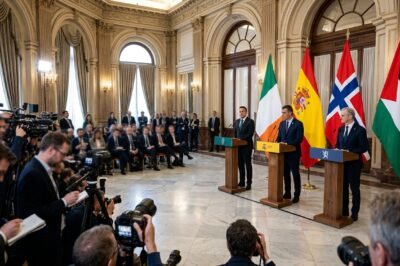
In a historic and coordinated diplomatic maneuver that has sent shockwaves through the international community, the governments of Ireland, Spain, and Norway have formally announced their recognition of the state of Palestine. This landmark decision, delivered simultaneously by Irish Taoiseach Simon Harris, Spanish Prime Minister Pedro Sánchez, and Norwegian Prime Minister Jonas Gahr Støre, marks one of the most significant shifts in European foreign policy in decades. The move is not merely symbolic; it represents a profound challenge to the traditional diplomatic frameworks that have governed the Middle East peace process since the 1990s. By acting in unison, these three nations aim to catalyze a broader movement within the European Union and the United Nations to acknowledge Palestinian sovereignty, arguing that a two-state solution is impossible without first acknowledging the fundamental right of both parties to exist as sovereign states. The announcement comes at a moment of unprecedented tension, as the conflict in Gaza continues to escalate, making the timing of this recognition both a moral statement and a strategic attempt to revive a long-dormant political process.
The leaders emphasized that their decision is rooted in a commitment to international law and a belief that peace cannot be achieved through military force alone. For Ireland, Spain, and Norway, the recognition of Palestine is seen as an essential prerequisite for a lasting peace, rather than the final outcome of a negotiation that has stalled for nearly thirty years. As we delve into this detailed analysis, we will explore the historical context of this decision, the immediate diplomatic fallout, the potential for economic repercussions, and the long-term implications for the regional stability of the Middle East and the unity of the European Union itself.
A Unified European Front? Breaking Down the Joint Announcement
The coordinated nature of the announcement on May 22, 2024, was designed to maximize its impact on the global stage. Irish Taoiseach Simon Harris described the move as an act of ‘historic and symbolic importance,’ drawing parallels between the Palestinian struggle for statehood and Ireland’s own historical journey toward independence. Harris noted that recognition is a statement of unequivocal support for a two-state solution, which he believes is the only credible path to peace and security for both Israelis and Palestinians. The Irish government has long been one of the most vocal critics of Israeli settlement expansion in the West Bank, and this move serves as the culmination of years of domestic political pressure and diplomatic positioning.
Spanish Prime Minister Pedro Sánchez, addressing the Spanish Parliament, framed the decision as a matter of ‘peace, justice, and consistency.’ Sánchez has been a leading voice within the EU calling for a more assertive stance on Palestinian rights, and his leadership in this joint initiative solidifies Spain’s role as a major player in Mediterranean and Middle Eastern diplomacy. Norway, while not a member of the EU, holds a unique position as the broker of the 1993 Oslo Accords. Prime Minister Jonas Gahr Støre acknowledged that the framework established in Oslo has been systematically undermined and that formal recognition is now necessary to protect the very concept of a Palestinian state from being rendered obsolete by facts on the ground.
By joining forces, these three countries have created a ‘critical mass’ that they hope will embolden other European nations, such as Belgium, Slovenia, and Malta, to follow suit. This collective action is a direct response to the perceived failure of the United States and the broader international community to prevent the collapse of the peace process. It signals a move toward a ‘multipolar’ approach to the conflict, where European nations are no longer willing to wait for a consensus that may never come while the humanitarian situation in the region deteriorates.
Historical Context and the Erosion of the Oslo Framework
To understand the weight of this recognition, one must look back at the history of the peace process, specifically the Oslo Accords of the 1990s. For decades, the dominant international consensus—led by the United States—was that Palestinian statehood should only be the result of direct bilateral negotiations between Israel and the Palestinian Authority. This approach was based on the premise that recognition should be used as a ‘final status’ bargaining chip to incentivize compromise on difficult issues like borders, the status of Jerusalem, and the right of return for refugees.
However, Ireland, Spain, and Norway have argued that this logic has been used to justify an indefinite delay of Palestinian rights while the physical viability of a Palestinian state is eroded by settlement expansion. The Norwegian government, in particular, noted that the ‘territorial contiguity’ required for a viable state is rapidly disappearing. By recognizing Palestine now, these nations are effectively saying that the ‘negotiation first’ model has failed and that statehood must be the starting point, not the finish line. This shift reflects a growing impatience with the Israeli government’s current policies, which many European leaders view as an existential threat to the two-state solution.
Historically, European nations have been divided on this issue. While countries like Sweden recognized Palestine in 2014, others like Germany, France, and the UK have remained hesitant, fearing that unilateral recognition would alienate Israel and undermine their influence in Washington. The decision by Ireland, Spain, and Norway represents a significant crack in this wall of Western caution, suggesting that the ‘middle ground’ of European politics is moving toward a more pro-active recognition stance.
Diplomatic Fallout and Israel’s Strategic Response
The reaction from the Israeli government was immediate and severe. Within hours of the announcement, Israel’s Foreign Ministry ordered the immediate recall of its ambassadors from Dublin, Madrid, and Oslo for ‘urgent consultations.’ Prime Minister Benjamin Netanyahu denounced the move as a ‘reward for terrorism,’ arguing that recognizing a Palestinian state in the wake of the October 7 attacks by Hamas sends a message that violence is a viable path to political gains. The Israeli government has consistently maintained that any recognition outside the framework of direct negotiations only emboldens extremist elements and makes a peaceful resolution more difficult to achieve.
Foreign Minister Israel Katz went further, issuing a stern warning to the three nations that their actions would have ‘grave consequences’ for their bilateral relations with Israel. This diplomatic freeze is expected to manifest in reduced cooperation on security, intelligence, and trade. Furthermore, Israel has hinted at retaliatory measures against the Palestinian Authority, which it accuses of orchestrating the diplomatic campaign for recognition. These measures could include the withholding of tax revenues or further restrictions on movement and construction in the West Bank, potentially destabilizing the already fragile Palestinian economy.
Internationally, the move has created a clear divide between these European nations and the United States. The Biden administration has reiterated its position that while it supports a two-state solution, recognition should come through direct negotiations between the parties. The US remains concerned that unilateral moves by European allies could complicate its own efforts to broker a regional normalization deal involving Israel and Saudi Arabia. This divergence in strategy highlights a growing gap in how Washington and its European partners view the path forward in the Middle East.
Legal and Symbolic Implications for Palestinian Sovereignty
While the recognition by Ireland, Spain, and Norway does not automatically grant Palestine the full powers of a sovereign state in the eyes of all international bodies, it carries significant legal and symbolic weight. Symbolically, it elevates the status of the Palestinian Authority and the Palestine Liberation Organization (PLO) on the global stage, providing a much-needed boost to their international legitimacy at a time when they are facing intense domestic criticism. It reinforces the idea that the Palestinian quest for statehood is a matter of international law rather than just a regional dispute.
Legally, recognition by more Western nations could pave the way for Palestine to seek fuller membership and participation in international organizations and treaties. It may also influence future deliberations at the International Criminal Court (ICC) and the International Court of Justice (ICJ). When a state recognizes another, it acknowledges that state’s right to exercise jurisdiction over its territory and its people. This could have implications for how European courts view products produced in Israeli settlements or how they handle legal disputes involving Palestinian entities. Some of the key legal areas impacted include:
- Diplomatic Immunity: Palestinian representatives in these countries will now likely enjoy full diplomatic status.
- Bilateral Treaties: These nations can now enter into formal state-to-state agreements with Palestine regarding trade, education, and security.
- International Forums: Strengthened support for Palestinian initiatives at the UN General Assembly.
Furthermore, this recognition challenges the narrative that Palestine is a ‘non-state entity’ or a ‘disputed territory.’ By using the term ‘State of Palestine,’ these nations are affirming that the 1967 borders (with mutually agreed swaps) remain the legal basis for Palestinian sovereignty, a position that stands in direct opposition to the current Israeli government’s policies of annexation and settlement building.
Market Implications and Regional Economic Stability
From a financial and business perspective, the recognition of Palestine by three significant European economies could have long-term repercussions for trade and investment in the region. Spain and Norway, in particular, have substantial economic ties that could be affected by a prolonged diplomatic rift with Israel. For instance, Norway’s sovereign wealth fund, the world’s largest, has previously faced pressure to divest from companies operating in Israeli settlements. This formal recognition could lead to stricter ethical guidelines for investments, potentially impacting Israeli tech and construction firms that rely on European capital.
Conversely, the recognition could open new doors for European investment in Palestinian infrastructure and technology. Both Ireland and Spain have expressed interest in supporting Palestinian economic development as a way to build the ‘foundations of statehood.’ We might see increased funding for projects in renewable energy, telecommunications, and agriculture in the West Bank and, eventually, a reconstructed Gaza. However, these opportunities are heavily contingent on the security situation and the willingness of Israel to allow the flow of goods and people across borders.
There is also the risk of ‘economic diplomacy’ being used as a weapon. If Israel decides to restrict trade with the recognizing nations, it could impact sectors like Spanish agriculture or Norwegian maritime services. While the immediate market impact has been muted, the long-term trend points toward a more fragmented economic relationship between Israel and certain European nations, which may lead to a redirection of trade flows toward Asia or other parts of the Middle East. Investors are closely watching for any signs of broader EU-wide sanctions or trade restrictions, though such a consensus currently seems unlikely given the internal divisions within the bloc.
The Two-State Solution: Resuscitation or Final Breath?
The ultimate question surrounding this decision is whether it will truly help achieve a two-state solution or if it is a case of ‘too little, too late.’ Proponents argue that by recognizing Palestine, Ireland, Spain, and Norway are providing a ‘political horizon’ for the Palestinian people, countering the despair that fuels extremism. They believe that a strong, internationally recognized Palestinian state is the best partner for a secure Israel. This move is seen as a way to bolster moderates within the Palestinian leadership and demonstrate that diplomatic engagement can yield tangible results.
On the other hand, critics argue that recognition is a hollow gesture that ignores the reality of the situation on the ground. They point to the deep political division between the Palestinian Authority in the West Bank and Hamas in Gaza, the lack of a unified Palestinian leadership, and the presence of over 500,000 Israeli settlers in the West Bank. Some analysts suggest that recognizing a state that does not have control over its own borders or security is a ‘legal fiction’ that does nothing to alleviate the suffering of civilians. They worry that instead of encouraging negotiations, this move will cause Israel to further entrench its positions, making a two-state solution even more remote.
Regardless of which view one holds, it is clear that the status quo is no longer an option for these European nations. Their decision reflects a fundamental belief that the path of the last thirty years has led to a dead end and that a new, more confrontational approach to the ‘peace process’ is necessary to prevent a total collapse of regional order. The recognition of Palestine is an attempt to force a conversation that much of the world has been trying to avoid.
Future Implications for Global Diplomacy
The decision by Ireland, Spain, and Norway to formally recognize the Palestinian state is a watershed moment that will likely redefine European-Israeli relations for years to come. In the short term, we can expect a period of intense diplomatic friction, with recalled ambassadors, canceled summits, and heated rhetoric at the United Nations. However, the true impact will be measured by whether other nations follow their lead. If countries like France or the UK were to eventually join this movement, the pressure on both Israel and the United States would become nearly insurmountable, potentially forcing a total recalibration of Middle East policy.
In the long term, this move could lead to a more assertive European role in international mediation. For too long, the EU has been seen as a ‘payer but not a player’ in the Middle East—providing the lion’s share of humanitarian aid but exercising little political influence. By taking this bold step, these three nations are asserting their right to shape the political outcome of the conflict. The success of this strategy will depend on their ability to translate symbolic recognition into meaningful support for Palestinian governance and a renewed, credible push for a negotiated settlement that addresses the security needs of Israel and the sovereign rights of Palestine. The world is watching to see if this ‘European spark’ will ignite a new era of diplomacy or if it will simply be another footnote in the long and tragic history of the region.



































Leave a Reply