
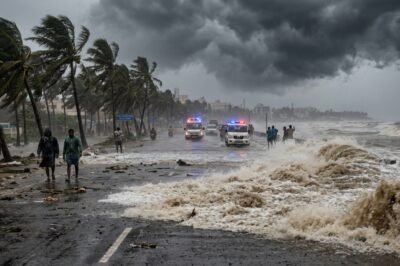
The Bay of Bengal has long been a cradle for atmospheric disturbances, but the arrival of Cyclone Murasu marks a particularly perilous chapter in the seasonal weather patterns of the Indian subcontinent. As the barometric pressure drops and the wind speeds escalate, the state of Andhra Pradesh finds itself in the direct line of fire of a meteorological giant that threatens to disrupt the socio-economic fabric of its coastal belt. The urgency of the situation was underscored today by the immediate response of the state government, reflecting a state of high alert that transcends administrative routine. For the people of the five affected districts, the darkening skies are not merely a sign of rain but a herald of a significant natural challenge that requires resilience, preparedness, and swift executive action. With the Indian Meteorological Department (IMD) issuing a red alert, the narrative of the day is dominated by the looming threat of landfall and the subsequent chaos it could unleash upon infrastructure, agriculture, and human life. Chief Minister Chandrababu Naidu, recognizing the magnitude of the threat, has taken the decisive step of canceling his scheduled high-profile visit to the national capital, signaling that the safety of his citizens takes precedence over political engagements.
The Meteorological Trajectory and Escalation of Cyclone Murasu
Cyclone Murasu began its life as a low-pressure area over the southeast Bay of Bengal, quickly intensifying into a deep depression before attaining the status of a cyclonic storm. Meteorological experts have noted that the sea surface temperatures in the region have been unusually high, providing the thermal energy necessary for such rapid intensification. As the storm moved northwestward, it organized into a cohesive system with a well-defined eye, signaling a severe cyclonic category. The IMD has been tracking its progress with satellite imagery and coastal radar systems, providing hourly updates that paint a grim picture of its trajectory towards the Andhra coastline. The projected wind speeds at the time of landfall are expected to range between 120 and 150 kilometers per hour, with gusts reaching even higher intensities that could cause widespread damage to temporary structures and power lines.
Beyond the wind, the storm carries an immense moisture load, promising torrential downpours that could exceed thirty centimeters in a single twenty-four-hour period. This deluge is particularly concerning for the low-lying areas of Srikakulam and Visakhapatnam, where the drainage systems are often overwhelmed by such sudden volumes of water. The combination of high-speed winds and intense rainfall creates a multi-hazard scenario, where the risk of flooding is compounded by the potential for uprooted trees and structural collapses. Scientists have pointed out that Murasu represents a broader trend of more frequent and intense storms in the Bay of Bengal, a phenomenon increasingly linked to global climatic shifts. This specific event is a litmus test for the state’s modern weather-tracking infrastructure and its ability to translate scientific data into actionable public safety measures. The IMD has warned of storm surges that could reach up to two meters above the astronomical tide, threatening to inundate several coastal villages.
Political Pivot: CM Chandrababu Naidu’s Crisis Management
In a significant shift of priorities, Chief Minister Chandrababu Naidu has canceled his scheduled visit to New Delhi, where he was expected to participate in high-level discussions regarding central fund allocations and state development projects. This decision highlights the gravity of the impending natural disaster and Naidu’s commitment to being at the helm of the state during a time of crisis. The political optics of a leader staying back to manage a disaster are significant, but the functional necessity of his presence in the state capital is even more critical. By staying in Amaravati, the Chief Minister can ensure that there is no bureaucratic delay in the deployment of resources or the communication between the state executive and the district collectors. His leadership during previous disasters, such as the Hudhud cyclone, has set a high bar for crisis management, and the public’s expectations are equally high as Murasu approaches.
The cancellation of the Delhi trip also signals to the central government that the situation in Andhra Pradesh requires immediate attention and potential disaster relief funding. Naidu has reportedly been in contact with the Union Home Minister, seeking the pre-emptive deployment of National Disaster Response Force (NDRF) teams. Inside the state, the political machinery has shifted from policy debates to disaster mitigation, with cabinet ministers assigned to oversee specific districts under the red alert. This hands-on approach is designed to bolster public confidence and ensure that the administrative response is both swift and visible. The Chief Minister’s office has been converted into a temporary war room, where real-time feeds from the coastal districts are being monitored to coordinate the evacuation of thousands of residents from the most vulnerable coastal villages. The state cabinet has been directed to pause all other administrative work and focus exclusively on the ‘Mission Murasu’ response.
Districts Under Red Alert: Vulnerability and Preparedness
The districts of Srikakulam, Vizianagaram, Visakhapatnam, East Godavari, and West Godavari have been placed under a red alert, indicating a high probability of severe impact. These regions are characterized by a mix of dense urban centers like Visakhapatnam and sprawling rural agricultural lands, each presenting unique challenges for disaster management. In the urban areas, the focus is on preventing waterlogging, securing industrial sites, and ensuring that the electrical grid is safely managed to prevent accidents. In the rural heartlands, the priority is the safety of the farming communities and the protection of livestock. The district collectors have been empowered to take all necessary steps, including the forced evacuation of people living in thatched houses or dilapidated buildings, to prevent loss of life.
The local administrations in these five districts have established hundreds of relief camps, equipped with essential supplies such as food, clean drinking water, and medical kits. The challenge of maintaining hygiene and preventing the spread of waterborne diseases in these camps is a secondary but vital concern for the health departments. Communication networks, often the first casualty of high winds, are being reinforced with satellite phones and ham radio operators to ensure that the flow of information remains uninterrupted even if the mobile towers go down. The spirit of the local communities is being tested, but the systematic preparation—ranging from clearing storm drains to pruning large trees near roadways—shows a level of preparedness that has been refined through years of dealing with the fury of the Bay of Bengal. Each district has been allocated emergency funds to facilitate immediate rescue and sustenance for displaced families.
Economic and Infrastructure Implications for Coastal Andhra
The economic impact of Cyclone Murasu is expected to be substantial, with the agricultural sector bearing the brunt of the storm’s initial impact. Coastal Andhra is often referred to as the rice bowl of the country, and the current timing of the cyclone coincides with critical stages of crop growth. Flooding of the paddy fields could lead to massive crop losses, affecting the livelihoods of millions of small-scale farmers. Furthermore, the aquaculture industry, which is a major export earner for the state, faces severe risks as prawn and fish ponds are susceptible to overflow and contamination during heavy surges. The loss of infrastructure, including rural roads and irrigation canals, will require significant capital investment for restoration once the storm passes, placing a strain on the state’s fiscal reserves.
Industrial activities in the Visakhapatnam corridor, including the major port and the steel plant, have also seen a slowdown as safety protocols are prioritized. Shipping operations have been suspended, and vessels have been moved to safer waters to avoid collisions or grounding. The power sector is perhaps the most vulnerable, as high-tension wires and substations are frequently damaged by falling debris. Restoring electricity to millions of households in the aftermath of the storm will be a Herculean task that requires the mobilization of thousands of technical staff. The long-term economic narrative will depend on how quickly the state can recover from these disruptions, emphasizing the need for more disaster-resilient infrastructure, such as underground cabling and reinforced sea walls.
- Total estimated crop area at risk: 2.5 million hectares
- Major ports affected: Visakhapatnam, Gangavaram, Krishnapatnam
- Expected infrastructure repair cost: Exceeding 1,500 Crores
State Response and Relief Operations: SDRF and NDRF Deployment
The mobilization of the State Disaster Response Force (SDRF) and the National Disaster Response Force (NDRF) has been unprecedented in its scale for this season. Multiple battalions have been pre-positioned at strategic locations across the five red-alert districts to ensure the fastest possible response time. These teams are equipped with inflatable boats, specialized cutting equipment, and medical stabilization units, making them the vanguard of the rescue efforts. The coordination between the military, the paramilitary, and the local police is being facilitated through a unified command structure, designed to eliminate overlaps and ensure that every distressed call is answered. Helicopters from the Indian Navy and Air Force have been placed on standby at the Visakhapatnam naval base, ready for search and rescue missions or for dropping relief material in cut-off areas.
Volunteers from various non-governmental organizations and the local youth wings have also stepped up, assisting the official agencies in the massive task of evacuation and relief distribution. The use of technology, including drones for aerial surveillance of flooded areas and mobile apps for tracking the movement of the storm, has enhanced the efficiency of the response. Public announcements are being made through loudspeakers and community radio, advising citizens to stay indoors and keep their emergency kits ready. This collective effort is not just about managing a storm; it is about demonstrating a sophisticated societal response to a natural threat, where every gear in the administrative machine works in harmony to protect the most vulnerable citizens. Health departments have stocked up on anti-venom and chlorine tablets to address post-cyclone sanitary hazards.
Conclusion: Future Implications and Climate Resilience
As Cyclone Murasu continues its relentless march towards the coast, it serves as a stark reminder of the increasing volatility of our climate. The immediate priority is, and must remain, the preservation of human life and the mitigation of suffering. However, once the winds die down and the waters recede, the state of Andhra Pradesh will have to engage in a deep introspection regarding its long-term coastal management strategies. The frequency of such “red alert” events is a clear signal that the status quo is no longer sufficient. Future planning must integrate climate resilience into the very core of urban and rural development. This includes the restoration of natural buffers like mangroves, which can significantly reduce the impact of storm surges, and the implementation of more robust building codes along the coastal belt.
The leadership shown by CM Chandrababu Naidu in this moment of crisis will likely be remembered as a defining aspect of his current tenure. His decision to prioritize state-level emergency management over national political engagements sets a precedent for responsive governance. Ultimately, the story of Cyclone Murasu will be written not just in the records of the IMD, but in the stories of the families who were kept safe, the infrastructure that held firm, and the speed with which the state rose back to its feet. As Andhra Pradesh braces for landfall, the eyes of the nation are upon it, witnessing a state that is prepared, vigilant, and resilient in the face of nature’s greatest furies. The upcoming days will test the limits of human planning against the raw power of the atmosphere, but the foundations of response laid today will be the safety net for tomorrow.





































Leave a Reply