
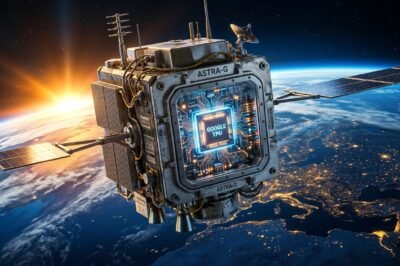
The traditional boundaries of cloud computing are no longer confined to the terrestrial expanse of Earth-bound data centers, as Google has successfully demonstrated a landmark achievement in orbital edge computing. In a strategic move that signals the next frontier of the digital age, Google has successfully deployed and executed an artificial intelligence model directly onto a satellite-bound microprocessor. This breakthrough, first highlighted by SpaceNews, represents more than just a technical curiosity; it is the foundational step toward Google’s ambitious vision of creating an integrated orbital data center infrastructure. For decades, the primary bottleneck in space-based observation has been the latency and narrow bandwidth associated with transmitting massive raw datasets from orbit back to ground stations for processing. By migrating the intelligence directly to the source of data collection—the satellite itself—Google is effectively bypassing the limitations of physics that have long hindered real-time planetary intelligence. This shift promises to transform how we respond to global crises, monitor climate change, and manage global logistics by providing instantaneous, actionable insights directly from the stars. As the competition for orbital supremacy intensifies among tech giants, Google’s successful demonstration of on-chip AI in the vacuum of space marks a definitive pivot toward a future where the cloud is no longer just in the sky, but part of the celestial architecture itself.
Breaking the Terrestrial Tether: Google’s Orbital Milestone
The successful execution of an AI model on a satellite chip is a testament to the maturation of both hardware miniaturization and machine learning efficiency. For the duration of the Space Age, satellites have primarily functioned as high-altitude cameras and relays, capturing images and signals to be sent home for heavy lifting by terrestrial supercomputers. However, the sheer volume of data generated by modern hyperspectral sensors is staggering, often exceeding the capacity of available radio frequency (RF) downlinks. Google’s approach utilizes a specialized architecture designed to operate within the extremely constrained power envelopes of a small satellite. By proving that a Tensor Processing Unit (TPU)-like logic can survive and function in the radiation-heavy environment of Low Earth Orbit (LEO), Google has demonstrated that the intelligence of the cloud can be decentralized far beyond the reach of undersea fiber cables.
This milestone is particularly significant because it addresses the critical issue of data throughput. In the current paradigm, a satellite might capture several terabytes of data daily, but only a fraction of that can be transmitted due to limited windows of contact with ground stations. When an AI model is situated on the satellite chip, it can analyze the data in real-time, discarding irrelevant information—such as images obscured by cloud cover—and transmitting only the high-value detections. This ‘edge-first’ strategy reduces the demand on bandwidth by orders of magnitude, effectively making the entire orbital constellation more efficient and responsive to immediate user needs.
The Architecture of Space-Based Intelligence
To understand the magnitude of this achievement, one must look at the specific technical hurdles Google had to overcome. Standard consumer chips are susceptible to ‘single-event upsets’ caused by cosmic radiation, which can flip bits and crash software. Google’s engineering team had to optimize the AI model for a chip that balances performance with extreme power efficiency, as satellites rely entirely on solar arrays and batteries. The model used in this demonstration was likely a version of a convolutional neural network (CNN), optimized via TensorFlow Lite to ensure that it could run on low-power hardware without sacrificing accuracy. This process of quantization and pruning is essential for moving complex AI from the massive servers of a Google data center into the compact frame of a CubeSat or SmallSat.
The integration of AI at the hardware level allows for ‘closed-loop’ satellite operations. Traditionally, if a satellite detects a wildfire, it sends the data to Earth, where a human or server processes it, and then commands are sent back up to take more detailed images. With Google’s orbital AI, the satellite can detect the fire, realize its importance, and automatically retask its own sensors to track the blaze with higher precision, all within milliseconds. This autonomy is the cornerstone of what Google envisions as a self-optimizing orbital mesh network, where satellites communicate with one another to coordinate complex tasks without human intervention.
Financial and Market Implications for the Global Cloud Race
From a business and financial perspective, Google’s advancement in orbital AI is a direct challenge to the burgeoning space divisions of Microsoft and Amazon. Microsoft Azure Orbital and AWS Ground Station have already established footprints in the space-to-ground communication market, but Google is looking to leapfrog the competition by making the ground station secondary. By offering ‘Intelligence as a Service’ directly from orbit, Google Cloud can target high-value sectors such as defense, maritime logistics, and high-frequency trading where every second of latency has a quantifiable dollar value. Analysts suggest that the market for orbital edge computing could grow into a multi-billion dollar industry over the next decade as more industries demand real-time global monitoring.
Furthermore, this technology significantly lowers the barrier to entry for commercial satellite operators. Instead of investing in massive ground infrastructure and data storage facilities, a small satellite startup could leverage Google’s pre-trained AI models to deliver refined data products directly to end-users. This creates a new ecosystem where Google acts as the operating system for the New Space economy. The financial benefits of reducing downlink costs alone are enough to drive rapid adoption; by processing data in space, companies can save millions annually in telecommunications fees, redirecting those funds toward expanding their constellations or improving sensor technology.
Overcoming the Harsh Realities of the Orbital Environment
Operating a data center in space presents environmental challenges that are non-existent on Earth. Heat dissipation is a primary concern; in a vacuum, there is no air to carry heat away via convection. Google’s AI hardware must rely on radiative cooling, which requires sophisticated thermal management systems. Every watt of power consumed by the AI chip must be accounted for to prevent the satellite from overheating. This necessitates the use of extremely efficient AI architectures that maximize ‘inferences per watt,’ a metric that has become the gold standard for orbital computing. Google’s expertise in custom silicon, exemplified by their TPU development for terrestrial data centers, provides them with a significant competitive advantage in creating chips that are both powerful and thermally viable.
Another layer of complexity is the software-defined nature of these systems. Unlike terrestrial servers that can be physically serviced, an orbital chip must be resilient and capable of remote updates. Google’s test showed that AI models can be updated and refined over-the-air (OTA), allowing the satellite to ‘learn’ and adapt to new mission requirements long after launch. This flexibility transforms a satellite from a fixed-purpose tool into a multi-functional computing node, capable of switching from monitoring agricultural yields in the morning to tracking illegal fishing vessels in the afternoon. The ability to reconfigure the orbital brain on the fly is a game-changer for the longevity and ROI of space assets.
Strategic Integration with Google Cloud and Vertex AI
The synergy between Google’s orbital ambitions and its existing cloud ecosystem is the key to its long-term strategy. By integrating orbital data directly into Vertex AI, Google’s premier machine learning platform, developers can now build applications that utilize space-based data with the same ease as terrestrial data. This creates a seamless pipeline where a model can be trained on a massive cluster of GPUs in a traditional data center and then deployed to a satellite in LEO with a single click. This vertical integration simplifies the complexity of space-based operations, making ‘Space-to-Cloud’ a reality for developers worldwide.
Moreover, Google is positioning itself as the leader in ‘Data Sovereignty in Space.’ By processing sensitive data in orbit and only sending the result back to Earth, Google can offer enhanced security for government and enterprise clients. This reduces the surface area for cyberattacks, as raw, sensitive data never actually crosses the open airwaves between space and ground. As geopolitical tensions rise, the security of data in transit becomes paramount, and Google’s orbital AI provides a secure, air-gapped-by-distance alternative to traditional data relay methods. This strategic alignment of space hardware and cloud software ensures that Google remains at the center of the global information economy, regardless of where the data is generated.
Future Outlook: The Rise of the Autonomous Satellite Constellation
The successful test on the satellite chip is only the beginning. Looking ahead, the convergence of AI, 5G, and LEO constellations will likely lead to the creation of a global ‘Orbital Mesh,’ where thousands of intelligent satellites act as a decentralized supercomputer. In this future, Google wouldn’t just own data centers on the ground; it would manage a dynamic, swirling cloud of processors that blanket the planet. These satellites will be able to perform complex collaborative tasks, such as creating a real-time, 3D digital twin of the entire Earth that is updated every minute. Such a capability would revolutionize everything from autonomous vehicle navigation to global supply chain management and emergency response.
In conclusion, Google’s advancement in running AI on a satellite chip marks the transition from the era of passive observation to the era of active orbital intelligence. By overcoming the physical constraints of space and the technical hurdles of AI hardware, Google is setting the stage for a new economy where space is just another region in the global cloud network. As this technology matures, the distinction between Earth-based and space-based computing will continue to blur, leading to a truly planetary-scale intelligence system. The data center of the future is no longer a sprawling complex in a remote desert; it is a shimmering network of silicon and solar panels, orbiting high above our heads, processing the pulse of the world in real-time.




































Leave a Reply