
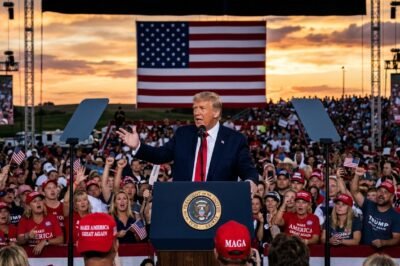
As the United States hurtles toward a pivotal moment in its democratic history, the atmosphere surrounding the midterm elections has reached a fever pitch. In the final hours before voters head to the polls, the political landscape is defined by a frantic scramble for influence, with former President Donald Trump taking center stage in a last-minute blitz across the American heartland. His strategic stops in Iowa and Kansas are not merely coincidental; they represent a calculated effort to fortify the Republican base in regions where the party’s dominance has faced unexpected challenges. For the Indian Express and global observers alike, these live updates signal a broader struggle for the soul of the American electorate, where economic anxiety, cultural identity, and the legacy of the previous administration collide. This isn’t just about local seats or governorships; it is a high-stakes referendum on the current administration and a litmus test for the enduring power of the MAGA movement. As the sun sets on the campaign trail, the urgency in Trump’s rhetoric underscores a reality that many Republicans fear: the once-predicted ‘red wave’ may require every ounce of remaining momentum to manifest as a decisive victory. The world watches with bated breath as these final rallies attempt to shift the needle in a race that remains historically volatile.
The Strategic Weight of Iowa and Kansas in the GOP Playbook
The decision to hold final rallies in Iowa and Kansas is a telling indicator of the Republican Party’s internal polling and strategic concerns. Traditionally, these states are seen as solid red bastions, yet the tightening of specific races has forced the GOP to deploy its biggest campaign asset—Donald Trump. In Iowa, the focus remains on ensuring a high turnout for incumbent Governor Kim Reynolds and Senator Chuck Grassley, whose long-standing tenure is being tested by a changing demographic landscape and shifting priorities among rural voters. The Iowa stop serves as more than just a local boost; it is a symbolic return to the state that kicks off the presidential primary cycle, subtly signaling Trump’s potential 2024 intentions while shoring up support for current candidates.
Kansas presents an even more complex challenge. With a competitive gubernatorial race where Republican Derek Schmidt is attempting to unseat Democratic Governor Laura Kelly, the GOP recognizes that any sliver of voter apathy could result in a significant loss. Trump’s presence in Kansas is designed to energize the conservative base, particularly those who may feel disillusioned by traditional political machinery. By framing the election as a battle against radicalism and economic decline, Trump seeks to bridge the gap between moderate Republicans and his fervent supporters. This late-stage intervention highlights the party’s realization that they cannot take ‘safe’ states for granted in an era of extreme polarization.
Economic Anxiety and Market Implications of a Shifted Congress
One of the primary drivers of this election cycle is the state of the American economy. With inflation reaching levels not seen in decades and the cost of living skyrocketing, voters are increasingly viewing their ballots through a fiscal lens. From a financial analysis perspective, the prospect of a Republican-controlled Congress often signals a period of legislative gridlock, which historical market data suggests can be beneficial for stock performance. Investors generally prefer a divided government, as it limits the likelihood of major tax hikes or radical regulatory changes that could disrupt corporate earnings. Trump’s rhetoric at these final stops has leaned heavily into these economic fears, blaming the Biden administration’s spending for the current inflationary pressure.
Furthermore, the global market is closely monitoring the outcome of these elections due to the potential impact on US foreign policy and trade. A shift in the balance of power could lead to a more isolationist or protectionist stance on trade, particularly concerning relations with major economic partners. The Indian Express has noted that for international stakeholders, the stability of the US dollar and the continuity of energy policies are at stake. If the GOP manages to ‘save the polls’ and secure a majority, we can expect a significant push for increased domestic energy production and a rollback of various green energy subsidies, which would have far-reaching implications for global energy markets and the transition to renewable resources.
The Trump Factor: Candidate Selection and 2024 Aspirations
Donald Trump’s influence on the midterm elections is perhaps the most scrutinized element of the entire cycle. By endorsing a slate of candidates who mirror his populist ideology, Trump has effectively remade the Republican Party in his own image. These final stops in Iowa and Kansas are as much about his own political future as they are about the candidates he is supporting. Each rally serves as a platform to test the resonance of his 2024 messaging. If his endorsed candidates perform well, it provides him with a powerful mandate to lead the party into the next presidential cycle. Conversely, if these candidates fail to win in traditionally red areas, it may embolden his rivals within the party who seek a different direction.
- Candidate Loyalty: Trump has prioritized loyalty to his narrative over traditional electability, leading to a unique set of challenges in general election matchups.
- Base Mobilization: The rallies are specifically engineered to maximize turnout among ‘low-propensity’ voters who only participate when Trump is on the ticket or the campaign trail.
- Rhetorical Shift: Recent speeches have moved from defending the past to attacking the current administration’s handling of crime, the border, and education.
The success of this strategy hinges on whether the MAGA base is sufficiently motivated to overcome the ‘enthusiasm gap’ that often plagues the party out of power. By focusing on Iowa and Kansas, Trump is attempting to prove that his brand of politics remains the dominant force in the American heartland, regardless of what mainstream polling might suggest.
Polling Volatility and the ‘Save the Polls’ Narrative
The phrase ‘saving the polls’ refers to the Republican effort to counteract a late-summer surge in Democratic momentum. Following the Supreme Court’s decision on Roe v. Wade and a series of legislative wins for the Biden administration, Democrats saw a significant bump in their polling numbers. However, as the focus has shifted back to the economy and crime, Republicans have regained ground. The final rallies are a tactical response to this volatility. In many swing districts, the margin of error is so slim that a few thousand votes could determine the control of the House or Senate. Trump’s role is to act as a catalyst for that final push, turning narrow losses into narrow wins.
Analysis of recent polling data suggests that while the ‘red wave’ may have been dampened, a ‘red ripple’ is still highly probable. The challenge for Republicans in states like Kansas is the ‘split-ticket’ voter—individuals who may vote for a Republican Senator but a Democratic Governor. Trump’s messaging aims to discourage this behavior by framing the entire Democratic ticket as a monolithic threat to the country. This strategy of nationalizing local races has become a hallmark of modern American politics, turning every state-level contest into a battle over national identity and federal policy.
Voter Turnout and the Changing Demographic Landscape
Beyond the rhetoric and the rallies, the actual mechanics of the election will come down to turnout. There has been a notable shift in how different demographic groups are aligning. Republicans are seeing increased support among Hispanic and working-class voters, while Democrats continue to maintain a strong hold on urban centers and suburban women. The Iowa and Kansas stops are crucial because they target the suburban-rural divide. In Iowa, the GOP needs to maintain its massive margins in rural counties to offset any losses in Des Moines or Cedar Rapids. In Kansas, the focus is on the suburban voters around Kansas City and Wichita, who have shown a tendency to drift toward the center-left in recent years.
The Indian Express reports that the international community is particularly interested in how these demographic shifts will influence the long-term stability of American democracy. A highly polarized electorate often leads to legislative stalemates and a reliance on executive orders, which can create a volatile environment for international diplomacy and trade agreements. As Trump speaks to his supporters, he is not just asking for a vote; he is calling for a rejection of the current socio-political order, a message that resonates deeply with those who feel left behind by the rapid pace of cultural and economic change.
Conclusion: Future Implications of the Midterm Results
The outcome of the US Midterm elections will set the stage for the next two years of American governance and the 2024 presidential race. If Republicans succeed in their mission to ‘save the polls’ and take control of Congress, we will likely see a period of intense oversight and investigation into the Biden administration. This could include probes into the withdrawal from Afghanistan, the business dealings of Hunter Biden, and the handling of the southern border. For the global community, this means a United States that is more inwardly focused and potentially more adversarial in its legislative approach.
On the other hand, if Democrats manage to hold onto their majorities or limit their losses, it will be seen as a significant validation of President Biden’s agenda and a stinging rebuke of Donald Trump’s influence. Regardless of the winner, the 2022 midterms have demonstrated that the political divide in America is deeper than ever. The final stops in Iowa and Kansas are just the closing chapters of a long and contentious campaign season, but the implications of these events will be felt for years to come. As the results start trickling in, the world will see whether Trump’s final push was enough to secure a Republican future or if the American electorate has chosen a different path forward.



































Leave a Reply