
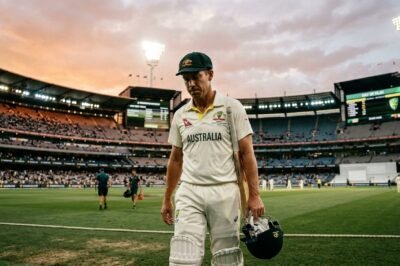
For more than a decade, the Australian men’s Test team has projected an aura of calculated invincibility, a cricketing monolith that thrived on the clinical execution of its pace trio and the reliability of a generational spinner. However, the recent series defeat has not merely cracked the facade; it has invited a forensic examination of the very pillars upon which this era of dominance was built. The narrative is no longer about a temporary lapse in concentration or a bit of bad luck with the toss; it is about systemic fatigue, a transition phase that was perhaps delayed too long, and the unsettling realization that the ‘Golden Generation’ is nearing its twilight. As the dust settles on a result that few saw coming, the questions facing George Bailey’s selection panel and Andrew McDonald’s coaching staff are as complex as they are urgent. From the diminishing returns of a legendary off-spinner to the structural fragility of a batting order that seems to be searching for its soul, Australia stands at a crossroads that will define its trajectory for the next three years of the World Test Championship cycle.
The Waning Shadow of the GOAT: Is Nathan Lyon Fading?
Nathan Lyon, affectionately dubbed the ‘Greatest of All Time’ by his teammates, has been the strategic anchor of the Australian attack for 129 Test matches. His ability to bowl long, restrictive spells while extracting overspin on unresponsive tracks allowed the pace battery to rotate and attack in bursts. However, this series has exposed a worrying trend: Lyon’s strike rate has climbed, and his ability to run through a side on day four and five—once a hallmark of his game—appears to be flickering. While his control remains respectable, the drift and ‘bite’ that used to discomfort elite subcontinental and local batsmen alike were missing for significant periods of this series. Statistics reveal that Lyon’s average in the fourth innings has seen a steady rise over the last eighteen months, suggesting that the physiological toll of over 500 Test wickets is finally manifesting.
The broader implication of Lyon’s struggle is the lack of a clear succession plan. For years, Australia has relied so heavily on Lyon that they have failed to blood a secondary spinner in meaningful home conditions. While Todd Murphy showed promise in India, the lack of opportunities for a specialist spinner to develop in the shadow of the incumbent has left the cupboard looking dangerously bare. If Lyon is indeed entering the ‘fading force’ stage of his career, the transition period for the Australian bowling unit will be far more volatile than previously anticipated. The reliance on a single spinner is a high-stakes gamble that is now beginning to yield diminishing returns, putting unprecedented pressure on the fast-bowling stocks to take wickets in all conditions.
The Steve Smith Conundrum: The No. 3 Debate and Batting Identity
Few players in the history of the game have been as scrutinized as Steve Smith, and his recent move back to the number three position has become a lightning rod for criticism following the series loss. After a failed experiment as a Test opener—a move born more out of a desire to accommodate other players than Smith’s own natural suitability for the role—the return to his ‘traditional’ slot was supposed to stabilize the innings. Instead, it highlighted a lack of rhythm. Smith’s technique, famously idiosyncratic and reliant on hand-eye coordination and precise triggers, seems slightly out of sync. While he still occupies the crease for long periods, the ‘big hundreds’ that defined his career between 2014 and 2019 are becoming increasingly rare.
The debate is not just about where Smith bats, but how his positioning affects the rest of the order. With Marnus Labuschagne also enduring a significant lean patch, the Australian top order has lost its ability to intimidate. The middle order, once buffered by the prolific scoring of the top three, is now being exposed to the new ball and fresh bowlers far too early in the innings. This has led to a collapse-prone identity that was once alien to this squad. The coaching staff must decide whether Smith’s return to No. 3 is a long-term solution or a stop-gap measure while they wait for the next generation of Sheffield Shield talent to mature. At 35, Smith’s window to rediscover his superhuman form is narrowing, and the team’s over-reliance on his genius is now a strategic liability.
The Never-Ending Boland Debate: Selection Rigidities
Perhaps no player in recent Australian history has sparked as much public debate as Scott Boland. The Victorian seamer, who possesses a Test average that rivals the greats of the game, continues to find himself on the periphery of the starting XI, usually relegated to ‘squad member’ status behind the Big Three: Pat Cummins, Mitchell Starc, and Josh Hazlewood. The series defeat has reignited the argument that Australia’s selection policy is too rigid and overly loyal to its established stars. Boland’s ability to bowl metronomic lengths and extract movement on pitches where others struggle was precisely what Australia needed during the critical middle sessions of the lost Tests.
The debate is not merely about Boland’s individual brilliance, but about the philosophy of fast-bowling rotation. The Big Three have been the backbone of the team for nearly a decade, but as they age, the lack of a rotational policy that integrates Boland more frequently is coming at a cost. Over-reliance on the established trio has led to visible fatigue in the final sessions of back-to-back Tests. Critics argue that by treating Boland as an ‘injury replacement’ rather than a tactical weapon, Australia is failing to utilize its most efficient resource. This selection inertia suggests a team that is afraid to disrupt its internal hierarchy, even when the data suggests that a change of pace and style is required to break stubborn partnerships.
Commercial Stakes and the Brand of Invincibility
From a financial and market perspective, the series defeat carries implications far beyond the scoreboard. Cricket Australia (CA) recently secured a multi-billion dollar domestic broadcast deal, and the valuation of these rights is heavily predicated on the team’s status as a dominant global force. A fading Australian team leads to lower television ratings, reduced gate receipts, and a potential cooling of the sponsorship market. For commercial partners, the ‘Unbeatable Australia’ brand is a premium asset; when that brand is tarnished by consecutive home losses or a clear decline in performance, the ROI (Return on Investment) for blue-chip sponsors begins to look less attractive.
Furthermore, the decline of star players like Lyon and Smith creates a marketing vacuum. These players are the faces of the sport in Australia, driving engagement across digital platforms and merchandise sales. If the team enters a prolonged rebuilding phase without a clear ‘next big thing’ to market to the public, CA could face a challenging period of brand management. The financial health of Australian cricket is inextricably linked to the performance of the men’s Test team, and this series defeat serves as a warning shot to the administration that the era of easy dominance—and the easy revenue that comes with it—may be coming to an end. The pressure to win is not just sporting; it is a fiscal necessity in a competitive sports market like Australia.
Future Implications: The Road to the Ashes and Beyond
Looking forward, the implications of this series defeat will reverberate through to the next Ashes series and the World Test Championship final. Australia can no longer afford to ignore the aging profile of its squad. With the average age of the starting XI hovering around 33, the ‘Dad’s Army’ label is beginning to stick. The transition must begin now, rather than waiting for players to retire simultaneously, which could lead to a catastrophic collapse in standards, similar to what was seen after the retirements of Warne, McGrath, and Hayden in the mid-2000s. The integration of younger talent like Sam Konstas or potentially bringing back Nathan McSweeney must be handled with more strategic foresight than the Steve Smith opening experiment.
Ultimately, this series defeat must serve as a catalyst for a cultural and strategic reset. The ‘tried and true’ methods that worked for the last five years are no longer sufficient against opposition teams that have decoded Australia’s plans. Whether it is moving on from legendary figures, rethinking the bowling rotation, or overhauling the batting order, the path back to the top of the ICC rankings will require bold, and perhaps unpopular, decisions. The era of stability is over; the era of evolution must begin if Australia is to avoid becoming a fading force in the global game. The upcoming months will reveal if the leadership has the courage to break the status quo or if they will continue to drift toward mediocrity.




































Leave a Reply