
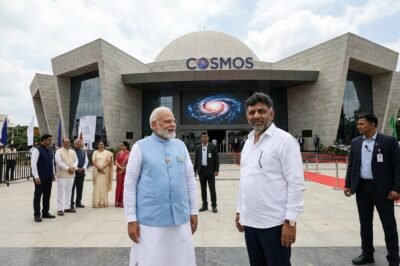
The cultural capital of Karnataka, Mysuru, recently witnessed a historic confluence of political leadership and scientific aspiration as Prime Minister Narendra Modi inaugurated the state-of-the-art COSMOS planetarium. This event was not merely a ceremonial ribbon-cutting but a symbolic acknowledgment of Karnataka’s foundational role in India’s journey to the stars. The presence of high-profile leaders, including Karnataka Deputy Chief Minister D.K. Shivakumar, underscored a rare moment of political synergy focused on the shared goal of scientific advancement. In his address, Shivakumar made a compelling argument that has resonated across the nation: the history of India’s space exploration is fundamentally incomplete without the mention of Karnataka. This statement highlights the deep-rooted legacy of the state, which serves as the nerve center for the Indian Space Research Organisation (ISRO) and a burgeoning hub for aerospace innovation. The inauguration of the COSMOS planetarium, located on the University of Mysore’s campus, represents a significant leap forward in democratizing scientific knowledge and inspiring the next generation of researchers, engineers, and astronauts who will carry forward the torch of India’s ‘Viksit Bharat’ vision for 2047.
The COSMOS Vision: A New Era for Astronomical Education
The COSMOS planetarium is not your typical dome; it is a sophisticated data-driven facility designed to bring the mysteries of the universe closer to the common man. Built with an investment that reflects the national priority on STEM education, the facility features a high-definition 8K digital system that can project real-time data from space missions. Unlike traditional planetariums that rely on static shows, COSMOS is integrated with modern astronomical databases, allowing students and enthusiasts to witness live celestial events as they are recorded by global observatories. This transition from passive observation to active engagement is a cornerstone of the Prime Minister’s vision for a scientifically literate India.
During the ceremony, Prime Minister Modi emphasized that such infrastructure is vital for fostering a ‘scientific temper’ among the youth. The COSMOS project, conceptualized under the guidance of the Principal Scientific Adviser to the Government of India, is a testament to what can be achieved when academic institutions like the University of Mysore collaborate with national scientific bodies. The facility is expected to serve as a regional hub for science communication, bridging the gap between complex astrophysical research and the curiosity of the general public. By situating this marvel in Mysuru, the government is leveraging the city’s academic heritage to create a new landmark that is both educational and inspirational.
D.K. Shivakumar’s Proclamation: Karnataka’s Indelible Space Footprint
Deputy Chief Minister D.K. Shivakumar’s remarks during the inauguration provided a necessary historical context to the event. By stating that space history is incomplete without Karnataka, he pointed to the state’s decades-long commitment to the aerospace sector. Bengaluru, the state capital, has earned the moniker of the ‘Space City of India’ for a reason. It is the headquarters of ISRO, the site where the first Indian satellite, Aryabhata, was designed, and the location where the control centers for historic missions like Chandrayaan and Mangalyaan operate. Shivakumar’s speech was a powerful reminder that the state’s ecosystem—comprising premier research institutions like the Indian Institute of Science (IISc), public sector undertakings like HAL, and thousands of tech startups—is the engine room of India’s space successes.
Furthermore, Shivakumar emphasized that the state government is committed to providing the necessary infrastructure and policy support to ensure that Karnataka remains at the forefront of the global space race. The collaboration between the state and the center on the COSMOS project, despite political differences, illustrates a mature approach to national development. This unity is crucial as India moves toward more complex milestones, such as the Gaganyaan human spaceflight mission. The Deputy CM’s rhetoric also served to instill a sense of regional pride, aligning the state’s identity with the cutting edge of human achievement, thereby encouraging local investments in the high-tech sectors.
Technological Marvel: Inside the Digital Frontier of COSMOS
The technical specifications of the COSMOS planetarium are a source of pride for the Indian scientific community. It utilizes a state-of-the-art opto-mechanical projector combined with a digital 8K resolution system, providing an immersive experience that is virtually indistinguishable from looking at the actual night sky from a remote, dark location. The dome itself is designed with acoustics that enhance the storytelling experience, making it a premier destination for educational documentaries. The integration of the ‘Digital Sky’ software allows the facility to update its library with the latest discoveries from the James Webb Space Telescope and other international missions, ensuring that the content remains current and relevant.
Beyond the projection system, the COSMOS facility includes interactive galleries and laboratories where students can experiment with concepts of physics and astronomy. The goal is to move away from rote learning and provide a tactile, visual understanding of how the universe works. This approach aligns with the New Education Policy (NEP) which advocates for experiential learning. The facility also plans to host workshops for teachers, equipping them with the tools to explain complex astronomical phenomena to their students in more engaging ways. In this sense, COSMOS is more than a building; it is a dynamic educational ecosystem.
Strategic Implications for India’s Scientific Infrastructure
The inauguration of COSMOS in a Tier-2 city like Mysuru marks a strategic shift in India’s infrastructure development policy. For too long, high-end scientific facilities were concentrated in major metropolitan areas. By decentralizing these assets, the government is ensuring that talent from smaller cities and rural areas has access to world-class resources. This move is expected to have a multiplier effect on the regional economy. Mysuru, already a major tourist destination, now adds a ‘science tourism’ dimension to its profile, attracting researchers, school groups, and families from across the country.
From a market perspective, the development of such facilities signals a robust demand for high-tech components, ranging from specialized optical glass to high-performance computing systems. As India plans to build more such science centers under the ‘Science Cities’ initiative, it creates a sustainable market for domestic technology providers. This aligns with the ‘Atmanirbhar Bharat’ (Self-Reliant India) initiative, encouraging local manufacturers to innovate and meet the high standards required for scientific instrumentation. The long-term implication is a more resilient and diverse technological base for the country.
Political Synergy and the Future of Federal Science Funding
The sight of PM Modi and D.K. Shivakumar sharing a platform for a scientific cause sends a strong message about the nature of Indian federalism. While political competition remains intense, the shared commitment to national progress through science and technology remains a unifying force. This synergy is vital for the execution of large-scale projects that require land and local logistics from the state and funding and technical expertise from the center. The COSMOS project serves as a blueprint for such collaborative ventures in the future.
Analysis of the funding patterns suggests that the 15th Finance Commission has played a role in incentivizing states to invest in educational infrastructure. By showcasing the success of the Mysuru project, the center can encourage other states to prioritize similar initiatives. The political capital gained from such inaugurations is significant, as it demonstrates to the electorate that the leadership is focused on future-ready infrastructure that will benefit the next generation. It shifts the political narrative from immediate populist measures to long-term developmental goals, which is a positive trend for the nation’s democratic discourse.
Conclusion: Charting the Path to Space Superpower Status
The inauguration of the COSMOS planetarium in Mysuru is a landmark event that perfectly captures the current trajectory of India. It celebrates the state of Karnataka’s historical and continuing contributions to space science while looking ahead to a future where every Indian child has the opportunity to dream of reaching for the stars. The eloquent words of D.K. Shivakumar and the presence of Prime Minister Modi highlight a collective national resolve to lead the world in the new space age. As India continues to break records with its cost-effective and successful space missions, facilities like COSMOS will ensure that the human capital required to sustain this momentum is nurtured and developed.
Ultimately, the COSMOS planetarium is a symbol of hope and a beacon of knowledge. It stands as a reminder that while our feet are planted on the soil of Karnataka, our eyes are fixed on the infinite possibilities of the universe. The integration of high technology, political will, and historical pride makes this inauguration a pivotal moment in the nation’s journey toward becoming a global space superpower. The legacy of this day will be measured not just in the number of visitors who pass through its doors, but in the number of scientific careers it launches and the national pride it continues to instill in every citizen who gazes up at its digital stars.




































Leave a Reply