
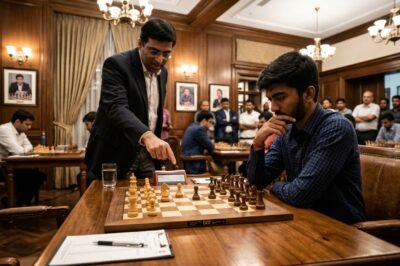
The global chess landscape is currently witnessing a paradigm shift that many experts believe occurs only once in a generation. At the center of this metamorphosis is the five-time World Champion Viswanathan Anand, whose insights have become the north star for analysts and fans alike. In his latest commentary featured on Chess.com, Anand has provided a profound breakdown of the upcoming World Championship cycle, specifically focusing on the meteoric rise of Dommaraju Gukesh and the competitive shadow cast by peers like Javokhir Sindarov. This is not merely a transition of power; it is a total overhaul of the classical chess archetype. Anand, who bridged the gap between the pre-engine era and the modern data-driven age, remains uniquely positioned to evaluate how these teenagers are dismantling established hierarchies. His predictions suggest a World Championship match that will be defined by youthful intuition supported by terrifyingly deep computational preparation. As the chess world looks toward the clash between Gukesh and Ding Liren, Anand’s focus on the Gukesh-Sindarov dynamic illustrates the broader context of a new era where age is no longer a barrier to the highest levels of strategic mastery.
The Architect of Modern Chess: Viswanathan Anand’s Strategic Vision
Viswanathan Anand’s role in modern chess has transitioned from the legendary ‘Tiger of Madras’ to a sage mentor whose influence permeates the top ranks of the FIDE ratings. Through the WestBridge Anand Chess Academy (WACA), he has nurtured the very talents that are now challenging for the world crown. Anand’s predictions regarding Gukesh are rooted in years of observing the young grandmaster’s psychological resilience. He notes that Gukesh possesses a rare ability to remain unflappable under extreme time pressure, a trait that was evident during his historic run at the Candidates Tournament. Anand emphasizes that the leap from a top-tier Grandmaster to a World Championship challenger involves more than just tactical sharpness; it requires a temperament that can withstand the isolation of a head-to-head match.
Furthermore, Anand’s analysis extends to the stylistic evolution of these young players. He points out that while the previous generation relied heavily on intuition honed over decades, the current crop of stars, including Sindarov and Gukesh, has integrated artificial intelligence into their very DNA. This ‘cyborg’ style of play, as some analysts call it, allows them to find resources in positions that were previously thought to be losing or drawn. Anand’s predictions highlight that Gukesh’s greatest strength might not be his opening preparation alone, but his ability to pose ‘uncomfortable’ questions to his opponents throughout the middle game, forcing them to burn precious clock time on moves that are objectively equal but practically difficult.
Gukesh D: Analyzing the Youngest World Championship Challenger
Dommaraju Gukesh has shattered records that many thought would stand for decades. At just 17 years old, his victory at the Candidates solidified his status as the primary threat to the reigning world order. Anand’s breakdown of Gukesh’s game highlights a specific ‘technical coldness’ that mimics the greatest champions of the past, such as Bobby Fischer or Garry Kasparov. Unlike many of his contemporaries who might prioritize safety, Gukesh has shown a willingness to embrace complexity and variance. This risk-taking profile is exactly what Anand believes will give him an edge in a long-format match where psychological fatigue becomes a decisive factor.
Statistically, Gukesh’s performance over the last 18 months has been nothing short of extraordinary. His ELO rating has seen a steady climb, but it is his performance against 2750+ rated players that catches Anand’s eye. Anand observes that Gukesh does not play the ‘player’ as much as he plays the ‘position,’ a level of maturity that is rarely seen in teenagers. By focusing on the objective truths of the board, Gukesh avoids the traps of intimidation that often plague younger challengers when facing established legends like Ding Liren or Magnus Carlsen. Anand’s prediction for the World Championship hinges on Gukesh’s ability to maintain this objective distance throughout the high-stakes environment of a title match.
The Sindarov Factor: Why Every Move Matters in Global Competition
While Gukesh is the immediate challenger, Viswanathan Anand frequently references Javokhir Sindarov as a key figure in the collective rise of the ‘2000s generation.’ Sindarov, representing the powerhouse of Uzbek chess, exemplifies a different but equally lethal style of play. Anand’s comparison between Gukesh and Sindarov serves to highlight the diversity of the new guard. Where Gukesh is often seen as a classical strategist with modern flair, Sindarov represents a hyper-aggressive, tactical school of thought that thrives in chaotic positions. This rivalry, or rather this parallel development, is what Anand believes is pushing the overall ceiling of professional chess higher than ever before.
Anand’s predictions suggest that the presence of players like Sindarov on the global circuit forces Gukesh to remain hyper-vigilant. The ‘Uzbek school,’ led by Sindarov and Nodirbek Abdusattorov, has introduced a level of physicality and endurance into chess that requires challengers to be in peak athletic condition. Anand notes that the World Championship cycle is no longer just about the two players in the final match; it is about the entire ecosystem of young sharks who are constantly innovating. Sindarov’s recent performances in high-stakes blitz and rapid formats have shown that the modern elite must be masters of all time controls, a reality that Gukesh has embraced as part of his path to the championship.
Technical Breakdown: Opening Theory and Engine Innovations
In his Chess.com analysis, Anand dives deep into the technical aspects of modern preparation. The use of neural network engines like Stockfish 16 and Leela Chess Zero has leveled the playing field in terms of opening knowledge. Anand predicts that the World Championship will be decided in the ‘transition zones’—the moments where the players run out of their engine-prepared lines and must rely on their own understanding. He praises Gukesh’s team for their ability to find ‘side-lines’ that bypass the most heavily analyzed draws, looking for imbalanced positions where the younger player’s stamina can be leveraged.
The technical sophistication of Gukesh’s play is particularly evident in his handling of the endgame. Anand has pointed out that Gukesh possesses a ‘Karpovian’ feel for small advantages. This is a crucial insight, as the World Championship matches often boil down to the conversion of infinitesimal edges in the sixth or seventh hour of play. Anand’s technical prediction is that Gukesh will attempt to drag the reigning champion into deep waters where the exhaustion of a three-week match will favor the teenager’s recovery speed and cognitive endurance. The analysis suggests that we are moving away from the era of ‘opening kills’ and into an era of ‘endgame attrition.’
Market Dynamics: The Financial Rebirth of Chess Sponsorships
The surge in popularity of young stars like Gukesh and the insights provided by legends like Anand have significant financial implications. Chess is no longer a niche hobby; it is a booming digital sport. Anand’s predictions about the World Championship reflect a broader trend where corporate sponsors in India and globally are flocking to the game. The ‘Gukesh Effect’ has led to a massive spike in chess viewership across streaming platforms like Chess.com and YouTube, with millions of concurrent viewers tuning in for major events. This demographic shift is attracting non-endemic brands, from fintech companies to luxury watchmakers, who see the intellectual prestige of chess as a perfect marketing vehicle.
Anand acknowledges that the financial stakes have never been higher. The prize funds for the World Championship and the surrounding circuit have grown, but more importantly, the ‘brand value’ of the players has skyrocketed. Gukesh, as a potential World Champion from India, represents a market of over a billion people. Anand’s analysis suggests that the outcome of this match will dictate the commercial trajectory of the sport for the next decade. If Gukesh wins, we could see a total dominance of the chess economy by the Asian market, leading to more high-stakes tournaments in Mumbai, Chennai, and Tashkent, further fueling the development of players like Sindarov.
The Psychological Threshold of the World Stage
One of the most compelling parts of Anand’s prediction is the psychological aspect. A World Championship match is a unique pressure cooker that differs significantly from a tournament format. Anand, having defended his title multiple times, knows that the ‘off-days’ are just as important as the game days. He predicts that Gukesh’s greatest challenge will be the psychological weight of the Indian public’s expectations. Every move will be scrutinized by millions, creating a level of national pressure that few 17-year-olds are equipped to handle. However, Anand believes Gukesh’s stoicism is his secret weapon.
Comparing the psychological profiles of Gukesh and his peers, Anand notes that the younger generation has a ‘fearless ignorance’ of the historical greatness of their opponents. They respect their elders but do not fear them. This shift in mindset is what allows Gukesh to sit across from a World Champion and play as if it were a casual online game. Anand’s insights conclude that the player who manages their nervous system most effectively during the first four games of the match will likely emerge as the victor, as the early momentum in a World Championship match is historically difficult to reverse.
Conclusion: A New Era Defined by Youth and Precision
As we approach the pinnacle of the chess calendar, Viswanathan Anand’s predictions serve as a roadmap for what to expect. The emergence of Dommaraju Gukesh as a challenger is the fulfillment of a prophecy Anand himself helped write through his years of dominance and subsequent mentorship. The game is becoming faster, more precise, and more physically demanding. While the focus remains on the crown, the underlying story is the incredible depth of talent represented by Gukesh, Sindarov, and their peers. The World Championship will not just be a test of chess skill, but a showcase of the incredible cognitive potential of a new generation that has mastered the machines and is now ready to reclaim the human element of the game. Regardless of the final score, Anand’s analysis makes it clear: the era of the veteran is giving way to the era of the prodigy, and the world of chess will never be the same again.





































Leave a Reply