
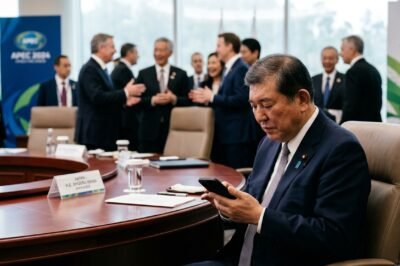
The image was as striking as it was symbolic. Amidst the high-stakes atmospheric buzz of the Asia-Pacific Economic Cooperation (APEC) summit in Lima, Peru, world leaders engaged in the fluid, informal choreography of international diplomacy. Joe Biden, Xi Jinping, and Justin Trudeau were seen in huddles, exchanging the tactile gestures of power that define global summits. Yet, at the center of this diplomatic whirlwind sat Shigeru Ishiba, the newly minted Prime Minister of Japan, seemingly anchored to his chair and preoccupied with his smartphone. The Reuters report detailing how Ishiba ‘cut a lonely figure’ has resonated far beyond the tarmac of Jorge Ch!vez International Airport. It serves as a visual metaphor for a leader who is currently fighting for his political life at home while simultaneously struggling to find his footing on the world stage. For a nation that has historically prided itself on being the primary linchpin of American interests in Asia, the sight of its leader isolated at a major multilateral gathering signals a potentially profound shift in Japan’s regional influence and domestic stability.
The Visual of Isolation: More Than Just Poor Optics
In the world of high-level diplomacy, optics are often as consequential as the communique released at the end of the day. Ishiba’s perceived isolation in Lima was not merely a matter of personal temperament; it reflected a leader who lacks the deep-rooted international network that his predecessors, such as the late Shinzo Abe, meticulously cultivated over decades. Reuters reported that while other leaders were busy with the ‘standing diplomacy’ that often yields more results than formal bilateral meetings, Ishiba remained seated, only rising when approached, and even then, appearing somewhat stiff. This lack of engagement is being scrutinized by political analysts as a symptom of a deeper malaise within the Japanese administration. If a Prime Minister cannot command the room at APEC, there are growing fears that Japan’s voice in the Comprehensive and Progressive Agreement for Trans-Pacific Partnership (CPTPP) and other regional frameworks may begin to dim.
Furthermore, the timing of these optics could not be worse. Japan is currently navigating an increasingly assertive China, a volatile North Korea, and the transition to a new, more isolationist-leaning administration in the United States. When a Japanese leader appears disconnected at a forum designed specifically for trans-Pacific cooperation, it sends a message of vulnerability. Critics argue that Ishiba, who has long been a policy wonk with a focus on defense and rural revitalization, has yet to master the performative aspects of the Prime Ministership which are essential for maintaining Japan’s status as a top-tier global power. The ‘lonely figure’ narrative is now being weaponized by domestic opponents who claim that the Ishiba cabinet is fundamentally inward-looking at a time when the world demands outward-facing leadership.
Domestic Frailty as a Diplomatic Anchor
To understand why Ishiba appeared so detached in Peru, one must look at the wreckage of the Liberal Democratic Party’s (LDP) recent electoral performance. In October, the LDP and its coalition partner Komeito suffered their worst electoral defeat in over a decade, losing their majority in the lower house of the Diet. Ishiba is now leading a minority government, a precarious position that requires him to negotiate every piece of legislation with a emboldened opposition. This domestic instability acts as a heavy anchor, preventing the Prime Minister from projecting strength abroad. A leader who might be ousted in a matter of months lacks the ‘diplomatic currency’ needed to forge long-term alliances or strike complex trade deals.
The internal dynamics of the LDP are also fraught with tension. Ishiba, often viewed as an outsider within his own party due to his history of criticizing previous leadership, lacks a solid power base. He is constantly looking over his shoulder at rival factions that are waiting for the opportune moment to challenge his leadership. This internal discord means that while he was at APEC, his mind was likely back in Tokyo, calculating how to survive the next budget session. For world leaders, a counterpart who is politically ‘dead man walking’ is someone to be treated with polite indifference rather than strategic urgency. This domestic weakness was palpably felt in the corridors of the Lima summit, where the lack of a strong Japanese presence was noted by diplomats and observers alike.
The Trump Shadow and the Failed Mar-a-Lago Meeting
Perhaps the most significant blow to Ishiba’s standing was the unsuccessful attempt to secure a meeting with U.S. President-elect Donald Trump on his way back from the summit. The Japanese diplomatic machine had been working feverishly to replicate Shinzo Abe’s 2016 success, where he was the first foreign leader to meet the then-President-elect at Trump Tower. Ishiba’s failure to land a similar meeting at Mar-a-Lago has been framed as a major diplomatic setback. The Trump team cited legal constraints and the ‘Logan Act’ as reasons for declining the meeting, but the reality is that the Japanese side was unable to penetrate the inner circle of the incoming administration with the same speed and efficacy as in the past.
This failure highlights a critical gap in Ishiba’s foreign policy toolkit. Trump values personal rapport and ‘strongman’ dynamics, qualities that Ishiba has yet to demonstrate. Without a direct line to the next U.S. President, Japan faces an uncertain future regarding trade tariffs and defense spending demands. The ‘lonely figure’ at APEC becomes even more concerning when considering that the U.S.-Japan alliance is the cornerstone of Tokyo’s security. If Ishiba cannot navigate the transactional nature of the new Washington, Japan risks being sidelined in favor of other regional actors who are quicker to adapt to the changing political tides in America.
Geopolitical Recalibration in the Asia-Pacific
While Ishiba struggled, other regional players were quick to fill the vacuum. China’s Xi Jinping used the APEC summit to project an image of stability and openness, contrasting sharply with the protectionist rhetoric coming out of the United States. Xi’s meeting with Ishiba was polite but notably lacked the warmth or substantive progress on long-standing issues like the ban on Japanese seafood or the territorial disputes in the East China Sea. Beijing is well aware of Ishiba’s weak domestic position and is likely to use this period of Japanese instability to further its own regional agenda, particularly in the South China Sea and regarding Taiwan.
Furthermore, Japan’s role as a bridge between the West and the Global South appears to be fraying. Countries in Southeast Asia and Latin America, which once looked to Tokyo for leadership and investment, are now seeing a Prime Minister who is distracted by internal LDP squabbles. The implications for regional security are profound. Japan has been a vocal proponent of a ‘Free and Open Indo-Pacific,’ but this vision requires a leader who can actively build coalitions and counter Chinese influence through constant, high-level engagement. If the Japanese PM remains a ‘lonely figure’ at these summits, the collective resolve of the Indo-Pacific nations to balance China’s rise may begin to weaken.
Economic Consequences of Political Stagnation
The financial markets have reacted with a mixture of caution and skepticism to Ishiba’s lackluster performance. The Japanese Yen has continued its volatile streak, and the Nikkei 225 has struggled to find a clear direction as investors weigh the risks of a minority government. There is a tangible fear that political gridlock in Tokyo will prevent the necessary structural reforms needed to combat inflation and boost wage growth. At APEC, trade was a central theme, yet Japan was unable to take a leading role in discussions regarding the modernization of digital trade or green energy transitions.
- Market Uncertainty: Foreign investors are wary of the ‘Ishiba Discount,’ fearing that a weak leader will be unable to push through unpopular but necessary fiscal policies.
- Trade Vulnerability: Without strong diplomatic leverage, Japan may find itself at the mercy of renewed ‘Section 232’ tariffs on automotive exports under the next U.S. administration.
- Resource Security: Japan’s energy strategy requires strong bilateral ties with resource-rich APEC nations, ties that are currently not being reinforced at the highest levels.
The intersection of politics and economics in Japan is more critical than ever. The country is dealing with an aging population, a shrinking workforce, and a debt-to-GDP ratio that remains the highest in the developed world. To navigate these challenges, Japan needs a Prime Minister who can command the respect of the G7 and APEC. Ishiba’s isolation at the summit suggests that Japan may be entering a period of ‘diminished presence’ on the global economic stage, which could have long-term repercussions for its credit rating and investment attractiveness.
Future Implications: The Survival of the Ishiba Cabinet
The road ahead for Shigeru Ishiba is fraught with peril. Upon his return to Tokyo, he faces an uphill battle to pass a supplementary budget and prepare for the regular Diet session in the new year. The opposition, led by the Constitutional Democratic Party, is smelling blood and will likely use the Prime Minister’s perceived failures abroad to further weaken his standing. Within the LDP, the countdown to the next party leadership race has already begun in the minds of many. If Ishiba cannot demonstrate a quick turnaround in both his domestic approval ratings and his international stature, his tenure may go down as one of the shortest in modern Japanese history.
Ultimately, the APEC summit was a missed opportunity for Ishiba to reinvent himself as a statesman. Instead, it reinforced the narrative of a leader who is out of his depth. For Japan, the consequences are more than just bruised pride; it is about the nation’s ability to shape the rules of the 21st-century global order. If Japan continues to cut a lonely figure in international forums, it may find itself increasingly isolated in a world where alliances are being redrawn at lightning speed. The ‘lonely figure’ on the tarmac in Lima may well be the defining image of an era of Japanese retreat, unless Ishiba can find a way to bridge the gap between his domestic challenges and his international responsibilities.


































Leave a Reply