
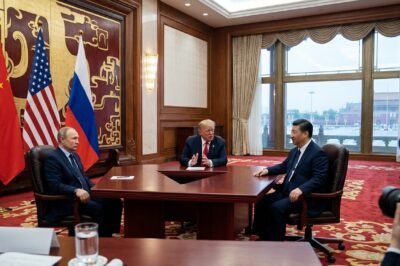
The world stood still as the three most powerful figures in global politics—Xi Jinping, Donald Trump, and Vladimir Putin—concluded their historic trilateral summit in Beijing. This gathering represents more than just a meeting of heads of state; it is a tectonic shift in the post-WWII geopolitical architecture. As the dust settles on the summit floor, Xi Jinping’s stern warning that major powers must respect each other’s “bottom lines” rings through the halls of the Great Hall of the People. The air is thick with the implications of this new “Big Three” dynamic, reminiscent of the Yalta Conference but set against a 21st-century backdrop of trade wars, technological supremacy, and nuclear posturing. Markets across the globe are reacting with cautious volatility, as investors and policy experts scramble to decode the nuances of the joint communique. The conclusion of this summit marks the end of unilateralism and the messy birth of a complex, multipolar reality where the stakes are higher than ever before. This meeting signifies a departure from the traditional G7-dominated narrative, placing the nexus of power firmly within a trilateral framework that encompasses the world’s largest manufacturer, the world’s largest economy, and its most significant energy exporter.
The Context of the Trilateral Summit: Why Now?
The timing of this summit is far from coincidental. As the United States navigates a turbulent domestic political landscape under the Trump administration, the need for a recalibrated approach toward both China and Russia has become increasingly urgent. Beijing, for its part, has been seeking to solidify its position as a global mediator, moving away from its previous role as a passive participant in Western-led international norms. Russia, embroiled in the ongoing consequences of the conflict in Ukraine and heavily sanctioned by the West, finds in this trilateral meeting a vital lifeline to maintain its relevance and economic stability. The convergence of these three leaders suggests a mutual realization: the previous status quo is no longer sustainable for any party involved.
Strategically, the summit addresses the vacuum left by the fracturing of traditional alliances. The European Union’s internal divisions and the growing skepticism toward NATO in certain American political circles have created an environment where Xi, Trump, and Putin can effectively rewrite the rules of engagement. This is not merely about diplomatic niceties; it is about establishing a hard-edged realism where national interests are prioritized over ideological alignment. The geopolitical gravity has shifted, and this meeting in China is the most visible manifestation of that movement. Analysts suggest that the backdrop of the meeting—the Great Hall of the People—was carefully chosen to project China’s role as the central pillar of this new global triad.
Analyzing Xi’s “Bottom Line” Doctrine
At the heart of the summit’s conclusion was Xi Jinping’s emphatic declaration regarding “bottom lines.” In diplomatic parlance, this refers to non-negotiable sovereign interests that, if crossed, would trigger severe repercussions. Xi specifically highlighted that major powers must not touch each other’s sensitive issues, a clear reference to China’s stance on Taiwan, the South China Sea, and its internal governance structures. By framing the discussion around these bottom lines, Xi is effectively demanding a degree of respect and non-interference that has been a point of contention with Washington for decades. This doctrine seeks to establish a “live and let live” philosophy among the titans, provided that the hierarchy of influence is respected.
For the Trump administration, these bottom lines present a complex challenge. Donald Trump has built a political identity on challenging the status quo, particularly regarding trade and China’s economic rise. However, the recognition of these red lines by the American side suggests a pivot toward a more transactional form of diplomacy. If the U.S. respects China’s sovereignty in certain spheres, what can it expect in return? This is the fundamental question that will define the next decade of Sino-American relations. Meanwhile, Putin’s presence ensures that Russia’s own bottom lines—primarily regarding security architecture in Eastern Europe and the preservation of its energy markets—are integrated into this new tripartite understanding.
Economic and Market Implications: A New Financial Iron Curtain?
The economic ramifications of this summit are staggering. Global markets have been on a roller coaster as the three leaders discussed the future of the dollar, trade tariffs, and supply chain security. Xi’s insistence on respecting bottom lines extends to the economic realm, where technology bans and semiconductor restrictions are seen as direct violations of China’s development rights. The summit hinted at a potential easing of certain trade tensions in exchange for strategic concessions, but it also raised the specter of a bifurcated global economy. We are seeing the possible emergence of two distinct financial ecosystems: one led by the U.S. and its traditional allies, and another centered around the Beijing-Moscow-Riyadh axis.
Investment banks and hedge funds are already adjusting their portfolios to account for this new reality. The focus is shifting toward “resilience” and “localization.” If the trilateral agreement holds, we could see a stabilization in energy prices, as Russia’s oil and gas flows are more predictable under a trilateral understanding. However, the risk of localized economic shocks remains high if any party perceives a breach of the agreed-upon bottom lines. The financial world is watching closely to see if this summit leads to a genuine de-escalation of the trade war or if it is simply a temporary truce before the next phase of technological competition begins. The emphasis on “sensitive issues” suggests that tech transfers and AI development will remain highly contested and protected areas.
Trump’s Transactional Diplomacy vs. Putin’s Strategic Pivot
The personal chemistry and conflicting goals of Donald Trump and Vladimir Putin added a layer of unpredictability to the summit. Trump’s approach is famously transactional; he views international relations through the lens of “the deal.” For him, the summit was an opportunity to showcase American strength while simultaneously seeking concessions that benefit his domestic base. His rhetoric centered on “reciprocity” and ensuring that American workers are not disadvantaged by the trilateral arrangement. This contrasts sharply with Putin’s more existential and long-term strategic pivot. For the Russian leader, the summit is a means to break the Western isolation and secure a permanent seat at the table where the world’s most significant decisions are made.
Xi Jinping acted as the ultimate balancer between these two forces. While Trump pushed for immediate economic wins and Putin sought security guarantees, Xi maintained a focus on the structural stability of the international system—on China’s terms. The interplay between Trump’s unpredictability and Putin’s calculated maneuvers creates a volatile but potentially productive environment. If these three can find a way to coexist without infringing on the “bottom lines” mentioned by Xi, it could lead to a period of relative, albeit tense, global stability. However, the personal nature of this diplomacy means that a change in leadership or a shift in domestic approval ratings in any of the three nations could easily unravel the progress made in Beijing.
Regional Security and the Fragile Peace in the Indo-Pacific
Security was a paramount topic, with the Indo-Pacific region serving as the primary theater of concern. Xi’s warnings about sensitive issues are most applicable here, where territorial disputes and military posturing have reached a fever pitch. The summit discussions reportedly touched upon the need for a crisis management mechanism to prevent accidental escalations in the South China Sea. While no formal treaty was signed, the verbal commitment to respect “bottom lines” suggests a cooling of rhetoric. This is a significant development for regional actors like Japan, Australia, and India, who must now navigate a world where the three major powers are actively negotiating the regional architecture over their heads.
Furthermore, the inclusion of Russia in these Indo-Pacific discussions highlights the growing synergy between Moscow and Beijing in the maritime domain. For the U.S., this represents a more complex security environment where it must account for a dual-threat scenario. The summit’s conclusion implies that the U.S. might be willing to trade a degree of maritime assertiveness for stability in other areas, such as the Middle East or trade. However, the fragility of this peace cannot be overstated. The definition of a “bottom line” is subjective, and what one nation considers a sensitive internal issue, another may see as a violation of international law. The success of the summit depends entirely on the consistent interpretation of these boundaries by military and diplomatic staff on all sides.
Future Implications: The Long-Term Forecast
As we look toward the future, the Xi-Trump-Putin summit will likely be remembered as the moment the “liberal international order” was officially replaced by a “realist trilateral order.” The future implications are profound. First, we will see a continued shift toward bilateral and trilateral agreements that bypass traditional institutions like the United Nations or the WTO. These legacy organizations are increasingly viewed as ineffective by the Big Three. Second, the concept of “sovereignty” will take precedence over “human rights” or “global norms” in international discourse, as per the bottom-line doctrine. This has significant consequences for global governance and the protection of minority rights and democratic values worldwide.
Finally, the summit sets the stage for a new era of competitive coexistence. The competition for resources, technology, and influence will not disappear, but it may be governed by a set of understood boundaries that prevent total systemic collapse. For businesses and investors, the key takeaway is the need for extreme flexibility. The global landscape is no longer a single playing field but a collection of interconnected zones with different rules and risks. The Beijing summit has provided a map for this new world, but the terrain remains dangerous and the path ahead is far from certain. The world now waits to see if the “bottom lines” established in the Great Hall of the People will hold, or if they will become the fault lines of the next global conflict.

































Leave a Reply