
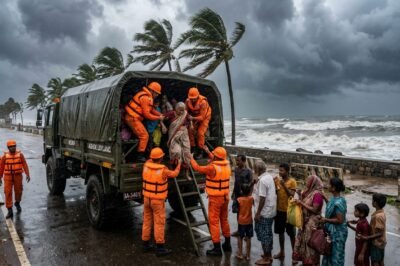
The eastern seaboard of India is currently facing one of its most significant atmospheric challenges of the year as Cyclone Akvan gathers unprecedented strength in the Bay of Bengal. Residents and authorities in Odisha and Andhra Pradesh are on high alert as the India Meteorological Department (IMD) predicts a devastating landfall near the coastal town of Gopalpur. The gravity of the situation is reflected in the massive mobilization of state resources, with over one lakh individuals already moved to safer locations. This evacuation effort, one of the largest in recent months, underscores the government’s commitment to a ‘zero casualty’ policy. As the storm surges forward, the atmosphere in coastal villages is a mixture of tension and rapid activity, with the National Disaster Response Force (NDRF) and local police working around the clock to ensure that the most vulnerable populations are shielded from the impending fury of the wind and rain. The geographical positioning of Gopalpur makes it a critical point for the storm’s entry, potentially leading to significant storm surges and high-velocity winds that could redefine the landscape of the region in the coming forty-eight hours.
The Meteorological Genesis and Path of Cyclone Akvan
Cyclone Akvan originated as a low-pressure area over the East-central Bay of Bengal, quickly intensifying into a deep depression before reaching cyclonic status. According to the latest bulletins from the IMD, the system is moving at a steady pace, drawing moisture from the warm sea surface temperatures which have been recorded at levels higher than the seasonal average. This thermal energy has acted as fuel, allowing Akvan to maintain its structure and even intensify as it approaches the coast. Meteorologists have noted that the steering currents in the upper atmosphere are guiding the cyclone directly toward the southern Odisha coast. The projected wind speeds are expected to touch 120 to 130 kilometers per hour, with gusts reaching up to 145 kilometers per hour at the time of landfall. This intensity classifies it as a ‘Severe Cyclonic Storm,’ necessitating the highest level of preparedness.
The tracking of Akvan has been facilitated by state-of-the-art Doppler Weather Radars located at Paradip, Gopalpur, and Visakhapatnam. These instruments provide real-time data on the storm’s inner core structure and the distribution of rainfall. Satellite imagery shows a well-defined ‘eye’ emerging, which is a classic sign of a powerful cyclone. The outer bands of the storm have already begun to lash the coast with heavy to very heavy rainfall, causing early flooding in low-lying areas. The synergy between satellite data and ground-based observations has allowed for precise forecasting, giving local administrations the crucial window needed to execute evacuation plans. However, the unpredictability of cyclonic paths means that even a slight deviation could bring new areas under the direct line of fire, keeping the entire eastern coast in a state of constant vigilance.
Odisha’s Massive Evacuation and Logistics Strategy
In Odisha, the state government has activated its full disaster management machinery. Chief Minister’s Office has been monitoring the situation hourly, coordinating with district collectors in Ganjam, Puri, Khordha, and Jagatsinghpur. The primary focus has been the evacuation of over 100,000 people living in kucha houses or within five kilometers of the shoreline. These individuals are being moved to multi-purpose cyclone shelters, which have been equipped with dry rations, clean drinking water, and medical supplies. The logistical challenge of moving such a large number of people in a short timeframe is immense, requiring hundreds of buses and trucks. Special attention is being given to the elderly, pregnant women, and children, ensuring they receive priority during the transport process.
Furthermore, the state has deployed 20 units of the NDRF and 17 teams of the Odisha Disaster Rapid Action Force (ODRAF) to the districts most likely to be affected. These teams are equipped with tree cutters, inflatable boats, and high-tech communication equipment to handle post-landfall scenarios such as road blockages and search-and-rescue operations. Public address systems are being used in coastal villages to warn people against venturing into the sea. Fishermen who were already out in the deep sea have been successfully recalled to the shore. The administration has also ensured that essential services like hospitals have backup power generators and sufficient oxygen supplies, anticipating potential power grid failures due to uprooted trees and damaged transmission lines. The readiness of the state serves as a model for disaster resilience, having learned hard lessons from past events like Phailin and Fani.
Andhra Pradesh: Red Alert and District Preparedness
While Odisha prepares for the direct hit, the neighboring state of Andhra Pradesh is not taking any chances. A ‘Red Alert’ has been issued for the districts of Srikakulam, Vizianagaram, and Visakhapatnam. These northern districts share a border with Odisha and are expected to experience extreme rainfall and high-velocity winds. The state government of Andhra Pradesh has directed the district collectors to set up 24/7 control rooms to handle emergency calls. In Srikakulam particularly, the administration is worried about the potential for riverine flooding as the heavy rainfall in the catchment areas of the Vamsadhara and Nagavali rivers could lead to a rapid rise in water levels. Pre-emptive measures including the closure of schools and colleges have been implemented to minimize movement during the peak of the storm.
The Integrated Command and Control Centers in the three red-alert districts are utilizing GIS mapping to identify vulnerable hamlets and power infrastructure. In Visakhapatnam, the naval command is also on standby, ready to deploy aerial assets for surveying damage or conducting rescue missions if the ground situation deteriorates. The horticultural department has warned farmers of significant risks to coconut and banana plantations, which are highly susceptible to wind damage. The synergy between the state and central agencies in Andhra Pradesh is visible in the coordinated deployment of the Coast Guard, which is patrolling the waters to ensure no fishing vessels remain at sea. The red alert signifies not just the weather severity, but a comprehensive state of emergency where every resource is pivoted toward life-saving operations.
Economic Implications: Markets, Infrastructure, and Agriculture
The economic impact of Cyclone Akvan is expected to be substantial, affecting multiple sectors across the two states. From a financial perspective, the immediate concern is the disruption of supply chains. Major ports like Paradip and Visakhapatnam have suspended operations, leading to a temporary halt in the movement of coal, iron ore, and other essential commodities. This pause in port activity can have a ripple effect on the national economy, particularly for industries that rely on a steady supply of raw materials for power generation and steel manufacturing. Market analysts are also watching the stocks of insurance companies and infrastructure firms, as the cost of damages to property and public utilities is projected to run into hundreds of crores.
The agricultural sector is perhaps the most vulnerable. Thousands of hectares of standing paddy crops, almost ready for harvest, are now at risk of being submerged. In Odisha and Andhra Pradesh, the agricultural heartlands are currently in a delicate phase of the kharif cycle. Excessive rainfall and flooding can lead to crop rot and soil erosion, significantly impacting the livelihoods of small-scale farmers. Furthermore, the destruction of rural infrastructure, including local markets and storage godowns, could lead to a spike in food prices in the regional markets. The government will likely need to announce a comprehensive relief package to compensate farmers for their losses, adding pressure to the state exchequers already strained by the costs of the evacuation and disaster response efforts. Long-term economic recovery will depend on the speed of infrastructure restoration, particularly the power and communication networks which are often the first casualties of high-velocity winds.
The Role of Technology and Early Warning Systems
One of the silver linings in the face of Cyclone Akvan is the remarkable advancement in early warning systems. The IMD’s ability to predict the storm’s trajectory and intensity with high precision is a testament to India’s growing technological prowess in meteorology. High-performance computing models and global forecasting systems have enabled authorities to issue warnings several days in advance, providing the lead time necessary for large-scale evacuations. In addition to traditional media, social media platforms and mobile-based SMS alerts are being used to disseminate information to the farthest corners of the coastal districts. The ‘Sachet’ portal and mobile app have been instrumental in providing localized weather updates to users, ensuring that the public remains informed and avoids panic.
On the ground, technology is being used to manage the disaster in real-time. Drones are being readied for post-landfall damage assessment, allowing authorities to view inaccessible areas without risking personnel. Satellite-based communication handsets have been provided to field officers in case the mobile networks collapse. This tech-heavy approach significantly reduces the time between a disaster event and the commencement of relief operations. However, the challenge remains in bridging the ‘last-mile’ gap—ensuring that every individual in a remote village understands the severity and acts upon the warnings. The integration of community-based radio and local language broadcasts is part of this multi-modal communication strategy, aiming to reach every citizen regardless of their digital access.
Conclusion: Navigating the New Normal of Climatic Extremes
As Cyclone Akvan makes its final approach toward the coast, it serves as a stark reminder of the increasing frequency and intensity of extreme weather events in the Bay of Bengal. The rising sea surface temperatures, a direct consequence of global climate change, are making cyclones more potent and less predictable. While the immediate focus remains on saving lives and minimizing physical damage, the long-term implication is the need for more resilient coastal infrastructure. This includes the construction of more permanent cyclone shelters, the strengthening of coastal embankments, and the promotion of saline-resistant crop varieties for farmers. The repeated cycles of destruction and rebuilding are not sustainable, and a shift toward climate-adaptive development is becoming a necessity rather than a choice.
The successful evacuation of over one lakh people is a major win for disaster management, but the real test will begin after the eye of the storm passes. The restoration of normalcy, the rehabilitation of displaced families, and the recovery of the local economy will require sustained effort and investment. Cyclone Akvan will likely be studied by meteorologists and disaster management experts for years to come, providing valuable data to refine future response strategies. For now, the focus of the nation remains on the brave personnel on the ground and the millions of citizens waiting for the storm to pass. The resilience of the people of Odisha and Andhra Pradesh, who have faced many such trials before, will undoubtedly be the cornerstone of the recovery process. As we look forward, the lessons learned from Akvan must be integrated into national policy to ensure that the coastal regions of India are better prepared for the volatile future of our planet’s climate.



































Leave a Reply