
In the high-stakes theater of modern geopolitics, where military precision and technological superiority are often touted as the bedrock of national security, a startling revelation from Operation Epic Fury has sent shockwaves through the global defense community. Reports originating from credible sources, including The Times of India, have highlighted a peculiar and somewhat unsettling tactical decision by the United States Navy: the deployment of ordnance that had technically surpassed its manufacturer-rated expiration date. This disclosure, which emerged following the complex aerial and naval maneuvers directed against Iranian-backed assets, has ignited a firestorm of debate regarding the readiness of the American military-industrial complex and the logistical challenges of maintaining a perpetual state of global deterrence. While the operation was initially framed as a demonstration of overwhelming force and surgical accuracy, the subsequent admission that some of the munitions utilized were ‘past their prime’ has shifted the narrative toward the pragmatic, and sometimes desperate, realities of modern warfare inventory management.
The controversy reached a fever pitch when a senior U.S. Navy officer, tasked with explaining the rationale behind the use of aged weaponry, offered a strikingly domestic analogy that compared the missiles to ‘stale bread.’ The officer suggested that while the missiles were technically expired, their core functionality remained intact, much like bread that has passed its sell-by date but is still perfectly safe for consumption. This ‘stale bread’ comparison has become the focal point of both ridicule and serious military analysis, as it touches upon the uncomfortable truth that the cost and time required to replace high-tech ordnance often outpace the operational demands of the Department of Defense. As the US continues to navigate rising tensions in the Middle East, the implications of using ‘expired’ hardware extend far beyond the immediate tactical outcomes of Operation Epic Fury, raising questions about fiscal responsibility, hardware reliability, and the psychological impact of such admissions on international adversaries who monitor US capabilities with predatory focus.
The Strategic Context and Execution of Operation Epic Fury
Operation Epic Fury was conceived as a multi-domain response to escalating maritime threats and proxy provocations attributed to Iran. The operation involved a sophisticated coordination of carrier strike groups, stealth tactical aircraft, and guided-missile destroyers. The primary objectives were to degrade the command-and-control infrastructure of regional militias and to send a clear message of deterrence to Tehran. On the surface, the operation appeared to be a textbook example of American power projection, with high-definition footage of missile launches and successful impact assessments dominating the news cycle. However, the internal logistical reports painted a different picture, one where the strain on existing stockpiles necessitated the dipping into reserve inventories that many assumed would remain untouched or be decommissioned.
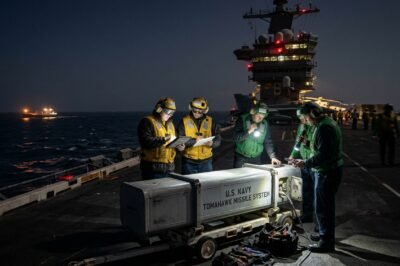
Underpinning this operation was the need for high-volume fire. Modern conflict, particularly when targeting entrenched or mobile assets, requires a density of munitions that often exceeds immediate production capacities. Strategic planners were forced to weigh the risks of using newer, more expensive inventory against the deployment of older systems like the Tomahawk Land Attack Missile (TLAM) variants that were approaching or had already exceeded their twenty-year shelf life. The decision to proceed with the latter suggests a calculated risk that prioritized quantity and immediate availability over the pristine reliability certifications typically demanded by military protocol. This section of the analysis explores how the pressure of maintaining multiple fronts—from the Eastern Mediterranean to the Red Sea—has depleted the ‘fresh’ stocks of the US Navy, leading to the controversial ‘stale’ deployments seen in Epic Fury.
The Science of Ordnance Shelf Life and Reliability
To understand why the ‘stale bread’ analogy is both apt and alarming, one must look at the technical composition of a guided missile. A missile is not a monolithic object but a complex assembly of solid-fuel rocket motors, sensitive electronic guidance systems, thermal batteries, and high-explosive warheads. Each of these components has a distinct degradation profile. Solid fuels can become brittle or unstable over decades, electronics can suffer from solder whiskers or capacitor failure, and seals can perish, allowing moisture to enter sensitive areas. When the military labels a missile as ‘expired,’ it typically means the statistical probability of a failure-free launch has dropped below a pre-defined threshold, not that the missile is suddenly inert or non-functional.
Experts in ballistics and aerospace engineering note that the US military frequently performs ‘service life extension programs’ (SLEPs) on older hardware. These programs involve testing sample batches of older munitions to determine their actual failure rates. If a batch of twenty-year-old missiles shows a 95% success rate in test firings, they may be cleared for combat use despite their formal expiration. However, the use of such weapons in a high-profile operation like Epic Fury carries a massive reputational risk. If an expired missile were to malfunction and hit a civilian target or fail spectacularly over a friendly zone, the fallout would be catastrophic. The ‘stale bread’ analogy, therefore, simplifies a deeply complex statistical gamble into a palatable soundbite for the public, masking the rigorous (and sometimes frantic) engineering assessments that precede the use of such hardware.
Financial Implications and the Defense Procurement Bottleneck
From a business and financial perspective, the use of expired missiles is a glaring symptom of a larger procurement crisis within the Western defense industrial base. The cost of a single modern cruise missile can range from $1.5 million to $4 million. Replacing thousands of these units annually requires not just significant budgetary allocations, but also a manufacturing infrastructure that can handle the volume. Currently, lead times for advanced munitions have stretched to years due to supply chain disruptions, labor shortages, and a focus on high-margin, next-generation technology over the mass production of ‘dumb’ or standard guided munitions.
This has created a financial paradox for the Department of Defense. While the budget for defense remains at record highs, the actual ‘purchasing power’ in terms of ready-to-use missiles is constrained by the physical limits of production lines.
Key Financial Constraints Include:
- Rising Raw Material Costs: The price of specialized alloys and energetic materials has surged globally.
- Component Obsolescence: Older missiles use microchips that are no longer manufactured, making repairs and refurbishments nearly as expensive as new builds.
- Stockpile Depletion: High-intensity conflicts elsewhere, notably in Ukraine, have diverted significant portions of the US tactical inventory, leaving the Navy to make do with older stock for its own operations.
The decision to fire ‘stale bread’ is, in many ways, an accounting necessity. It allows the military to utilize assets that have already been paid for and would otherwise require expensive disposal procedures. However, the long-term cost of this strategy could be an erosion of the perceived reliability of American arms, which is a key component of the defense export market.
The ‘Stale Bread’ Analogy: Public Relations Masterstroke or Blunder?
The Navy officer’s comparison of missiles to stale bread is a fascinating case study in crisis communication. In one sense, it humanizes a cold, technical reality, making it relatable to a civilian audience who understands that a slightly old loaf of bread is still functional for toast. It defuses the panic that might arise from the headline ‘US Navy Uses Broken Missiles.’ By reframing ‘expired’ as ‘stale,’ the military attempts to normalize the degradation of its arsenal as a minor, manageable inconvenience rather than a systemic failure of readiness.
On the other hand, the analogy has been criticized by military analysts as being dangerously reductive. A missile is not bread; a failure in a missile system does not result in a bad sandwich, but in a failed mission, lost lives, or unintended geopolitical escalation. Critics argue that such language undermines the gravity of military operations and signals to adversaries that the US is struggling with its inventory. If the world’s most powerful navy is forced to use ‘stale’ equipment, it suggests a vulnerability that Iran and other regional players may seek to exploit. The psychological dimension of warfare relies heavily on the perception of perfection; the ‘stale bread’ comment may have accidentally pierced that veil of invincibility.
Geopolitical Risks and the Message to Iran
The use of older munitions in Operation Epic Fury sends a complex message to Tehran. On one level, it demonstrates that the US has such a massive ‘depth of bench’ that it can achieve its tactical goals even with secondary or older hardware. It shows that the American machine is capable of utilizing every scrap of its power to maintain dominance. However, Iranian military intelligence is likely analyzing the telemetry and success rates of these strikes with intense scrutiny. If they perceive a higher-than-normal rate of duds or inaccuracies, the deterrent value of future US deployments could be severely compromised.
Furthermore, the reliance on older stock might suggest to Iranian planners that the US is hesitant to commit its ‘top-shelf’ assets to the region, perhaps holding them back for a potential larger conflict with a peer competitor like China or Russia. This perception could embolden regional proxies to push the boundaries further, under the assumption that the US is currently in a ‘maintenance mode’ regarding its Middle Eastern presence. The geopolitical calculus is always shifting, and the ‘stale bread’ incident provides a new variable for adversaries to factor into their provocation models.
Conclusion: Future Implications for Defense Readiness
The revelations surrounding Operation Epic Fury and the ‘stale bread’ missiles serve as a stark wake-up call for the future of US defense policy. It highlights the urgent need for a more resilient and scalable defense industrial base that can replenish stocks at the speed of modern conflict. Moving forward, we can expect to see a renewed focus on ‘attritable’ munitions—cheaper, mass-produced systems that are designed for a shorter shelf life and higher volume, reducing the need to rely on aging, expensive legacy systems. There will also likely be increased Congressional oversight into the Navy’s inventory management, with demands for clearer data on the actual reliability of the missiles currently sitting in silos across the globe.
Ultimately, while the ‘stale bread’ comparison provided a moment of levity and simplified a complex issue, the underlying reality is one of transition. The US military is grappling with the end of the post-Cold War era of abundance and is entering a new period where resource management, fiscal discipline, and manufacturing speed are just as important as the technology itself. As the dust settles on Operation Epic Fury, the lesson learned is clear: the bread may be stale, but the hunger for regional stability and strategic dominance remains as sharp as ever. Ensuring that the next generation of ‘bread’ is fresh and ready for the table will be the defining challenge for the Pentagon in the decade to come.





































Leave a Reply