
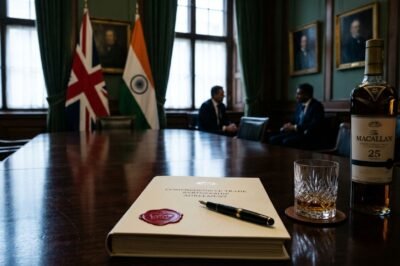
The global spirits market is currently witnessing a tectonic shift as India, the world’s largest consumer of whiskey, hardens its stance on trade negotiations with the United Kingdom. In a move that has sent ripples through the boardrooms of London and Mumbai, the Indian government has signaled a definitive intent to maintain a staggering 162.5% total duty and tax on bulk Scotch imports. This decision comes at a critical juncture in the long-protracted Free Trade Agreement (FTA) negotiations, which have seen multiple missed deadlines and increasing political friction. The aroma of aged malt is now being overshadowed by the complex stench of protectionist policies and geopolitical maneuvering. For British distillers, who have long eyed the Indian middle class as their ultimate growth frontier, this latest development represents a significant barrier that could redefine the economics of global spirits for the next decade. As the standoff intensifies, the implications go beyond mere bottle prices, touching upon the very core of post-Brexit British economic strategy and India’s own ‘Make in India’ manufacturing ambitions.
For years, the Scotch Whisky Association (SWA) has lobbied for a reduction in the basic customs duty, which currently stands at 150%. However, when factoring in the various cesses and surcharges applied by the Indian revenue department, the effective tax rate reaches the eye-watering figure of 162.5%. This latest move by New Delhi highlights a strategic refusal to grant early concessions, using the high-value liquor industry as a powerful lever in the broader trade talks. The standoff is not merely about booze; it is about labor mobility, professional services, and the intricate balance of trade deficits between a rising Asian power and a British economy looking for its footing outside the European Union. This article provides a comprehensive breakdown of the components of this tax, the industry reaction, and the potential long-term consequences for the global beverage sector.
The Anatomy of the 162.5% Duty Structure
To understand the gravity of this fiscal barrier, one must look at the specific components that constitute the 162.5% total charge. The foundation of this tax regime is the Basic Customs Duty (BCD), which is currently pegged at 150% for Scotch whisky. On top of this base rate, India applies a 10% Social Welfare Surcharge and the Agriculture Infrastructure and Development Cess (AIDC), which further inflates the cost of importation. This cumulative tax structure is designed not just for revenue generation, but as a protective moat for domestic distillers who produce Indian Made Foreign Liquor (IMFL). By keeping the price of imported Scotch artificially high, the government ensures that domestic brands remain the competitive choice for the mass market.
The distinction between ‘Bottled-in-Origin’ (BIO) and bulk imports is a key battleground in these negotiations. Bulk imports are typically spirit shipped in large containers to be diluted and bottled within Indian borders. While the UK had hoped for a significant reduction in duties for both categories, India’s focus on bulk spirits allows it to support local bottling plants and jobs. By maintaining high duties even on bulk shipments, India is sending a clear message: access to its 1.4 billion consumers will not come cheap, and it will require more than just shipping finished goods; it will require deep integration into the Indian industrial ecosystem.
Furthermore, the fiscal policy serves as a safeguard for India’s agricultural sector. The AIDC component of the tax is theoretically earmarked for improving rural infrastructure and supporting farmers. This makes any reduction in the duty a politically sensitive issue for the ruling Bharatiya Janata Party (BJP), as they must balance the demands of urban luxury consumers with the needs of the rural electorate. The 162.5% figure is therefore not just a number on a ledger, but a complex political statement reflecting India’s internal socio-economic priorities.
The Impact on UK Distillers and Global Giants
Major players in the spirits industry, including Diageo (which owns Johnnie Walker and holds a majority stake in India’s United Spirits) and Pernod Ricard (the makers of Chivas Regal), are the most exposed to this trade standoff. For these companies, India represents the single largest volume growth opportunity globally. A reduction in tariffs would allow them to lower price points, making premium Scotch accessible to millions of new consumers. The current 162.5% duty effectively doubles the shelf price compared to other international markets, confining Scotch to the upper echelons of Indian society and the duty-free segments.
Smaller, independent distilleries in Scotland are arguably even harder hit. While giants like Diageo have the infrastructure to bottle locally in India, smaller producers lack the capital to set up domestic operations. For them, the 162.5% duty is a total barrier to entry. This creates a market distortion where only the largest multinational corporations can afford to play in the Indian market, stifling the diversity of products available to Indian aficionados. The Scottish government has repeatedly voiced concerns that this standoff is hurting the ‘heritage’ industry of Scotland, which supports thousands of jobs in rural Highlands and Islands.
The strategic response from these companies has been to pivot toward ‘premiumization’ within the Indian market. Since they cannot compete on price due to the tax, they focus on high-margin, luxury offerings. However, this strategy has a ceiling. Without a significant reduction in bulk import duties, the ability to scale operations and move into the massive ‘prestige’ and ‘premium’ segments of the Indian whiskey market remains limited. The industry is essentially operating with one hand tied behind its back while waiting for a diplomatic breakthrough that seems increasingly elusive.
Geopolitical Friction and the FTA Stalemate
The Scotch whisky duty is inextricably linked to the broader negotiations of the India-UK Free Trade Agreement. Reports suggest that the primary sticking point is not actually liquor, but people. India has been pushing for greater mobility for its professionals, including easier visa access for IT workers, doctors, and engineers. Conversely, the UK government, under pressure to control net migration, has been hesitant to grant these concessions. This ‘whisky-for-visas’ trade-off has become the defining characteristic of the standoff. New Delhi is using the high Scotch tariffs as a hostage in the negotiations, refusing to lower them until the UK offers a more favorable deal on labor mobility.
Furthermore, the timing of this standoff is crucial. Both nations have recently undergone or are approaching significant political cycles. In the UK, the change in government has led to a reassessment of trade priorities. In India, the focus remains on ‘Atmanirbhar Bharat’ (Self-Reliant India). This ideology promotes domestic manufacturing and discourages imports that could be substituted by local production. The 162.5% duty is a perfect tool for this policy, as it encourages foreign firms to invest in Indian distilleries rather than simply exporting from Scotland.
The lack of progress is also influenced by the ‘Services’ sector. India wants better access for its massive services industry in the UK market. The UK, meanwhile, is seeking lower barriers for its financial services and legal firms to operate in India. Scotch whisky is the most visible and emotive ‘Good’ in these negotiations, but it is being used as a tactical pawn to win concessions in the ‘Services’ arena, which represents a much larger portion of both countries’ GDPs. Until a grand bargain is reached across these disparate sectors, the duty on Scotch is unlikely to budge.
Domestic Market Reaction and Protectionism
Inside India, the domestic spirits industry is not a monolithic block. There is a sharp divide between the local producers of IMFL and the Indian companies that bottle imported Scotch. The Confederation of Indian Alcoholic Beverage Companies (CIABC) has been vocal about protecting local interests. They argue that any sharp reduction in Scotch duties would lead to an influx of cheap foreign spirits that could decimate the domestic industry, which provides livelihoods to millions across the supply chain, from grain farmers to glass manufacturers.
Domestic brands like Amrut and Paul John have gained international acclaim, proving that India can produce world-class single malts. These producers argue that they need a level playing field. If Scotch duties are lowered, they want reciprocal access to the UK market, where ‘Indian Whisky’ often faces regulatory hurdles regarding its definition (as many Indian whiskies are molasses-based). This demand for ‘equitable treatment’ is a major pillar of India’s negotiating position. They are essentially saying: ‘We will lower our walls if you lower yours and recognize our standards.’
Moreover, the Indian consumer market is evolving. While the high duties remain, the thirst for premium spirits is growing. This has led to a boom in the ‘Grey Market’ and an increased reliance on duty-free purchases. The Indian government is aware that high duties lead to revenue leakage through these channels, yet they remain committed to the 162.5% figure as a matter of national trade policy. The domestic market is thus in a state of high-priced equilibrium, waiting for a catalyst to change the status quo.
Supply Chain Realities and the Cost to Consumers
The 162.5% duty has a compounding effect throughout the supply chain. When a bulk shipment of Scotch arrives at an Indian port, the duty is paid upfront, tying up significant working capital for the importer or the bottling partner. This cost is then passed down to the wholesaler, the retailer, and finally the consumer. In states like Maharashtra or Karnataka, where local state-level taxes are also high, a bottle of Scotch can end up costing three to four times its original export price. This makes Scotch a ‘Veblen good’ in India’s tier-1 cities—a product where high price increases its desirability as a status symbol.
- Basic Customs Duty: 150% – The primary hurdle for all imported spirits.
- Social Welfare Surcharge: 10% on the BCD – Added to fund social programs.
- AIDC: A variable percentage that targets infrastructure development.
- State VAT/GST: Varies by state, adding another layer of complexity to the final retail price.
Logistically, the high duty on bulk imports also discourages the use of higher-quality, aged spirits for blending. To keep the final retail price somewhat competitive, many blenders are forced to use younger spirits or mix Scotch malts with neutral Indian grain spirits. This affects the overall quality profile of the products available to the general public. For the true connoisseur, the duty structure is a barrier to experiencing the full range of Scottish heritage, as many niche or ‘cask strength’ offerings are simply too expensive to import under the current tax regime.
Conclusion: The Future of the India-UK Liquor Trade
The standoff over the 162.5% duty is a microcosm of the challenges facing global trade in an era of increasing nationalism and economic protectionism. For the UK, securing a reduction in this duty would be a crowning achievement for its post-Brexit trade policy, signaling that it can still secure lucrative deals for its most iconic industries. For India, maintaining the duty is a show of strength, demonstrating that its market is a prize that must be earned with significant concessions in other areas. The ‘exclusive’ nature of these reports suggests that neither side is ready to blink just yet, and the 162.5% figure may remain a fixture of the trade landscape for the foreseeable future.
Looking ahead, the most likely outcome is a phased reduction of duties over a 5-to-10-year period, rather than an immediate slash. This would allow the Indian domestic industry time to adapt while providing a clear roadmap for UK distillers to plan their investments. However, such a compromise depends entirely on the broader political climate. As long as the ‘pact standoff’ continues regarding visas and services, the Scotch whisky industry will remain caught in the crossfire. Investors and consumers alike should prepare for continued volatility in prices and availability, as the battle for the world’s most lucrative spirits market enters its most intense phase.






































Leave a Reply