
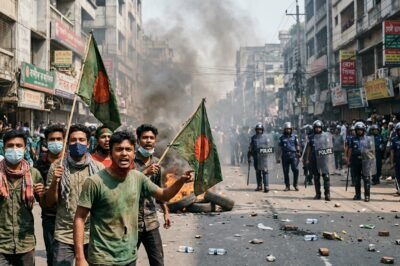
The streets of Dhaka, once the vibrant heart of a nation striving for economic parity, have transformed into a theater of volatility and blood-soaked unrest. As the news of former Prime Minister Sheikh Hasina’s potential return from exile in India filters through the narrow alleys and sprawling suburbs, the fragile peace maintained by the interim government is shattering. For weeks, the air has been thick with the acrid smell of tear gas and the rhythmic chanting of thousands of protesters, whose demands for justice for the victims of the July uprising have now evolved into a fierce resistance against the return of the Awami League matriarch. This is not merely a political transition; it is a profound existential struggle for a nation that finds itself caught between the ghosts of an autocratic past and the uncertain promises of a democratic future. The stakes have never been higher, as every clash in the streets echoes the deepening polarization of a society that is grappling with trauma, systemic corruption, and a desperate hunger for fundamental reform.
The current landscape is defined by a visceral reaction to the legacy of the previous administration. Sheikh Hasina, who led the country for over fifteen years, remains a deeply divisive figure whose departure in August was seen by many as a second independence. However, the vacuum left in her wake has been filled with shifting alliances and a resurgence of radical elements, leading to a precarious security situation. Reports of targeted killings, clashes between rival political factions, and a breakdown in local law enforcement have painted a grim picture of a state struggling to maintain the rule of law. As the interim government, led by Nobel laureate Muhammad Yunus, attempts to stabilize the economy and reform the judiciary, the specter of Hasina’s return threatens to undo months of painstaking progress, plunging the nation back into the cycle of vengeance and retribution that has plagued its political history since inception.
The Catalyst of Unrest: Examining the Recent Surge in Violence
The recent spike in fatalities and injuries across major urban centers like Dhaka, Chittagong, and Sylhet can be traced back to a series of provocative statements from the exiled leadership. Supporters of the Awami League, emboldened by rumors of a coordinated political comeback, have increasingly clashed with student-led groups and members of the Bangladesh Nationalist Party (BNP). These encounters are rarely peaceful; they often involve improvised weapons, heavy-handed police intervention, and a tragic loss of life that further fuels the fire of public indignation. The violence is not localized but has spread to rural districts, where land disputes and local power struggles are being reframed through the lens of national political upheaval.
Statistics from local human rights organizations suggest that the death toll since the transition has continued to climb, with hundreds of activists currently detained and thousands more injured in street-level skirmishes. The role of the security forces remains under intense scrutiny, as the police force—once seen as an extension of the Awami League’s power—struggles to regain the trust of a skeptical public. The lack of a clear mandate for the use of force has led to a paradoxical situation where either excessive violence is applied or there is a complete absence of authority, allowing mob justice to prevail in several high-profile incidents of public lynching and arson.
The Shadow of Sheikh Hasina: Political Ambitions and External Pressures
From her current residence in India, Sheikh Hasina remains a potent force in Bangladeshi politics. Her supporters argue that she is the only leader capable of preventing the country from sliding into religious extremism, while her detractors point to her long record of human rights abuses and the suppression of dissent. The tension is compounded by the complex diplomatic dance between Dhaka and New Delhi. India, which had a close strategic partnership with Hasina’s government, now finds itself in a difficult position, balancing its long-term security interests with the need to engage with the new interim administration. The presence of the former Prime Minister on Indian soil is a constant source of friction, with many in Bangladesh demanding her extradition to face trial for crimes against humanity.
Legal challenges against the former Prime Minister are mounting. The International Crimes Tribunal (ICT) in Bangladesh has issued warrants, and the interim government is under immense pressure from the families of those killed during the student protests to ensure she faces a court of law. However, the prospect of a high-profile trial is fraught with danger, as it could serve as a rallying cry for her remaining loyalists, potentially triggering a nationwide civil conflict. The narrative of her return is being used as a psychological weapon by both sides—one side using it to instill fear of a returning autocracy, and the other to maintain hope for a restoration of the old order.
Economic Fallout: Disruption in Supply Chains and the Garment Sector
Bangladesh’s economy, which is heavily reliant on the Ready-Made Garment (RMG) industry, is reeling from the persistent instability. The RMG sector accounts for over 80% of the country’s export earnings and employs millions of workers, mostly women. The ongoing protests have led to the frequent closure of factories, disruptions in the transportation of goods to Chittagong port, and a significant drop in international buyer confidence. Major global brands are reportedly shifting their orders to competing markets like Vietnam and India, fearing that the volatility in Bangladesh will lead to supply chain failures during peak retail seasons.
Key economic impacts include:
- Foreign Exchange Reserves: Continued depletion as exports falter and remittances face irregular channels due to banking instability.
- Inflation: Essential commodity prices have surged as supply chains break down, disproportionately affecting the urban poor.
- Investor Confidence: Foreign Direct Investment (FDI) has reached a standstill as corporations await a clear roadmap for the next general election.
- Infrastructure Damage: Protests have resulted in the destruction of public property, including metro rail stations and government offices, costing the exchequer billions of Taka.
The interim government is currently in negotiations with the International Monetary Fund (IMF) and the World Bank for emergency funding to shore up the economy. However, these institutions often require political stability and a clear path toward democratic elections as prerequisites for financial aid. Without a resolution to the political crisis, the economic hardship faced by the average citizen is likely to intensify, potentially leading to a new wave of protests driven by hunger and economic desperation rather than political ideology.
Regional Geopolitics: India, China, and the Struggle for Influence
The crisis in Bangladesh is not occurring in a vacuum; it has profound implications for the geopolitical balance of South Asia. China has been a significant investor in Bangladesh’s infrastructure through the Belt and Road Initiative, and Beijing is watching the current unrest with caution, concerned about the safety of its investments and the potential for a Western-aligned government to take power. Conversely, the United States and European Union have been vocal about the need for a transparent transition to democracy, placing emphasis on human rights and the freedom of the press—areas where the Hasina administration was frequently criticized.
The relationship with India remains the most critical external factor. The long-standing security cooperation between the two nations, particularly regarding the insurgency in India’s Northeast, was a cornerstone of the Hasina era. There are fears in New Delhi that a change in leadership could lead to a resurgence of anti-India sentiment and the return of militant groups using Bangladeshi territory as a base. This regional tug-of-war complicates the internal reform process, as domestic political actors are often perceived as proxies for foreign powers, further delegitimizing the democratic process in the eyes of the youth-led movement.
The Role of the Interim Government and Legal Challenges
The interim government under Muhammad Yunus is tasked with the monumental challenge of state-building while navigating a minefield of political traps. One of the primary demands of the student coordinators is the complete overhaul of the judicial system and the Election Commission to ensure that future polls are free and fair. However, the process of ‘purifying’ the administration has led to its own set of problems, including administrative paralysis as many seasoned civil servants have been removed due to their previous ties to the Awami League. The legal system is currently overwhelmed with thousands of cases related to the previous regime’s corruption and violence, leading to concerns about the quality and impartiality of the trials.
Furthermore, there is a growing debate over the duration of the interim government’s tenure. While some political parties, such as the BNP, are calling for elections within months, the student leaders and civil society groups argue that the state must be fundamentally reformed before any vote can take place. They fear that a premature election would simply return the same corrupt structures to power under a different name. This tension between the need for immediate democratic legitimacy and the desire for long-term structural change is the central dilemma facing the Yunus administration today.
Future Implications: A Path to Democracy or Perpetual Instability?
The coming months will be a defining period for Bangladesh. The potential return of Sheikh Hasina serves as a litmus test for the resilience of the nation’s institutions and the resolve of its people. If the government can successfully manage the security situation and provide a clear, inclusive roadmap for reform, there is a chance for Bangladesh to emerge as a more robust and transparent democracy. However, the path is fraught with significant risks. The possibility of an escalation into full-scale civil conflict cannot be ignored, especially if the economic situation continues to deteriorate and the political polarization deepens.
Ultimately, the resolution of this crisis lies in the ability of the various stakeholders—students, political parties, the military, and the interim government—to find a common ground that prioritizes the stability and prosperity of the nation over individual political ambitions. The international community also has a role to play by providing the necessary economic support and diplomatic pressure to ensure that the transition remains on track. For the people of Bangladesh, who have shown incredible courage in their pursuit of change, the hope is that the sacrifices of the past will finally lead to a future where the rule of law prevails and every citizen has a voice in the governance of their country.

































Leave a Reply